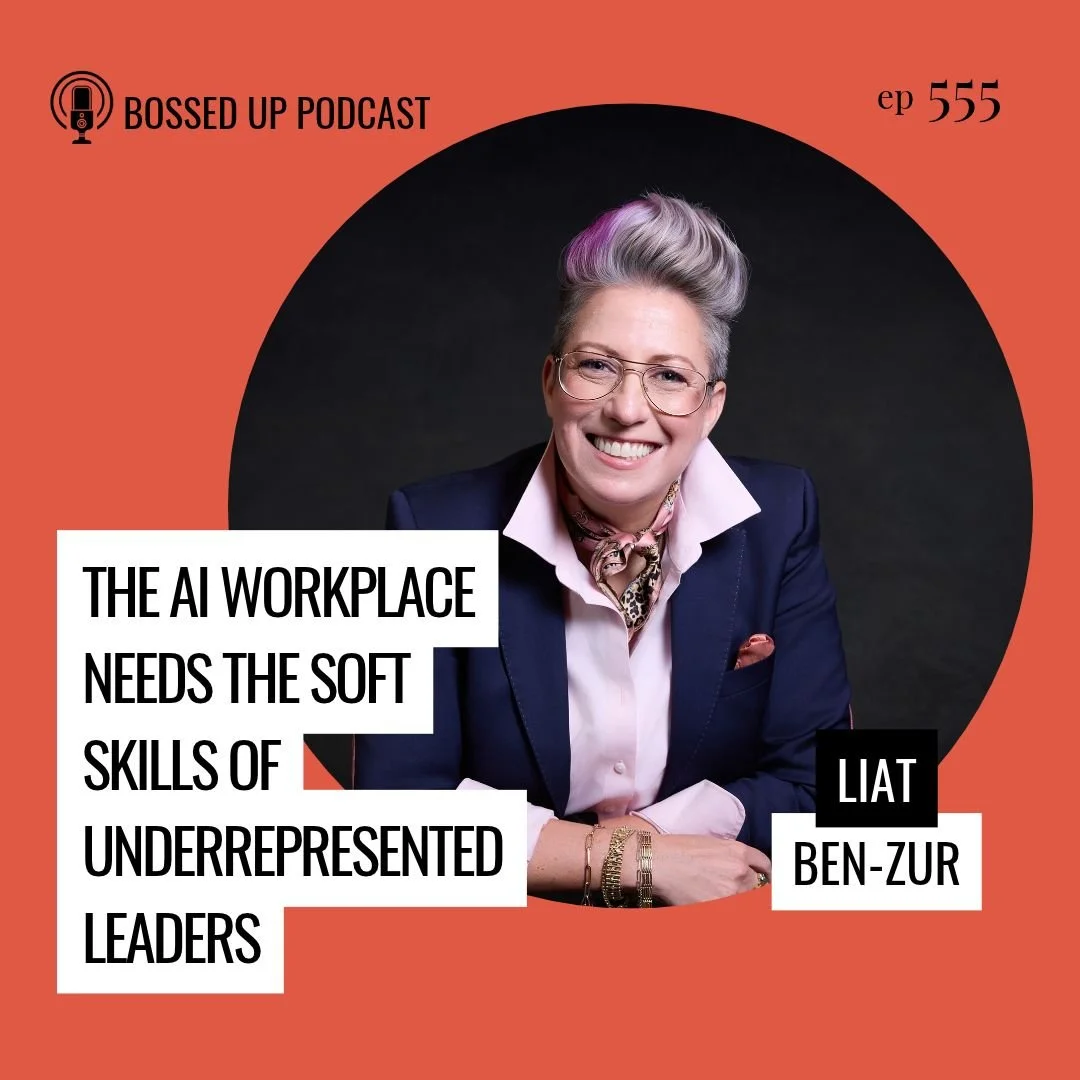
Episode 555 | Host: Emilie Aries | Guest: Liat Ben-Zur
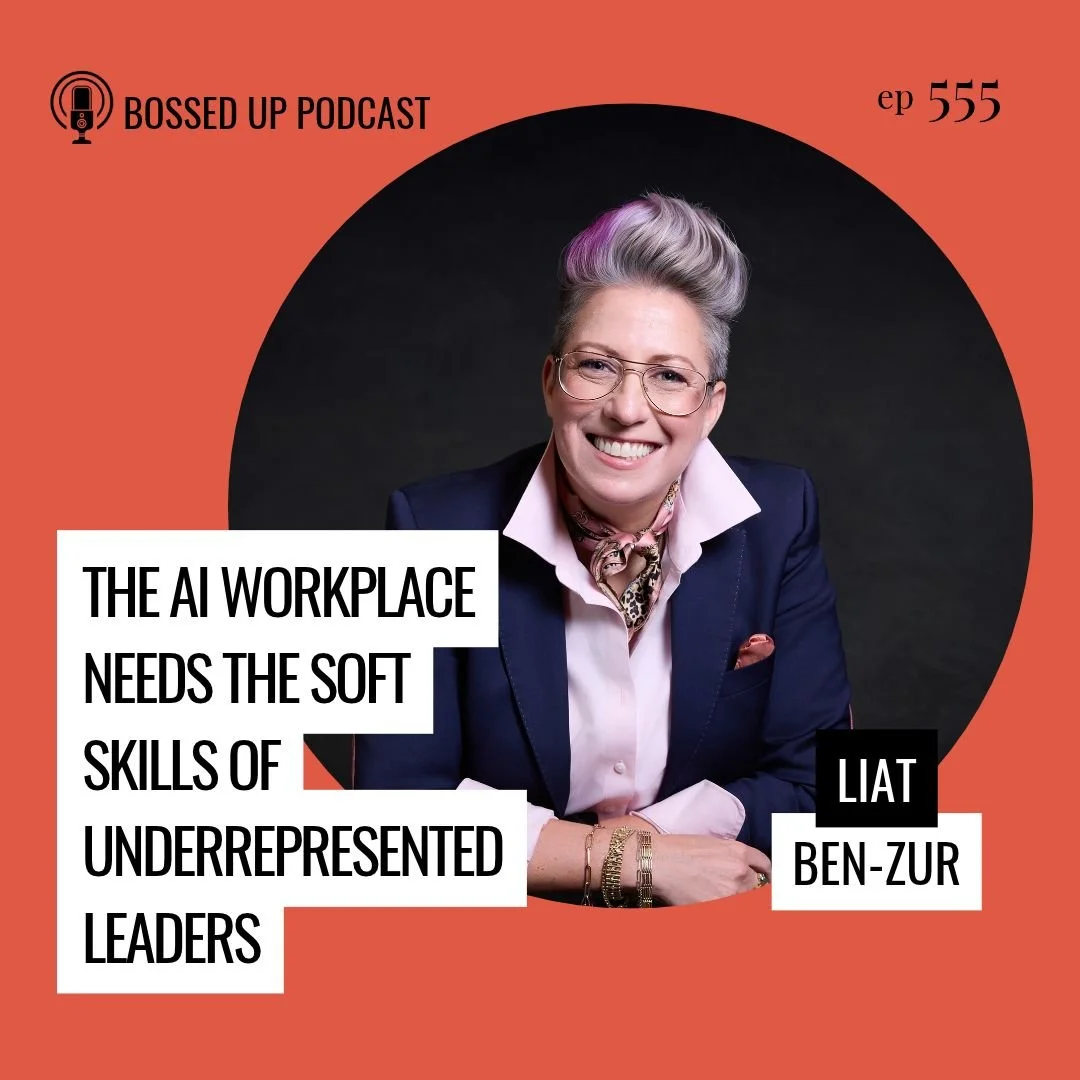
The skills you built as an underrepresented leader make you the best hope for our AI-dominated future.
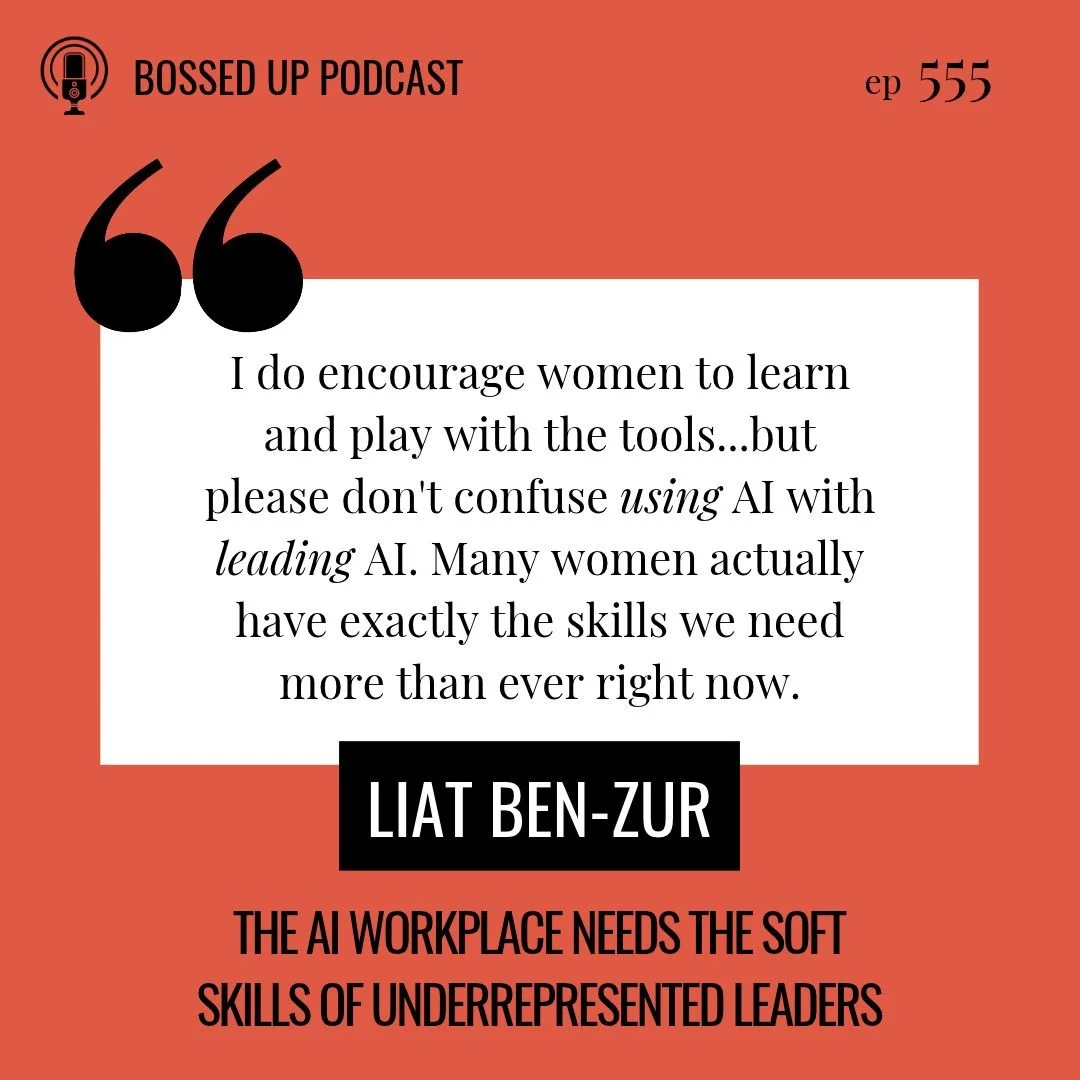
Like so many women, you may be no stranger to fighting your way up the leadership ladder. Being the only face or voice like yours in the room, spotting discrepancies more experienced C-suiters miss, and weighing speaking up against keeping your job. Scenarios like these might be a dime a dozen in your career journey, and Liat Ben-Zur believes those very challenges are what make you and other underrepresented people ideally positioned to lead as AI continues to expand through the modern industrial complex.
Decades of helping global organizations drive billions in revenue set Liat Ben-Zur up for success as the CEO of LBZ Advisory, where the tech leader and strategist turns AI disruption into a competitive advantage. In recent years, as she watched AI become increasingly vital to business, Liat began to see a pattern. Those who struggle are the leaders who built their authority on control and expertise. The ones who can’t fathom the old ways being updated and replaced. Against expectation, perhaps, the leaders succeeding (and improving their companies) are those who can adapt to ambiguity, willingly question data, and keep an eagle eye out for the downstream consequences of lofty decisions.
In response to this discovery, Liat wrote The Bias Advantage: How Unconventional Leaders Gain Power in an AI-Driven World. She joined me to discuss this trend and why it’s time to amplify the skills you learned in obscurity.
Why future leaders don’t need a background in tech
In addition to worries about the negative impacts of AI reliance, a lot of women tell me they are concerned about their lack of technical knowledge. But Liat doesn’t see that as a drawback. We need people of all different backgrounds, people from the margins, who are accustomed to unconventional leadership, she explains. The technical, model-building issues facing AI, the ones that call for computer scientists and developers, those are all pretty well handled. Companies can buy those services. What they need in-house are people skilled in organizational design, trust, and accountability as they usher in this new age.
AI can solve a lot of business problems. The most critical skill for leaders now, is being able to think through which business problems deserve to be solved. What data should and should not be used, what as-yet-unforeseen blowback could result tomorrow from the decisions made today. It’s easy to assume that technical fluency could prevent these oversights, but Liat has seen more than enough to know that’s not the case. Many women, she stresses, as well as other marginalized leaders, have exactly the soft skills organizations need right now.
The distinctly human skills we need
Liat identifies two essential abilities AI can’t recreate that are more important than ever as modern businesses strive for growth. The first is judgment under uncertainty. AI is not infallible. We need human beings, human brains, to consider the boundary where trusting the machine stops making sense, and challenge it when necessary. Not because we fear AI taking our jobs but because while the outputs are objective, based on mathematical equations, the data used to get to those outputs often is not. Humans need to decide what AI instructions to accept and reject, and ponder the tradeoffs that come from those decisions.
Then there’s pattern sensing with ethical radar. Empathy is paramount, but Liat isn’t just calling for bleeding hearts and kindness; she wants the kind of empathy born of an ability to identify forthcoming impacts before a year of collected data highlights them. That ability is born of living those impacts and seeing firsthand the damage they cause down the line.
People who have built “a muscle to survive, to prove themselves in the room again and again” ask the questions others aren’t asking because they see what those more privileged have never experienced.
The proof is in the data set
Results might be objective, but all too often, the data used to reach the result is a proxy for the real thing. Liat gives the example of a particular healthcare algorithm. The program was designed to prioritize patients based on the likelihood that they would require extra care, yet it consistently placed black patients at the back of the line. When the data set used to train the algorithm was examined, it became clear that the programmers had used the amount of money each demographic spent on care as a proxy for how much care they needed. In other words, people who could afford to spend more on healthcare were identified as more in need of care. It doesn’t take a degree in computer science or medicine to identify the problem in this assumption, but it does take a human.
A different lens on DEI
Like me, Liat worries deeply about the ongoing gutting of DEI initiatives across the country, and she highlights that her concern is about more than diversifying opinions in global boardrooms. It’s about looking at diversity, equity, and inclusion from a business performance lens as well as a human rights one.
The potential for AI bias in hiring
There are many people in the pro-DEI space who argue for the potential benefits of using AI for hiring. A program that compares a job posting’s required expertise, education, and other vital skill sets to applicants’ resumes could go a long way to weeding out bias. Applicants would be shortlisted based on merit alone.
But Liat explains that this, too, can go wrong if human beings aren’t examining the inputs and outputs. If, for instance, a program uses past employment successes to identify the most likely candidates, it is working from a biased data set that does not truly consider the merit of potential hires, simply the merit of potential hires who match previous hires.
Companies often don’t have access to the data sets on which their programs are trained; they are buying software designed by third parties. In her work as an advisor and in The Bias Advantage, Liat encourages the support of the startups who are building these impressive programs helping businesses scale in finance, legal, marketing, and so many other areas (and, she insists, are likely to increase jobs in the future, not eradicate them).
The solution in cases like this and so many others is not to throw out AI altogether. Rather, Liat argues, it’s to train, seek out, and raise up the workers and leaders that will identify these shortcomings and push to improve the systems. She points out that the kinds of people who will notice discrepancies like past hiring biases already exist in most companies. We need to stop fearing dissent and skepticism and instead encourage and amplify these unique, unconventional voices. Even if thinking about embracing AI grosses or freaks you out, like I explore in Episode 542, Why AI is Giving Women the Ick.
AI both frees and up and takes up our time
Thinking critically, talking things through, raising our hands to dissent; these are vital parts of a healthy transition, but they take up time in an environment that seems to be all about who can move the fastest. Liat says striking that balance with our time is something we need to figure out for ourselves as we move through it, and she acknowledges her own contradictory experience.
Like so many people delving into the possibilities of AI, Liat assumed automating processes in her daily life would free up time. What she quickly realized was that AI had the potential to turn her wishlist for her whole career into something doable this year, or even this week. Rather than taking things off her plate, suddenly so much more was available right now. Where she once focused on one or two big projects at a time, now she could run a dozen simultaneously.
That isn’t sustainable, however, and she began skipping the reflection and fine-tuning, the essential parts that we risk getting worse at if we stop practicing then. Liat made the conscious decision to slow down. Now, she spends thoughtful time discerning which projects AI is best suited to help her optimize and makes sure to keep them meaningful and authentic through reflection. In time, you will find your way to both slow down and speed up with AI, she says. Yet another distinctly human consideration that makes women and other marginalized leaders so essential in this mechanized race to the top.
“We need you,” Liat urges. “Get in here.”
My conversation with Liat highlights what I continue to see from the women and companies I engage with: a tension between us, the world of work, and the ever-encroaching role of AI. So, I want to know what you have to say! Come join the conversation in our Courage Community on Facebook or our group on LinkedIn, to share your experiences as a leader (or aspiring leader) in this new age.
Related links
-
[CONFIDENT RHYTHMIC DRIVING THEME MUSIC WITH DRUMS STARTS]
EMILIE: Hey, and welcome to the Bossed Up podcast, episode 555. I'm your host, Emilie Aries, the Founder and CEO of Bossed Up. And today we're talking about what leaders need, what skills we need,
[MUSIC FADES AND ENDS]
what kinds of mindsets and experiences we need to thrive in the age of AI. And in fact, why what makes you something of an outsider? Or maybe what's left you on the margins of the traditional male and pale archetype of leadership to date? Like what sets you apart and what makes you different might actually be your competitive advantage that's more necessary than ever as AI and automation transforms the way we all work together. Joining me today to break this down is Liat Ben-Zur, a transformative technology leader, board director and AI strategist who's driven billions in growth at Microsoft, Philips, and Qualcomm. As CEO of LBZ Advisory, she turns AI disruption into competitive advantage for global companies. She's the author of the new book The Bias Advantage: How Unconventional Leaders Gain Gain Power In An AI Driven World, which examines how AI is changing the rules of leadership, governance and organizational power. Liat, welcome to the Bossed up podcast.
LIAT: Thank you so much for having me. Appreciate being here.
EMILIE: Congratulations on the recent launch of your new book, The Bias Advantage: How Unconventional Leaders Gain Power in an AI Driven World. What led you to publishing this book?
LIAT: Honestly, the book kind of began with a contradiction that I just couldn't unsee. I've spent most of my career leading major technology shifts inside very, very large organizations. And then more recently, you know, I sit on several boards and I do a bunch of advisory work across healthcare and finance and consumer industries. Just very, very different industries, sectors, all trying to figure out their AI transformation. And I just started noticing some patterns. Like the leaders who really struggled with this transformation often were very, very accomplished people whose authority had been built on hierarchy and control, being the person with the deepest expertise in the room. And I noticed that AI was unsettling that and they were getting quite defensive when decisions would cross silos or they'd be really good at optimizing existing processes, but they would kind of freeze when you would question, like, do we even need this anymore at all? Like, why do we do this in the first place?
And then the leaders that were really adapting, I noticed, were a bit different. Like they were able to operate in ambiguity. They didn't just accept data, they would question a lot of the data. They paid attention to, like, the consequences of what was happening both with their product but also with their workforce. They were catching These weak signals really early. And the spark for my book came when I started connecting these observations that I was making as an advisor and in the boardroom with a bunch of private conversations that I was having with leaders that I mentor.
A lot of these are, like, brilliant people who've delivered incredible results, but, you know, often felt underestimated or sidelined. And one of them calls me up one day, and she was just bawling in tears, and she tells me that she was fired after she delivered this major transformation. And I was, like, listening to her story, and boom, all the dots just suddenly connected. And I just realized that when you, when you spend your life, your career, navigating these systems that aren't really built for you, you tend to learn things that the system doesn't formally teach.
Like, you know, she was great at reading weak signals and seeing hidden assumptions, and she would notice things that supposedly the neutral rules, you know, were leaving folks behind. And, I don't know, I think I started realizing that a lot of the experiences that kind of kept these leaders from being seen may have actually built exactly the capabilities that companies need the most right now. And that's. That's why I wrote the book. I just realized AI is absolutely changing what good leadership looks like. But most organizations are still hiring and promoting based off of the old picture, the old playbook. And I wanted to attempt to connect these dots that I was observing.
EMILIE: Yeah, it almost sounds like what you're saying is that the characteristics of leadership have to adapt in, you know, kind of away from the subject matter, expert model, which feels like, for some, I'm sure it feels like getting the rug pulled out from underneath you. You're like, but this is what I've been developing. This is the craft I've been honing my whole career. And for others, this is an opportunity, right? For that. That word unconventional really stands out to me. Like, the unconventional leader can thrive in a new landscape like this.
I'm curious how being an unconventional woman leader intersects with all of this, right? Because a lot of women hear the term, like, AI leadership or just are averse to AI in general more often than men. And they might also feel like I'm not technical enough to do this. I'm not, you know, I don't bring a technology background to the table. So why do you believe that some of the most important leaders of this next decade won't have a background in tech, won't have a background in AI at all?
LIAT: First of all, I think that is one of the most common things that I hear. And it worries me because we need these, not just female leaders, but like all, all different folks, neurodiverse folks, marginalized folks, like people that have kind of come from the margins, the unconventional ones, more than ever right now. And I do hear that a lot. Hey, I'm not technical enough. Here's the thing. The hardest problems right now in AI transformation and all the companies that I've been working with are very rarely technical. They're not model building problems, they're decision problems or workflow problems or trust. They're organizational design problems and they're accountability problems.
And so like, yeah, you know, it's nice if you're a technical expert, but the most critical leadership skill is really being able to think through which business problem deserves to be solved? What data should or should not be used in order to solve those problems? Who could be harmed, who could be left out, what are the second and third order consequences? Whether employees are going to trust the system, why or why not? And then who's accountable when these things do something wrong?
And you know, I do notice that when companies say they want AI leadership, they tend to be confusing like technical fluency with these skills that we're talking about. So I do, I do encourage women to learn and play with the tools, you should, but please don't confuse using AI with leading AI. And I think, you know, many women actually have exactly the skills we need more than ever right now.
EMILIE: Yeah, it's interesting, right, because there's been a lot of talk about how some of the uniquely human skills like emotional intelligence and organizational influence and politics, right? Like office politics will be and have become even more important in this age of like a lot of the number crunching can be automated. A lot of the data can be delivered. In fact, too much data can be delivered. And so it's our job to be really discerning and really thoughtful about, okay, but who needs to be part of this decision making process? And which teams are getting overly siloed, as you've already alluded to?
How do you see successful leaders untangle that knot? Because you're right. To me it always boils down to good management. It's like accountability, clear expectation setting process, you know, clarification, making sure the right decision makers are in the room and trust each other. But how do you see leaders today who are successful at navigating an ever changing workplace? Like what is it that they have going on that you see is working for them?
LIAT: So I think to understand, like, what are the human skills that are really becoming valuable in order to accomplish exactly what you say. I think first, before we even talk about the skills, I think we got to talk about like, how is AI changing our work, how is it changing our environments? And there's like a bunch of shifts that, that I see across every single industry, regardless of where you work.
The first one is that AI moves faster than the org charts. Insight is coming from anywhere and everywhere at all levels. Certainty is getting cheaper, right? Machines can sound very confident. And so if you're working in an environment where in order for a decision to be made it requires 27 reviews, and committees, and handoffs, you're already behind. And AI is challenging that environment. I think all of these changes kind of put a premium on a few very, very specific capabilities.
The first one is judgment under certainty. So knowing when to trust the model, when to challenge the model, knowing how to make decisions when the picture is not clear, when you don't have all the data. Judgment under uncertainty is huge in the age of AI because you're dealing with some very complex and messy systems. And you need to really understand what are you accepting, what are you rejecting, what trade offs are you making?
I think the second big pattern in terms of, like, the skills that we need now is pattern sensing with an ethical radar. Because pattern sensing by itself, AI can probably do better than all of us. But what it's not going to do is it's not going to reliably tell us what's missing from the data set, why the room went quiet, right? Which stakeholders are going to absorb the downside of a supposedly successful decision. And when I say, you know, ethical radar, I think it does require a lot of empathy. And I don't mean being nice. I think people hear me say empathy, like, oh, what does that mean?
EMILIE: Like it's a warm and fuzzy skill, right?
LIAT: I don't mean that, I don't mean that. I mean like the operational ability to anticipate lived impact before the damage shows up in your data. And when you've lived on the downside of bias, you don't just spot harm, you tend to see it coming. You, you anticipate consequences for who gets left out. And this is the stuff machines don't do well, right? When AI is making decisions at scale on who gets a loan, on who gets hired, on who gets flagged, on whose insurance claims gets denied or rejected, you need leaders who are going to sense when things are off even before it shows up in the data.
EMILIE: Yeah, I can just hear how much more important it is than ever to have diverse people in the room, you know, like a diverse array of lived experiences around the table, designing these things and discerning, you know, those consequences and those downsides. Because if we know that the machines are learning through pattern recognition, right. They're making judgments with an incomplete or imperfect data set in some ways, right?
It's like if you don't have people in the room who've lived on the margins in any way, shape or form, it's like you're going to miss those downsides. And recognizing that bias is so key to your argument here. How do we like, not only hone that strength, but own that strength, recognize that as a strength in the workplace?
LIAT: This is kind of the reason I wanted to write the book is I just don't think anyone ever talks about those things as a strength, right? I think like, you know, even when I went and got my MBA, when you're in all the leadership courses, when you're sitting on boards, like, there's all of these, these skills that we kind of associate with good leadership. But it's, it's in the quiet moments where I'm having conversations one on one, conversations with other. And it's not just female leaders, to be clear. Like, definitely, I feel this a lot with, with female leaders, but it's not just female leaders, leaders who share, you know, their challenges of not being seen, of not being recognized. There's a muscle that they have built to survive, to prove themselves in the room again and again, even when they weren't feeling that they were invited to ask the questions that others aren't asking because they just haven't lived those experiences. They haven't thought about that.
And that muscle that we tend to just kind of talk about in, you know, over drinks in very informal ways, is never really discussed as a muscle that we need around AI. But right now there's, there's very literal examples of where this muscle is. I'll just give you, like, a really simple one. I think the simplest example from the book is one of the studies that was done, I think, through an MIT research. But in 2018, there was this gender shades study by Joy Buolamwini and Timnit Gebru. I'm not sure if I say those names right.
EMILIE: Oh, yeah, I have Joy's book here Unmasking AI. Yeah, I was actually going to reference that because it is so illustrative of this.
LIAT: It really is. And so they tested like three commercial gender classification systems and they found a very striking difference in accuracy. For darker skinned women, the error rates of those gender classification Systems was like 35, almost 35%. But for lighter skinned men, the highest error rate was less than 1%. It was like 0.8%. So the same system was being applied to everyone, but the error rate for darker skinned women was significantly higher.
And then they found out that two very prominent facial analysis benchmark data sets, like the data sets that you use to really train and teach your, your, were overwhelmingly lighter skin. So like almost 80% were light skinned in one and 86% were light skinned in the other. And so we need to be careful not to confuse consistency with fairness. That AI system by itself was consistent. It wasn't broken, it was doing what it was designed to do. But it was designed with data that inherently.
EMILIE: Yeah. And it doesn't require any malicious intent, right?
LITA: That's right.
EMILIE: Joyce kind of explains in her book how, look, a lot of these data sets come from the Internet. It's just like there's an overabundance of white faces on the internet, right? Because there's more white, white people on the Internet. And so like you're going to get a biased sample that then has significant ramifications for things like facial recognition or gender recognition. What are some of the consequences of that, right? Like thinking through where these tools are being deployed. I'm thinking like, security concerns, like people being flagged as suspicious by a robot, by a machine. ICE was using facial recognition, right? To try to decide whether they should throw you in a caravan and haul you away or not.
LIAT: And look, I, my job is to help companies leverage AI to accelerate their business, to grow their business. I am a huge proponent of leveraging AI. The question that I bring is how and are we doing it responsibly and are we bringing the right leaders to ask these questions? Because I do think that it could help us at a societal level in so many ways. In security, in health care.
But like, here's an example in healthcare, what happens when it goes wrong too. This was also an example in the book. It was an article that was published in the Journal of Science, I think around 2009. But there was a widely used healthcare algorithm that was designed to flag patients who needed extra care management. But for some reason it consistently pushed black patients to the back of the line. And when they looked into it, what they realized is that the developers used healthcare spending as the proxy for healthcare need. So when you think about it like, that's not such a crazy idea. You can understand why maybe the developers were thinking about using that as a proxy. But obviously, you know, there's a huge…
EMILIE: Socioeconomic, like, blind spot there.
LIAT: …huge blind spot there.
EMILIE: Yes, yes.
LIAT: And a lot of, you know, black communities actually are spending less, not because they need it less, but because they couldn't afford it. And so massive hole on the data, massive gap. And it required someone to ask the questions. Like, again, the algorithm was doing what it's supposed to do and there was no mal intent. But,...
EMILIE: But it has bad consequences,...
LIAT: …massive consequences.
EMILIE: …if not highlighted. And I do think there's such a critical role for the human being in this process to be the one to ask those questions. I worry about the gutting of DEI in this context, right? Because we're, we're rapidly incorporating these swift moving technologies, which are great and so productive and so effective and so efficient in some ways.
And some of the, like, vehicles for sourcing those questions, for giving people cover, for raising their hand and asking those tough questions, that cover has like, evaporated in a lot of organizations where it feels like even asking about race or gender is off limits in some places now. What do you make of that and how might that impact technology's ability to bring more diverse stakeholders around the table?
LIAT: I deeply worry about that. I’m deeply worried about that for all of the reasons that I articulate in the book of why it's needed. But I think we need, you know, my aim is to also shift the conversation to the business performance lens of this, which is these are very hard examples of why it's not just like, I want diversity in the room for the sake of having different opinions, but when it comes to AI, AI codifies systemic biases that may or may not be in the data that it ingests to train, to learn.
And so it's one thing if you have someone on your team that makes like, bad decisions and, you know, rejects certain people from healthcare or from being hired. It's another thing when an engine that then gets used by 75 other companies accelerates and scales that bias. It is more important than ever to have the right people asking these questions and not to just accept, you know, what's coming out of these machines. Which, by the way, gets presented with a lot of confidence, right? Like, there's no lack of confidence.
EMILIE: Can we talk about the Dunning Kruger effect for a moment? In case folks aren't familiar with this concept of like, and I think I'm getting, I hope I'm getting that term right. But it's this idea that AI can make dumb people more confident. This idea of, like, you might not have subject matter expertise, you might not have deep, you know, deep experience in a certain domain, but the use of AI can create a false sense of unwarranted confidence among folks who are proceeding kind of blindly accepting what the AI is spitting out.
And, I mean, I've seen that happen to myself. Adjusting baking recipes at high altitude, and I proceed like it's, or I'm preparing to proceed like it's all definitely right, when I notice, wow, they've just completely introduced a new ingredient to my recipe for no apparent reason, Claude, what's going on here? So I do think scaling bias technologically is one thing, but then scaling confidence like that is not warranted is another effect that we're seeing in the workplace. Do you see that happening, too?
LIAT: So there's two, I think there's two really important aspects to that trend that we need to be wary of. And I, and I speak to this also. One is making folks sound confident that, yeah, that that's just based off of some superficial AI is a dangerous thing. And the flip side of that also is people that actually do have a lot of expertise in an area and depth in an area over time, when you rely on AI too much, there's also research, research that shows that it atrophies your brain.
And so you, you're not you. It's a muscle. If we don't use the muscle, the muscle gets tired. And so I think, again, like, it goes to finding people who can lead AI who care about these things and are going to have the skills to ask the right questions and challenge and, and ensure that there's accountability in areas where I think others might not. When you've experienced bias, you become exceptionally good at detecting it. You notice when the corporate story doesn't match the lived reality on the ground. And you will say it, you notice things like who's missing from the table, whose behaviors are being judged harshly, whose data, therefore is also missing. You notice which supposedly neutral rules keep producing unequal results.
You learn to read the room, including, and this one's a really big one, what's not being said, right? I think you, you probably can relate to that. And, and you're also paying attention to which groups of people are paying the price when the system gets it wrong. And that could be internally, it could be employees, it could be stakeholders. It could be cohorts. And that matters so much right now because AI bias is hiding in something that looks mathematical and objective.
And like, you know, when early in my career, it's one thing for me to challenge someone else who has an opinion and they invite challenge. And so even as a junior person, when there was a leader, someone else that, you know, said, hey, we should go down this path instead of this path, you feel like you are assuming you have a little bit of courage, you, you feel you have the right to, like, I can challenge that. It's another thing to challenge…
EMILIE: A system, yeah.
LIAT: …a machine where there's score scoring and ranking and algorithms and math. And that shuts down a lot of conversation because a lot of people are like, who the hell am I to question all the crunching?
EMILIE: Yeah, well, it's tricky too, because I think of the hiring example, I think it's a really good one for us to play with for a moment because creating hiring rubrics and creating a more mathematical approach to hiring is one of the solutions to bias presented by a lot of DEI experts saying, look, like, try to take the subjectivity out of it if you can, and let's come up with the key skills we're looking for and rank their relevance to this role and find a way to codify, to minimize human subjectivity.
But then that argument taken too far, can almost like bring you back to where you started from. If we over rely on a mathematical algorithm of sorts, it can kind of blind us to the human subjectivity that's important, which is like discerning and critical thinking and, and making sure you're seeing what that rubric didn't account for when you have candidates before you.
LIAT: I do think it comes down to like, really analyzing that rubric or like for all of these things, whether it's for hiring or for healthcare, or for financial decisions, loans. Like, again, I don't think the answer is we're not allowed to use AI. It should only be humans. I think the answer is, do we have leaders who can recognize the texture of bias, even when it's wearing a lab coat, even when it's coming across as like very formalized, you know, math and numbers and you know, they need to be asking questions like, what is this model actually optimizing for? What proxy are we using for the thing we actually care about? Where does the accuracy fall apart for specific groups? Who has authority to overrule some of these decisions? Like,...
EMILIE: That's a really good question.
LIAT: …yeah, I mean, I worry that in this, in this age, bias is going to stop sounding like opinions and it's going to start sounding like fact, which is why these leadership skills are so important. But I also worry that we have too many conversations that create so much fear that then people say, oh, you shouldn't use AI at all. That, that is not the case. You can codify, you can accelerate, you can. But you need folks in the room who are asking these questions.
And if it's like on the hiring example, if a big part of the training data is all of the past hiring successes, then we need to ask the question of what is baked into that past hiring success. If it's, well, most of it has been males or certain, most of it has been females with certain experience. Like, how might that bias our algorithms? What do we need to look at to counterbalance that? If that's something we don't want, it's possible, it's doable, but it requires leadership.
EMILIE: Yeah. And I feel like at this stage, so many companies are figuring out deployment on a large scale, right? Like there's, they're working with companies who are bringing them the model. And it's not like those companies who've been contracted in are really presenting their entire data set under the hood, you know what I'm saying? So when, when we're saying that people need to ask those tough questions, what assumptions are baked into this algorithm? That can feel pretty difficult, I think, when your company is being, is just a client of some big AI deployment organization.
And so I'm wondering, like, how we encourage everyone, regardless of seniority, to be willing to ask those tough questions. Even if the person delivering an algorithm for your company is coming from another company, is like, has been contracted in, it's not homegrown, which I think a lot of that's what we're seeing a lot of right now, whether it's Microsoft or, you know, ChatGPT as, you know, parent company or what is it Anthropic or, you know, those companies kind of are becoming the kingpins, for lack of a better word. And it's sometimes hard to ask them to show their math. So what do you make of those dynamics when you're just an employee on the front line kind of receiving the rollout?
LIAT: Important question. Very important question. Two aspects of that. One is, it's a talent question that I think is important question for all managers and leaders, HR executives, as they think about upskilling, like, what is the talent that we're looking for? And also thinking about developing and training the existing talent. You mentioned exactly one of the skills that you want to encourage, identify, support and amplify in the organization, which is the folks who are willing to ask these pointed questions and don't just accept everything that comes out.
And you have those people in your organization, they may not be at the top, they may be buried, they may be under some middle manager who squelches their voice. But you need to identify those folks and help them, you know, help them, lift them up, help, uh, encourage them, others to learn from them. Like those are the behaviors you want and you also want to train that, you want to train that in, you know, fresh new folks that you hire.
And then the second part of the question, the tactical part, what do you do when you're. First of all, most companies, let's be realistic, most companies are not going to be building their own AI solutions. And I don't encourage them to, I encourage them to leverage the incredible innovation that's coming out right now from all of these AI native startups that are building various vertical solutions. And I'm not even talking about the massive big ones like the Anthropics and OpenAI, I'm talking about vertical solutions that help you in your finance role, in your legal role, in your marketing role, in your sales role.
There's so many interesting AI vertical solutions that transform functions not just to save money and time, but to grow, to help drive growth, that allow employees not remove employees. But if you were to give every employee a set of agents that 10x their capability, you just change the type of role that that employee has. Now they're orchestrators and managers of 10 agents rather than themselves.
EMILIE: I've been joking on the podcast that now we've all gotten a promotion, we're all managers now, whether we wanted it or not.
LIAT: That's right. And whether you're a good manager of a, uh, AI agents is a question, right? That's kind of to my book of what does good management look like? And so you need to work with these vendors, you don't need to understand every single raw data of how they train or how their black box works, because often they don't even know how their black box works.
But you do need to have very clear guardrails on when you bring something into the company. What are your guardrails? What are your guardrails on accountability, on ownership, on data, on privacy? And there needs to be ownership and accountability where if you're taking in a third party vendor and they meet those guardrails, they have to be accountable if one day, you know, it breaks like there needs to be very clear lines of accountability and guardrails around. What isn't is not acceptable for the enterprise.
And by the way, that changes by enterprise, right? There's, there's ones that can afford more high risk and there's ones that are in highly compliant sectors that cannot and that limits what vendors they're going to pick because the vendors cannot meet those stringent requirements. So be very clear on accountability, on guardrails. All of that is part of the process. And again, that is less about AI expertise and more about leadership.
EMILIE: Yeah. And I come back to the topic of trust that you mentioned earlier and how much trust needs to be present for those things to work, right? For systems of accountability to work, for communication and information to flow without people protecting their little fiefdom, you know? Or just withholding information from other parts of the business, right? There needs to be high levels of trust to elevate that dissent that might emerge and bubble up that people are kind of afraid of saying out loud in some context. So I'm wondering where you see trust and building high trust teams fitting into all of this.
LIAT: Interestingly enough, one of the biggest patterns I see of where AI transformation fails in a lot of the companies that I help, again, very little to do with the tools they choose and they use. They choose so many different tools all over the map. There's not like one thing. And more to do with people mindset, trust, like all the, all the human aspects.
So for example, I'll just give you a very tangible example. All it takes is one senior leader in like middle management to have the wrong mindset to absolutely kill AI transformation because they are going to find every reason why this new AI tool doesn't do what they're used to and all the things that, you know, they feel like it needs to do and they're going to throw 27 wrenches into to slow down the AI transformation or someone who lacks trust on um, their. They're worried that this thing is going to take over their job. They think that they're going to lose their job again, 27 reasons why the AI isn't working. And these things happen kind of quietly and slowly, deep in the…
EMILIE: Passive, aggressively.
LIAT: …passively aggressively in the…
EMILIE: Yeah.
LIAT: …organization. The COO doesn't understand it, doesn't always see it. The sooner you understand who those folks are, that's what you need to change. You need to change out the wrong m mindset. This is not about firing 20% of organizations. Quite the contrary. I actually think AI will grow employee opportunities. But it requires a different mindset.
So if your mindset is to be protect protectionism of what you used to do, AI is going to change what you used to do, the tasks will change. But if you have the mindset to now recognize that you're going to oversee 20 of these things and get to ask different questions, you got to manage things. You got. It's going to create new problems that you didn't have yesterday because now there's new regulatory or, you know, complexity. Those are the problems that you're going to lead, that you're going to run. The people that don't have that mindset, that is what stops successful AI transformation. They're all over the place. They're in your organization. As soon as you remove those, it is amazing how many people are curious and they want to learn and they, and they want to try these things out.
EMILIE: I think there's some people who are in that camp listening right now. So I think one of the biggest things that you've identified in your work and I've certainly seen here is just women are overwhelmingly more skeptical of AI than men. And I worry a little bit. I'm not on the like, women are going to be left behind panic brigade, but I do worry about this binary thinking of it's good or bad and so any tool has an inherent normative value.
LIAT: I do too. I deeply worry about that.
EMILIE: Yeah, it's like it's all can be used for good or evil. And so when I hear my little Gen Z, little sister, you know, say there's no feminist case forever using AI, I'm like, hold, pump the brake, sister. You know what I mean? Because.
LIAT: So that worries me. That is exactly. And the reason I really want this book to get out is I want women to see themselves as needed and required leading this AI revolution because it's going to happen with or without us. And right now I do worry that we get left behind. I do worry that what AI does is it's going to increase the gap between the have and have nots. And I want women and marginalized folks and, you know, all the unconventional leaders that are out there to not be left behind. And not just because I don't want them to be left behind, but because I actually think they have the skills that will make AI better for all of us, for society.
EMILIE: Totally. And that's what I love about your argument, is that it's, you know, being a woman or an underrepresented leader is actually a competitive advantage in this moment. And I love that argument. I think it so speaks to healthy dissent, to all the things that good DEI was always designed to deliver. Which was better decision making, right? Like, more representation at the table to inform a dialogue. Not because it was warm or fuzzy or nice or inherently better, right? But because it's. It's about making the best decisions, or products, or solutions, or what have you for the world. And so I want everyone listening to just check your inherent, like, the ick factor. I did a podcast episode on, like, Why Ai Is Giving Women The Ick.
LIAT: Oh, gosh.
EMILIE: Based on Abi Awomosu’ Substack on this. I don't, I don't have a book of hers in front of me, but, you know, underrepresented voices who are also influencing the technology conversation around AI is how we're going to make sure this doesn't just ruin our world, right? And that it actually becomes a benefit to us all. So I think that's such a strong argument. Liat, I'm so glad you're shouting it from the rooftop.
I have one more question about all this for you. I've been thinking a lot about the time it takes to be willing to have those conversations, to pump the brakes, to raise your hand, to be a critical thinker, to ask yourself who's not being included in this or what decisions, like, what assumptions are underpinning these decisions, and how that requires some really slow thinking and mindfulness and discernment. And that feels antithetical to, like, the ever increasing pace of work that AI is enabling.
So I don't know if this comes up for you, but I'm trying to hold those two things as somehow a paradox. It's like, we can move so much faster with AI, but the kinds of skills that are more important, critical thinking, discernment, and better decision making, takes thinking slow. So how does a leader who's like, trying to be a productivity engine proving herself on a hamster wheel, how do you make time for thinking that, that way?
LIAT: I want to say that we are figuring that out in real time. And it is exactly those folks who even ask the question, who even think about the importance of reflection and slow thinking, they need to be in the room. And so let me give you a very just, you know, tangible example. When I started on my own AI journey, my understanding of what this technology means is it's gonna, like, free up all my time. Like, I'm gonna be able to kick off all this stuff, and all of these things are gonna, like, run all these processes for me, and I'm gonna go and have a brownie.
I quickly learned, and the more I experimented. And by the way, I learn every single day, like, whatever answers I think I have today, I learn new answers tomorrow that may reflect those learnings. The more I experimented and the more I learned and the more I automated and the more I was using all of these tools to redefine my entire workload, the busier I got. I mean, it was crazy. It felt like I went from a feeling of like, these are all the things I wish I could do for myself, like, my goal wish list for my career, for my personal whatever. Of these things, I, as a executive who's pretty good at breaking things down, these are the doable things, and these are the things I'm going to get done today and tomorrow and then the next week, and I'm going to focus on this. I went from a world where I live there to a world where I said, these are all the things that I want to do for my career with AI. These are all the things I can go do today. Like, oh, my god. And so what happened was I started doing so much more with AI in parallel. Like, like, I'm, you know, I'm writing a book, I'm building multiple businesses, websites I'm advising, I'm doing.
EMILIE: So your goal post internally moved you, your expectation for yourself increased.
LIAT: Your goal post move, your, your to do list, your roadmap, everything just double expands and it feels almost like it's an infinite thing that you can keep doing. Now, as this started happening, there's other, like, interesting psychological things that happen, which is, I started realizing, oh, my god, I'm doing like 20 really big projects in parallel. My brain cannot process this. I am not having the downtime to reflect the way that I used to reflect when I ran one big business or one big project. And then I started thinking about how to do that, you know, where, what, what I was going to drop, what I was going to focus on and how to like.
And I would spend time reflecting on the lessons that I've learned, playing with it, helping my. I do a lot of writing on LinkedIn. I have a blog on my website LBZadvisory.com where I share the insights from the things that I'm learning. I, I try to, you know, make it a little bit more generalized and, and protect all the innocent. But I share the lessons and that's my reflection for others. You are going to find your way of how to slow down and speed up at the same time. There's probably no recipe yet. I Think everyone who's deep in the AI world is kind of feeling this weird thing of like, we're running so fast and our brain isn't even, uh. But you have to manage that for yourself. And again, I want to emphasize the skills that, uh, the muscle that you've developed as unconventional leader who's had to fight and earn your way into those rooms are exactly the muscle that's going to allow you to ask these questions, to pause, to reflect, to wonder. Wait, wait, wait, wait, wait, wait, wait. Something's not right here. To smell it before it comes. And we need that. We need that more than ever. So please, please don't feel intimidated. Play with some of the stuff. And we need you. Get in here, get into the arena.
EMILIE: I love that. And I keep saying to business leaders, like, don't see skepticism as a bad thing. Like, these are the people who can sense. Who are your canaries in the coal mine.
LIAT: That's exactly right. That's literally. That's in the book. I say that
EMILIE: Exactly. It is discernment and I love that. But it's, it's comforting to hear that you have that kind of headache inducing experience that I have experienced as well. You're like, I have more aspirational planning than ever before where I'm like, yeah, I can do it all. What is your personal preference for reflection time? You talked about blogging and. But even that's in LinkedIn, that's producing content of some kind. So what is, what is like, deep reflection?
LIAT: For me, it's writing. Like, by forcing myself to write, I force myself to reflect, and by writing, I force my reflection to get crisper. So sometimes I can lay in bed or I can, you know, I can spend some quiet time and I'll have ideas, but those ideas are like fluffy clouds floating in my head. To get them from fluffy clouds to like, pointy concepts, I need to write. I need to write. And like, that helps me.
EMILIE: That's such a great point. And for context, for those listening, you've got two teenagers at home too, right? So it's not you got a lot going on, not just professionally, but also personally.
LIAT: They keep me on my toes. They to be honest, they remind me why I'm wrong 99 of the time.
EMILIE: Kids will do that, won't they? That's helpful. I love that so much. Liat, thank you so much, so much for sharing so much of your journey and for the argument that you make that's central to this book. Where can my listeners keep up with you and your writing and get their hands on a copy of it.
LIAT: Well, you can find me on LinkedIn, Liat Bin-Zur, and then also on my website, LBZadvisory.com. You can also find me on my the same website as liatbenzur.com and the book is called The Bias Advantage. It's available now on Amazon.
EMILIE: Awesome. I will drop links to all of those wonderful resources in today's show notes. Thank you again for being here.
LIAT: Thank you for having me.
EMILIE: For links to everything we discussed today, head to bossedup.org/episode555. That's bossedup.org/episode555.
[CONFIDENT RHYTHMIC DRIVING THEME MUSIC WITH DRUMS STARTS]
And now, as always, I want to hear from you. What do you make of this conversation? There's some tension at play here between women, the world of work and AI and all the disruption it's bringing with it. And I want to hear what you have to say about it. Let's keep the conversation going after the episode. Episode in the Bossed Up Courage Community on Facebook or in the Bossed Up Group on LinkedIn. And until next time, let's keep bossin’ in pursuit of our purpose. And together, let's lift as we climb.
[MUSIC FADES AND ENDS]