Episode 536 | Author: Emilie Aries
What would change if you stopped taking on everything at your organization?
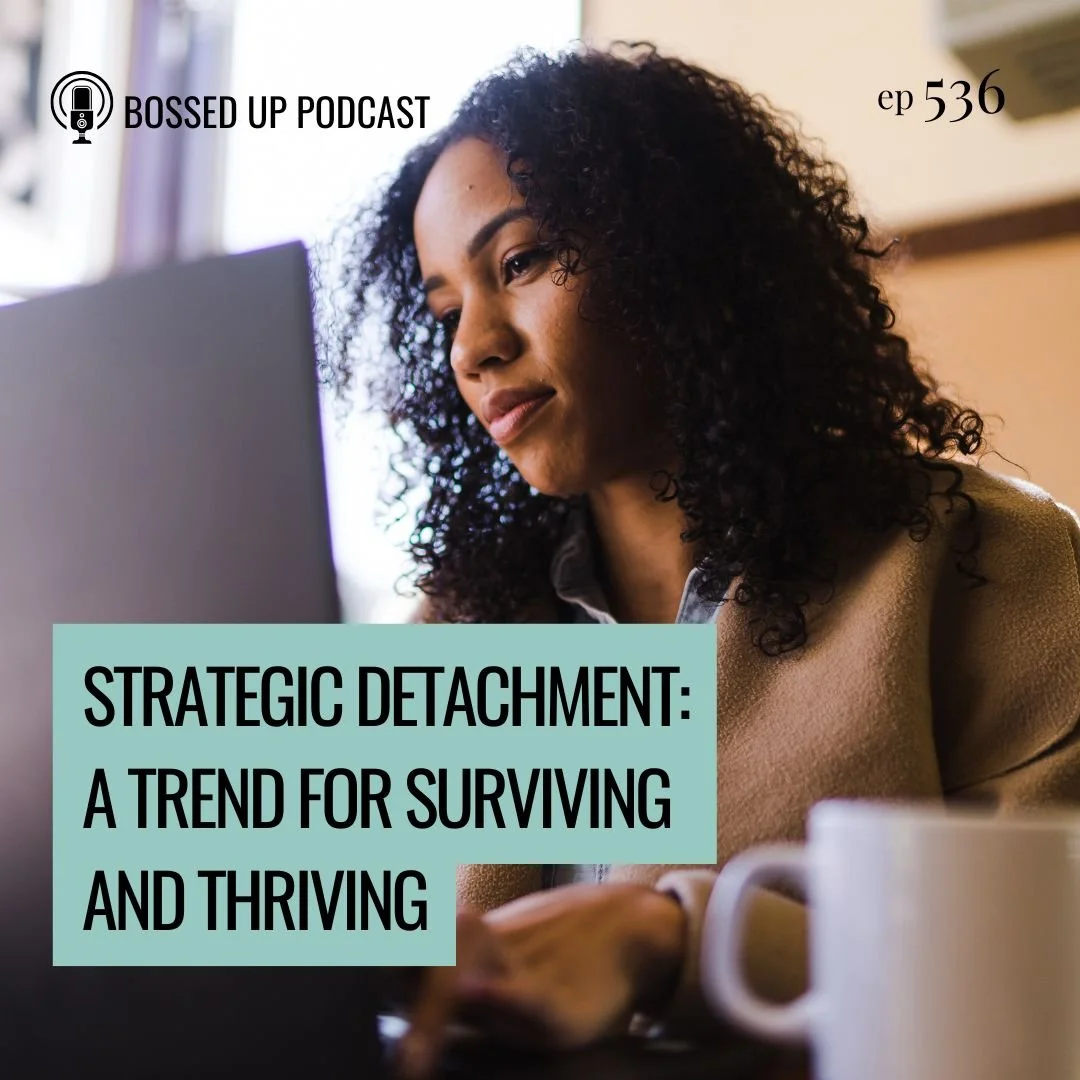
As a recovering perfectionist and overachiever, is it any wonder the workplace trend called “strategic detachment” intrigues me? I’ve adopted a more balanced approach to work and life in recent years, but I know I—and the high-achieving women who listen to this podcast and read this blog—can always use a refresher in what it means to be our best without being absolutely everything to everyone.
Let’s take a look at how strategic detachment can be applied in a workplace context and why it’s so important, especially for team leaders. It might just be the trend we need to survive 2026.
Figure out your driving fears
Strategic detachment isn’t about caring less, or checking out, or quiet quitting. Rather, it’sabout becoming more discerning when it comes to where you engage and where you detach (which is different than disengaging altogether).
If asking you to not do some of the things currently piled onto your plate feels terrifying, consider what might be fueling this over-functioning mentality. All too often, it’s fear. We worry that something bad will come out of relinquishing just a little bit of control—maybe we’re worried we’ll lose our job or be seen as dispensable. Sometimes, it’s the anxiety we know we’ll experience if we aren’t involved in every decision.
All these fears and feelings are valid, but they also deserve closer inspection. How many of the things you’re leaping to agree to and complete promptly are truly urgent? Why is saying “yes” your default?
Take a beat before you take the reins
The knee-jerk tendency to take on a new task is something many of us need to work on. Rather than seeing every request as needing an immediate answer—and that answer being ”yes,” obviously—consider the full time, effort, and urgency implications of the ask. Is it within the scope of your role, your responsibility, or your best use to the team? Does it offer an opportunity to grow, shine, or gain helpful recognition?
And finally: what are the hidden costs (exhaustion, overwhelm, putting off your well-deserved downtime)? Why is your first impulse to say yes?
Unintended consequences for leaders
Let’s face it: there’s a little dopamine hit that comes with being the one who does everything. You’re recognized as the go-to, and you’re kindly taking things off others’ plates.
However, especially for team leaders, weighing in on every day-to-day item comes with some pretty hefty drawbacks.
You’re preventing your team from learning and growing
When you over-involve yourself in the daily workings of the front-line team, you prevent your direct reports from thinking and learning for themselves. If you’re always there to present the solution or answer the question, you might be making yourself indispensable, but not in a good way.
This kind of management creates an environment where, if you quit or had to take a leave tomorrow, your organization would be at a loss. They’d need two or three people to replace you, people who would have to somehow re-source with all the information you were keeping exclusively in your brain. You think you’re being kind in taking on so much, but in doing so, you’re actually creating an organizational dependency.
Leading isn’t about having all the answers all the time. It’s about supporting and coaching the people you lead so they have the opportunities to take accountability and ownership of their own career journeys.
You’re stealing focus from other leadership responsibilities
The other downside to biting off more than you can chew is that all this busywork distracts you from the bigger-picture strategizing. Lost in the weeds of the everyday task list, you neglect the analysis, deep thinking, and innovation you’re uniquely qualified for.
This unintended consequence is relevant to those who aren’t “formal” leaders, too. Even if you don’t have a team to manage, if you’re constantly picking up odd jobs that don’t move the needle on your bigger dreams and goals, you’re missing out on opportunities to level up in your career.
How do you feel about this concept of strategic detachment? If you’re planning to embrace this trend or already practicing its tenets, what does that look like in your day-to-day? Keep the conversation going in our Courage Community on Facebook or join our group on LinkedIn to share your experience with reining in your unbridled overachieving and really honing in on the most impactful part of your work.
Related Links From Today’s Episode:
LEVEL UP the leadership qualities that really count:

-
[INTRO MUSIC IN]
EMILIE: Hey, and welcome to the Bossed Up podcast, episode 536. I'm your host, Emilie Aries, the Founder and CEO of Bossed Up. And one workplace trend that I'm seeing a lot of chatter about on social media lately caught my eye.
[INTRO MUSIC ENDS]
It's called strategic detachment. And as a recovering perfectionist and burnt out overachiever who's found my way to a more balanced life and a more balanced approach to work, this really resonates with me. So today I want to share my take on what strategic detachment is, why it's especially important for leaders of teams, and how it could be the workplace trend that we all need to survive 2026.
So what is strategic detachment? Here's how I think of it. I think it's about consciously deciding where at work you want to bring your A game, your focus, your highest and best use to the company or to the organization. It basically means not defaulting to bringing your A game to everything all the time. In fact, it also requires consciously deciding what you're not going to do to the best possible extent that you could do it. Like what are you going to give yourself permission to go a little easier on or dial it back a little bit? It's about being really thoughtful about where you bring that a game and where you give yourself permission to play a C game.
Strategic detachment should not be confused with caring less because that can be a really futile endeavor for someone who is just a high achiever and deeply cares about all the things, right? This is not saying that you should check out. This is not quiet quitting. This is also not to be confused with Buddhist detachment theory, which is powerful and incredible, and maybe even a little related to what we're talking about. But it's not quite the same, right? Buddhist detachment theory is about not clinging to an outcome.
And what I think strategic detachment is at work is not that necessarily, but rather being very discerning about where you will engage and get very attached and where you will disengage and detach just a little bit. It's not the same thing as full disengagement. It's about being discerning about your limited time, energy and attention. So to practice strategic detachment, you first have to get really clear on what is first fueling your over-functioning to begin with. A lot of us high achievers are motivated by fear. So it can be a helpful starting point to ask yourself, what am I actually afraid of? If I dial it back, if I, if I just relinquish control a little bit what is it that I fear? Am I afraid of being judged by my boss, my peers, my clients? Am I afraid about job insecurity, right? Do I fear being seen as dispensable or anything less than a team player?
Is it a fear about losing control, not having everything done exactly the way that you would like them to be done, or that you would have done yourself? Or is it simply having to handle the anxiety of not knowing, of not being involved with every decision, of losing input and influence, and maybe even a feeling of self importance? Those fears are all valid, but we have to check the facts so that fear is not really steering our behavior.
Is it true that everything that comes across your desk at work is that important? Is every outcome a high visibility, high importance situation? Maybe yes. But if not, I really want you to question and push back on the fears that are driving that behavior. That's just leading to burnout, resentment, and feeling like you're the only one who can carry the team.
It is really easy to just get in that default mode of acting like everything's important and urgent all the time because you're already on a hamster wheel of cortisol that's coursing through your veins. So we have to give ourselves permission to slow down and practice the art of discernment, mindful consideration of the undertaking that we're considering before we jump into action. And as someone whose strength in Gallup’s CliftonStrengths model is an Activator, you know, that can be really hard for people like me who are ready to jump into action and make things happen. We have to be discerning first and say, is this my role? Is this my highest and best use to the team? And is this really my purview? Is this my responsibility? If not, what are the downsides?
And that's another question I think we don't ask often enough. What are the hidden costs of defaulting to doing it all and doing it all yourself? Like what are the hidden costs to this kind of over functioning, perfectionistic behavior at work? We rarely take stock of the hidden costs of operating this way because it often comes with a lot of social praise, right? For doing it all, being the go to problem solver. Question, answer. It can feel really good. But not only can that stress be personally damaging, but it's got broader organizational consequences too. And this is what I talk to a lot of my clients and leaders who I work with about.
A lot of senior leaders I've worked with over the years fall into the trap of over involving themselves in the day to day decision making processes of their operational teams. They're so busy trying to remove obstacles for people, jump in with solutions and answer every question that pops up. Because frankly, it feels good to be of use to people, right? It feels good to have the answers. Gives you a little dopamine rush, a sensation of checking off a box and checking something off the to do list. And helping people feels good. Of course it feels gratifying.
But here's what's actually going on beneath the surface. There's two risks here. One, you're creating an organizational liability. By being the go to person, the singular source of all the answers, you're preventing people from learning and thinking for themselves. This goes back to everything I've ever said here on this podcast about coaching for development for, you know, sort of practicing the Socratic method of inquiry based coaching, which I'll link to a related podcast about in the show notes, right? But when you are not asking questions, but instead defaulting to giving all the answers, it's akin to like holding up the sky for your entire department. If you were to leave tomorrow, if you got hit by a bus, god forbid, or if you won the lottery, that's a better way of saying that, right? They'd have to hire like two or three people to replace you. And you're artificially inflating the company's P&L, right? When you are acting that way by sort of covering for an entire part of the organization, you're overcompensating, creating a liability. And actually in some ways which I know is totally unintentional, you're preventing other people from taking accountability for their own roles and responsibilities.
So I'm not saying that we should shirk any of our own responsibilities and our roles, but we have to be really careful about scope creep from a place of charitable kindness. Because while that all comes from a good place that can unintentionally take accountability away from others. And that's not a kind thing to do, right? To sort of patronize people in that way. We have to, we have to give other people the opportunity to rise to the occasion as well and take responsibility and ownership of their piece of the puzzle.
The second unintended consequence of this behavior is that it distracts you from the bigger picture. This is really relevant for leaders, right? Because if you are down in the weeds and stuck in the day to day operations and over involving yourself, you are likely to be neglecting the bigger picture, the strategic lens, the analysis, the iteration, the innovation that you should be bringing to your team that future orientation, that landscape analysis, right? That ability to see what's on the horizon and prepare your organization and your company and your team for what's next that needs your attention as a senior leader and that does not need the attention of the frontline, day to day individual contributor.
So if you as a leader are overly in the weeds, you're likely to be falling down on the job of more strategic leadership. And so it's again, it's not the kind thing that we think it is to kind of over function and try to be all things to all people. So many leaders I've worked with over the years say, well, I don't really know what else I would do and I have a lot of ideas for how to answer that question. If you're not removing obstacles for your team all the time and answering questions all the time, you could be doing a lot of other things to prepare your team for the future that's coming.
Now obviously this is all really relevant for leaders, but I would argue it's just as salient for anyone listening because even if you're an individual contributor or on a small, tiny but mighty team, you can be thinking strategically about innovation as well. I mean, let's be real, AI is coming for us all. It is like, every single trend report from this year and last year was about AI. Lots of controversial takes happening now about whether AI was overinflated hype, or whether it is a lateral accelerant that's going to improve everything.
It's going to be involved in a lot of different places in our lives. And so, thinking about how to work smarter, not harder, is not just for leaders. And by that I mean formal managers and positions of authority. Anyone at any level in the hierarchy can be a leader. So don't forget that. What it takes, whether you have authority or not, is creating the time and space that you need to think long term and to think strategically. And to do that you've got to pull back. If you are on a hamster wheel of over producing, over functioning and bringing your A game to every aspect of every day of your work.
So I want to hear from you. Does the concept of strategic detachment resonate with you for 2026? What does it look like in practice in your day to day? Does it look like learning to speak up and say no to the plethora of special projects that have been put on your plate but don't actually offer any opportunities for growth? Does it look like reevaluating how you're spending your time and reallocating your attention intentionally, because your attention is a finite resource and it should be handled with care. Let's keep the conversation going as always after the episode in the Bossed Up Courage Community on Facebook or in the Bossed Up Group on LinkedIn.
[OUTRO MUSIC IN]
For detailed show notes, a blog post, synopsis, and a full transcript of today's episode. You can also head to bossedup.org/episode536 that's bossedup.org/episode536 and until next time, let's keep bossin’ in pursuit of our purpose, and together let's lift as we climb.
[OUTRO MUSIC ENDS]