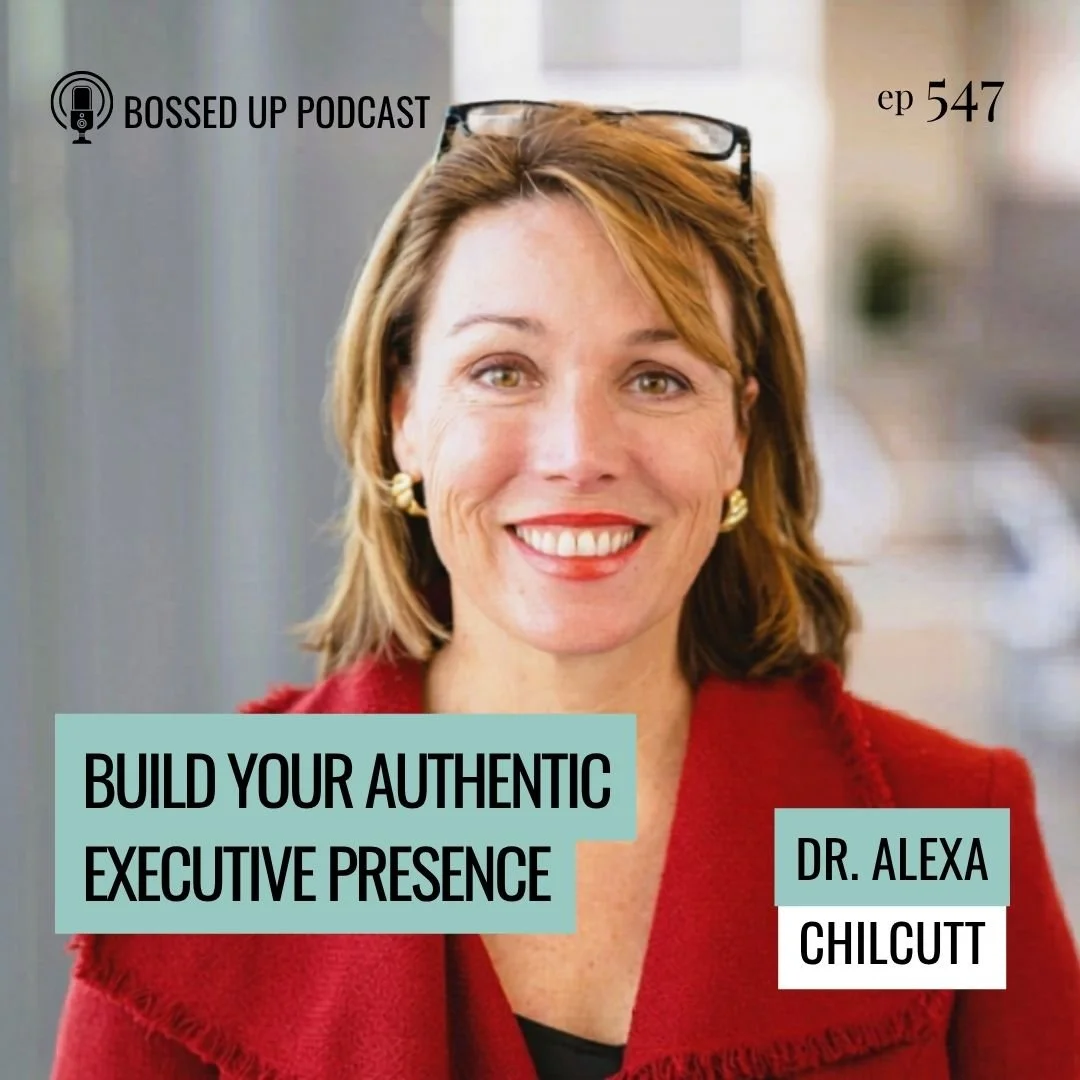
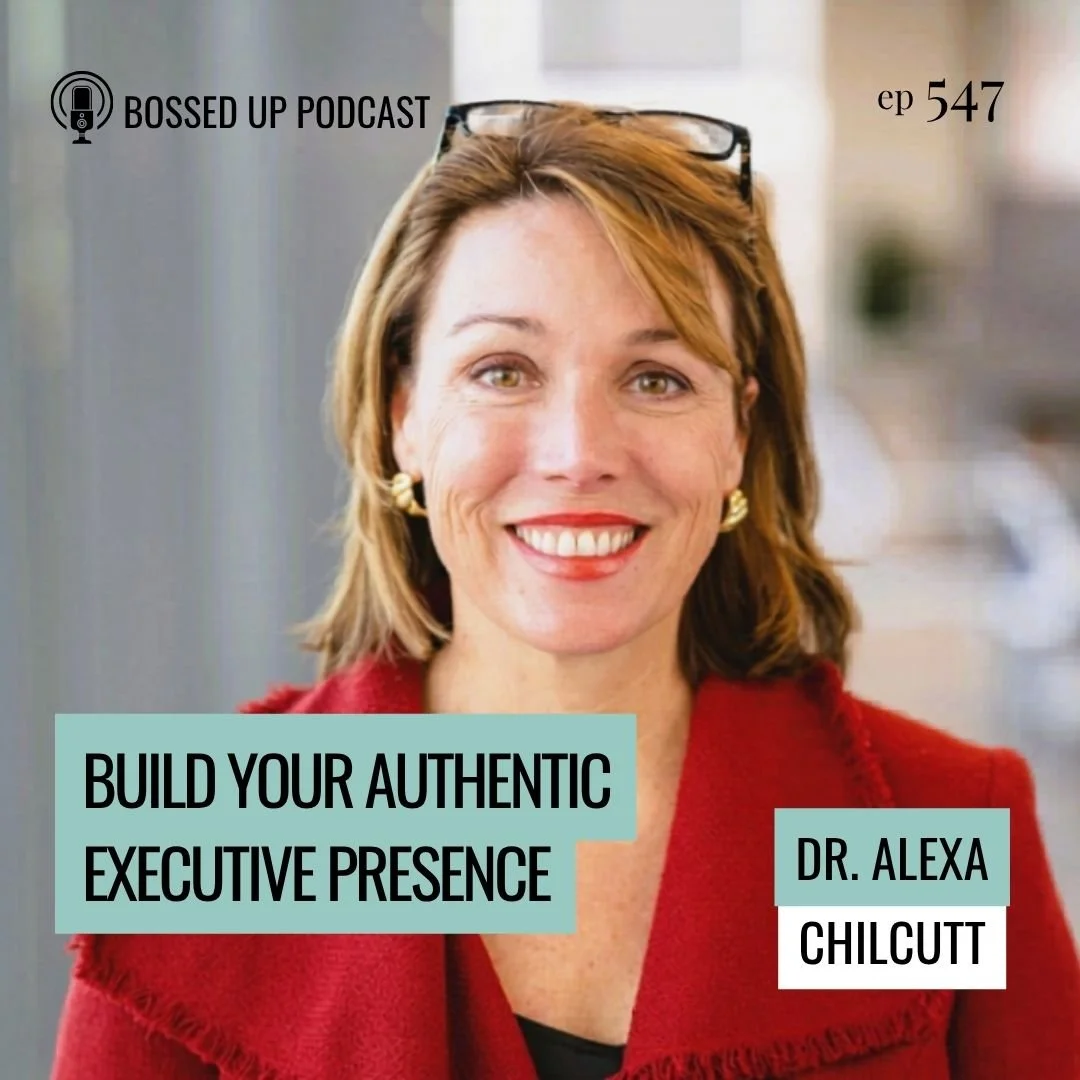
Episode 547 | Host: Emilie Aries | Guest: Dr. Alexa Chilcutt
How other people perceive your leadership ability directly impacts your career trajectory, for better or worse.
You’ve likely heard the term “executive presence” before. But for a phrase that most often appears at the end of the sentence, “you need to work on your…”, it lacks an objective definition or a clear path to success.
Dr. Alexa Chilcutt is an expert in just such a phenomenon. She even wrote the book on it: The Presence Principle: Embodying Executive Presence to Lead with Impact, co-authored with her fellow instructor and researcher in executive communication at Johns Hopkins University. Alexa uses an Inform, Equip, and Empower framework to demystify this confusing but vital professional perception management skill once and for all. She was more than happy to get into the weeds of her field with me, so we can all give our executive presence a little (or a large) boost.
What is executive presence?
Leaders consider executive presence extremely important in the workplace. In a survey of 400 CEOs and other C-suiters, 89% said that this quality “directly contributes to career advancement.” Another study, by the Center for Talent Innovation (now Coqual), found that 79% of senior executives feel a perceived lack of executive presence holds people back.
Despite this, that same study showed 81% of people who were advised to improve their executive presence found the feedback they received contradictory and ambiguous. Basically, people know they need it, but they don’t know how to build it. That’s the gap Alexa strives to bridge.
At its heart, Alexa explains, executive presence is “someone’s ability as a leader to align, engage, influence, and motivate people to action.” In other words, the trait is about other people’s perceptions of you. That’s what makes building executive presence something of a PR project. Luckily for us, Alexa started out in advertising and public relations, so she knows a thing or two about managing your message.
Your presence must be authentic
Professional women have been told for decades that to get ahead, they should act more like the traditional, predominantly male, archetype for what leaders should be like. But faking “executive traits” you think you’re supposed to have isn’t going to convince anyone for long. That’s good news, but it also means you need to figure out your own authentic secret sauce that will demonstrate how confident, trustworthy, and motivational you are, based on your own unique lived experiences and identities.
Step one, then, is internal: nailing down the authentic strengths that make you a great leader. Step two is external: figuring out how to communicate those strengths to ensure people recognize them in you.
Initial versus enduring impressions
In her book, Alexa talks about two key factors that weigh into how executive our presence really is: initial and enduring impressions. We know how important that first impression is. It sets the stage for whether someone is even going to give you a chance to progress the relationship.
But we all know someone (or many someones) with whom we were very impressed at first, only to be disappointed by them in the long run, when all the promise they seemed to exude turned out to be an illusion. That’s where enduring impressions come in. They give you a chance to showcase your values in action. This builds interpersonal integrity, which in turn builds trust. When people trust you, they’ll follow you.
Start showcasing your impact
Alexa understands the tendency to shy away from talking about your achievements at work. This instinct is probably familiar to you, and for most of us, it’s largely rooted in the negative pushback against “bragging” that we’ve internalized all our lives. As women, we’re often taught that drawing attention to ourselves is impolite or unladylike, and encouraged to let our actions “speak” for themselves to be humble about our successes. The problem is, actions don’t speak.
Alexa learned this lesson the hard way after losing a promising job early in her career because she didn’t share her accomplishments along the way. As a result, the board that might have hired her assumed the organization’s success would have happened with or without her. Determined never to make the same mistake again, she took every opportunity to give detailed reports about her progress and impact to the higher-ups.
If the idea of touting your achievements makes you feel the ick, you aren’t alone. Alexa lays out two reframes that can help.
First, don’t think of it as tooting your own horn. Rather, you’re giving your team or your boss the talking points they need to understand the value of your work, so they can talk about it to shareholders and other decision-makers with the deserved degree of enthusiasm.
Second, don’t share your win; share the impact that win had. If you open with “the company saw a 50% increase in sales this quarter because of our [Project Everyone Knows You Oversaw]” rather than “I completed [This Task],” you’re centering the 1000-foot view. This is a double whammy: it shows you’re both a capable manager and a big-picture thinker.
Common barriers to developing executive presence
In working with mid-level leaders to help them advance in their careers, Alexa has identified three things that consistently hold people back.
So many people at this level of leadership don’t take enough advantage of the seat at the table that they have been offered. When you’re included in larger meetings, it’s essential that you speak up. If you’re worried about just adding noise because you don’t think you have insights to share, ask clarifying questions instead. Expert or not, you were invited for a reason. You have more to contribute than you think.
Many of Alexa’s students take the wrong approach to self-advocacy. As I touched on above, Alexa recommends that when the opportunity to share arises, move away from just reporting the tasks. “My team completed 1, 2, and 3 this month” doesn’t paint a picture of impact and future-thinking the way “Because of our project, the company saw wins 1, 2, and 3 this month” does.
Of course, lots of (female and male) workers struggle with impostor syndrome, which is no stranger to most of us. There is one big indicator of confidence that you actually can fake until you make it. Alexa says, “Someone who is seen as confident is also in control of time.” So often, we want to prove we have every answer, so we leap on questions with rushed intensity. In the end, that works against us. Confident leaders aren’t in a hurry. When you’re asked a question, pause for a few seconds; it makes you look more thoughtful. (Years ago, I interviewed David Allen about time management and his Get Things Done methodology.)
Number three might evoke some understandable irritation. As women, we’re so often expected to be everywhere at once and everything to everyone. It’s maddening to learn that appearing as overwhelmed as we often are could hurt our chances of career advancement. But beyond the appearance of calm, there’s a hard truth here: if you’re overwhelmed, you might need to improve your delegation skills, too.
Alexa points out that we tend to assume our teams are just as overwhelmed as we are and shy away from dumping more on their plates. But often, if we offer a project or a task, one of our direct reports or coworkers will be eager to scoop it up. Instead of thinking of it as “dumping,” think of it as empowering them to have more opportunities to shine. It’s just an added bonus that it lightens our to-do list a little.
A simple step to building your executive presence
Try Alexa’s simple activity to help you identify what you need to work on when it comes to executive presence.
Grab a piece of paper and a pen. Imagine you are polling all the people you work with (direct reports, horizontal coworkers, and superiors). If you asked them for three adjectives they’d use to describe you to someone else, what would those adjectives be?
Now think: At my best, what are the adjectives I want to convey to be the authentic leader I aspire to be?
Compare those two lists. Where they differ is the gap you need to fill to be a motivating leader that your team wants to follow. From here, you can come up with actions that cultivate and better convey those three goal adjectives.
Exuding virtual presence
Alexa’s tips and insights relate largely to in-person situations, and most people in corporate roles today continue to spend at least part of their time in office. However, more and more of our presence is being built and shared online, so I asked her how we can cultivate better executive presence in the virtual sphere.
She points out that you can tie in your adjectives from the exercise above here, as well. What does someone who exudes those traits look like? So much of how we interpret interactions is non-verbal. It’s up to you to set the stage, and when it comes to Zoom calls, say, that’s you and your background. Alexa recommends structured clothing, something with a collar that creates lines. If you’re not a business formal type, a blazer over a t-shirt is still a great way to add some executive framing. You’ll also want to make sure you have good lighting, a camera angle that’s not up your nose, and a tidy, minimal background.
And what about LinkedIn, yet another place where first impressions can have a huge impact? Alexa encourages people to have a profile photo that’s really them (don’t use AI for this part). It doesn’t have to be a professional headshot, but it should be well-lit and flattering. For your banner image, return to your adjectives again. Does that big background convey what you want? Finally, use those adjectives in your LinkedIn profile to really drive home your cohesive, competent persona.
Alexa has so much more advice and wisdom like this in her book. You can order a discounted copy of The Presence Principle: Embodying Executive Presence to Lead with Impact using this link.
I want to hear about your own executive presence journey! If you’ve been told you lack this quality, how are you tackling that? What tips from this conversation are you most excited to try out? As always, you can email me directly or visit the Courage Community on Facebook or our group on LinkedIn to weigh in.
Related links
Sally Williamson, “Executive Presence Is a Top Priority for Leadership”
Episode 407, How to Delegate Without Feeling So Bad About It
Episode 447, Job Search Success: How to Optimize your LinkedIn Profile Skills Sections
Discover even more ways to LEVEL UP your executive presence:

-
[CONFIDENT RHYTHMIC DRIVING THEME MUSIC WITH DRUMS STARTS]
EMILIE: Hey, and welcome to the Bossed Up podcast, episode 547. I'm your host, Emilie Aries, the Founder and CEO of Bossed Up. And today I am excited to dig into the concept of executive presence.
[MUSIC FADES AND ENDS]
What the heck is it? How do you develop it, and why is it so, so important to so many people, especially women listening, who have been told a time or two that they need to work on their executive presence? If that sounds like you, you are in for a treat.
Helping me to break all of this down is Dr. Alexa Chilcutt, co-lead for the Academy for Women in Leadership and a Johns Hopkins University Executive Communication Expert. She designs transformational learning experiences for professional women worldwide, helping them break through gender barriers and lead with confidence.
She's also the co-author of the new book The Presence Principle: Embodying Executive Presence To Lead With Impact. It shares tools needed to lead with confidence and grace, and she and I get into what that looks like in today's conversation. So, Dr. Alexa Chilcutt, welcome to the Bossed Up podcast.
DR. ALEXA: I'm excited to be here and to talk to you.
EMILIE: Yeah, I'm so excited to dig into this concept of executive presence with a scholar behind the term, right? Because it's so often discussed but so rarely understood. And so I'm really excited to dig into this in a practical, tactical way. But first, tell my listeners sort of your background, how you got to this work, and how you approach it.
DR. ALEXA: Okay, well, my first, basically, job, right? Which was not in academia at all. I was in advertising and public relations. So I was a development director for a nonprofit, and I loved that work. But really, when you think about it, that's kind of what we're talking about is impression management. Communication, and how you think about the most desired impressions that you want, whether it's individually or for a company. And then how do you kind of align your strengths and what you're really about to creating those impressions? So that's, that's really at the heart of everything that I do. Like, I loved that world, and I think that just, it just makes sense.
EMILIE: I love it. So let's dig into what this term is really all about, because people talk about executive presence a lot, especially in the context of someone not having it, right? Like, that person needs more executive presence, or women listening to this podcast have probably gotten that feedback from their leaders in the past. Like, I need you to work on your executive presence. And that can feel very confusing because the definition feels very subjective and subject to interpretation. So when you think about executive presence, like what is it and what is it not?
DR. ALEXA: Mmm. Mhm. Well, first of all, you are 100% correct. It is confusing and in fact the research shows. So I'll just throw out some stats first to just kind of create a level set, right? Like why is it important? There was a survey of 400 CEOs, corporate communication executives and professional development managers. Out of those, 400, 89% said that executive presence directly contributes to career advancement. And 79% of them said if there's a perceived lack of executive presence, it holds people back. But then the center for talent innovation found that 81%, like you said, of people who receive feedback about you need to, you need to improve that. You're not quite there. The feedback is contradictory a lot of times and confusing. And those people have no idea what to work on.
So it's left us in this really kind of ambiguous space, right? So what is executive presence? We can go into lots of different characteristics later on, but at the heart of it is someone's ability as a leader, right? Because think executive, you are getting things done through other people. And that's when that presence matters, is when people are looking at you for leadership positions. And it's your ability to align, engage, influence, motivate, right? People’s action. And so what are those things that you can kind of accomplish that aligning, engaging? It takes trust, it takes confidence, right, in who you are, your abilities. And so there are lots of different characteristics of executive presence, but at the end of the day, it's are you a leader people can trust that motivates them, that encourages and engages them, and that they want to follow.
EMILIE: Yeah, I love that. I always think of executive presence like meta perception, right? It's someone else's perception of you and your ability to step up, to lead, to engage, to whatever, to take something else on. And so it's not just your perception of yourself that you're managing, you're really managing other people's perceptions of you, which is kind of an advertising job to go back to where you started your career, right? It's marketing yourself. And that can just feel really tricky when you don't know what's going to do it for the other people. You don't know what matters to them, them. And so there's just so much ambiguity, right, like you're saying there, that can leave people who get that feedback feeling really like they're spinning their wheels.
DR. ALEXA: So that is the place you said it's tricky. That is the place that people really get bogged down a little bit because I think the old idea of executive presence is that we need to put on presence and that it looks a certain way. But the way that my colleague Carl Dupont and I have began to teach this, because we began working with a Fortune 200 company training their mid level, and it was really a program for mid level leaders that they were trying to equip to become higher level leaders.
But it was minority employees within this Fortune 200 company, right? And so we were really having to dig into how do you do this authentically in a strengths based way, that your executive presence doesn't have to look like somebody else's executive presence. And so taking stock of your strengths, your values, what are you as a leader when you're at your best? Okay. Then taking stock of that and then how do we then really communicate that out so that people see that in us?
EMILIE: Totally. And I like that you mentioned identity here because your book really is the first guide for what you call The Presence Principle, which is the title of the book specifically designed for diverse and underrepresented professionals. So what do you feel like was missing from the traditional conversation about executive presence that made this a necessary conversation to have?
DR. ALEXA: Yeah, you know, I think Carl and I are also a great team to do this. I'm a woman. I work with a lot of women, women. I, um, coach women. I'm the co-lead for the Academy for Women in Leaders at Johns Hopkins in executive education. And so I see it so much from m women's perspective and all of the different aspects, right? Culturally diverse, you know, where we come from, all of that. And then Carl is a man, but he is a kind of an underrepresented man, right? He's fabulous because he's a international opera singer,...
EMILIE: Oh.
DR. ALEXA: …but he's a black man who is also kind of from the south as I am. And so we're constantly negotiating those identities. And so when we began to teach it, I think it was combating the idea of putting on that executive presence, you know, getting away from the Mad Men. Remember that series?
EMILIE: Yeah. Well, I immediately evoke a white man in a power suit in New York City, right? And so when we're talking about things like a southern accent or, you know, any gender that's not white CIS male, right? You are up against this sort of patriarchal norm of what it looks like to be powerful and have presence. And for so long, all the way up to an inclusive of the lean in era, a lot of advice that women were getting felt a little bit like be more like a man. And I'm the queen of like perpetuating that because I love an assertive communication workshop. And I've been talking about assertive communication for women for years. But there's some negotiation around. Okay, what is authentic to you? And how do I make sure I'm presenting myself in a way that doesn't sort of shy away from my own presence and power, right? And that's a tricky balance.
DR. ALEXA: It is. And that's where people need that reassurance that executive presence can look like you, whatever that is, and that you can when you're focused on your strengths, right? What is your experience by the way? And I do have a great story at some point, but by the way, women in particular and I think, and not to exclude men because I work with some men as well who this is an issue. Many times we do not self advocate. We don't talk about our experience, we don't talk about our accomplishments, we don't talk about our strengths. And that is part of that informing other people's opinions about you.
And so you really do need to take stock of what do I bring to the table because many times we have imposter syndrome and especially if we are within a more diverse community. It's right, as you said. Southern accent. When I began teaching at Johns Hopkins in Baltimore, I was so self conscious of my accent and I thought are they, are people going to be judging me? Not by the quality of my teaching and all of that. I was there for a reason. But I was very much in my head about it. And once I did lean into that and just brought my authentic self, but performed at a very, at a peak performance, high level, right? People saw that as an advantage. I was distinct from other people. So on some level it became kind of a calling card. I'm that girl from Alabama. [LAUGHTER] But you know, I mean then that's the other thing about executive presence. Is that what we know, going back to the traditional view, we think of it as that Mad Men put on the suit, look a certain way. But also we focus on first impressions.
EMILIE: Well, let's dig into that because your book really pushes back on the first impression being all that matters. So your framework really distinguishes between those initial impressions and what you call enduring impressions. Let's dig into that because I really want to know what you posit sustains a powerful impression over time.
DR. ALEXA: Mhm. You know, first impressions are important, so we don't want to discount that. It does matter when you initially meet someone and confidence. But by the way, confidence does not always look like an extroverted, you know, masculine kind of charisma, gravitas. Confidence can be self assured, poised, grace under fire. It can be an introverted calmness, right? But those first impressions do matter. Appearance, engagement, you know, all of that. But how many times? And your audience is all going to find an example in their brain that pops into their head.
How many times have you been impressed with someone and then over time you were disappointed in that individual, right? Like they made this great strong first impression and you thought they were going to be this fabulous leader. They had all of the reputation and status, they said the right things, all of that. But over time, you found that to be an illusion. This is why enduring impressions really matter most. It's kind of like that tip of the iceberg is the first impression, and the underneath of the iceberg is enduring impressions. It's things like, what are your values in action? You know, you say that you value certain things as a leader, and then do people see you enacting upon those values?
EMILIE: Right. You mentioned trust earlier. You need congruence there.
DR. ALEXA: Right, exactly. Because I'm not going to follow you if I don't trust you. And secondly, interpersonal integrity, huge. In first impressions. I can act like I want to get to know you. I can have engaging, right skills. But let's say I meet you, I'm super interested in you, blah, blah, blah, ask you questions, and the next week I meet you. I forget, I forgot that I met you. I have no idea what your name is. Don't remember our last conversation.
So a leader that has interpersonal integrity, people trust the relationship. So what you say to me is what you're going to say behind my back. You know, you remember our last conversation. You're actually invested in me as a person, not just as someone to get things done through, right? So those qualities that are more long term, that show themselves over time, you know, do you have the knowledge and expertise that at the beginning you said that you had? You know, do we see that?
EMILIE: You know, the distinction that's coming to mind for me is that old adage around, like, do you want a workhorse or a show horse?
DR. ALEXA: Oh, that's good.
EMILIE: You know? And I'm thinking about how so many women I know are workhorses. They get it done, they have the integrity, they build the trust, they follow through on their commitments, they like, are the reason why the organization exists and can function. But it is the show horse piece that's often a challenge. And you mentioned earlier, you know, women's ability to self advocate, which is something we talk a lot about here at Bossed Up. And I think so many women are afraid of the social penalties that come with being seen as braggadocious, right. Or bragging on your, on yourself. And so I wonder if that binary is just a false choice, the workhorse versus show horse, and what it would look like to really develop the show horsemanship or womanship, if that's the part that's missing.
DR. ALEXA: Well, so like I said, I work with a lot of people on this. And when Carl and I teach the course, this is something that we do. We actually teach people that leadership advocacy pitch. And it's in the book, right? Because. Okay, so I'm going to tell you a quick story. I'm trying to make it as quick as I can.
So my first job, right, that was. I've counted my really career first job, as I said, I was a development director for a nonprofit. It was the school that my children went to. And I was in love with the school. And it was in a really bad place. Okay? Like it was teetering. It was a private school, all the things, but great values, loved it. Fabulous education, but just not known of really, I mean, it didn't have a presence. So I began working as a development director.
Now, Emilie, for the first couple years, I really did not take much of a paycheck here, okay? Because I was just invested. But I was wholly invested. And at the end of three years, they had promised, right, that at a certain point this was going to be a full time position and all these things and blah, blah, blah. I turned the school around. I mean, enrollment was up, they had a wait list. I was, you know, doing fundraising benefits. They were making more money than they had ever made. I mean, all of these things.
But I was assuming that people who are making the decisions about that position three years down the road saw what I was doing. That assumption ended up biting me. So I had the opportunity to go to those board meetings every month, right? But I didn't take the opportunity to give a five minute update. Hey, here are the papers that we've been in. Here's what we've done. This is how much money we've raised. Our tuition is up by 12%, yada, yada. Because I assumed people saw the work.
EMILIE: Yeah, the work stands for itself. I've heard that.
DR. ALEXA: Exactly. And that's where people get stuck. So three years later came and guess what happened? They decided they were in such a good position, they didn't need anybody to do that work. And I was about 30 years old and I want to tell you, I was crushed, crushed. And anyway, that they could have a volunteer and it could be part time, that's kind of what they were going to go to.
So it taught me an invaluable lesson. And every position I ever had after that, I made sure that when there was an opportunity at a meeting to give a report with my direct report or my boss, one on one, that I was talking about the accomplishments and uh, not to brag on myself, but to give them talking points, right? So it's almost like reframe your mindset of being braggy to giving your team, your boss, management, the leaders, an understanding of the work that you're doing. So they value it, but then. So they can talk about it.
EMILIE: Yeah, absolutely. It's like writing the script for like the impact you're having so that they can talk about the impact you're having. And I think that frame, I've also found just focusing on the impact, not just the actions that you're taking, can help us overcome that self centered feeling that feels kind of icky for a lot of women. And just say, look, let me tell you about the impact I've had on others this month, this week, this year. And when you can frame it that way, talking about all the great work you're doing and the ways you turn that school around feels less weird if you're less about like, I'm taking credit for all this stuff. And you're more like they experienced this positive outcome because of what I did. There's just some, there's some framework there that feels like you're flipping the focus from you to someone else. And that's what servant leaders do, right? That's, that's sort of a leadership move in and of itself. I mean, in your work with women in particular, what are the common challenges that get in the way there and how do you push back on like the imposter syndrome conversation or the things that just bog women down from being able to confidently exercise that presence?
DR. ALEXA: Okay, I will tell you, in fact, I had this conversation with one of my colleagues at Hopkins recently. I am coaching and I have been coaching, but currently I'm coaching about, you know, 10 people from a specific organization, once again, all mid level, trying to get to that upper level position. And there are three things that are holding people back. And it's so interesting to me that everybody has these same challenges. So one is that they've been offered a seat at the table so let's say they are now included in some larger meetings and they're self censoring. They're not sharing their ideas. Well, maybe I don't. I'm not the expert in the room. Okay. You were invited in that room for a reason. They wanted to hear your perspective. The other things that they're telling me is, well, I don't want to just add noise to add noise. Everybody else is talking. Okay, great. Don't when you speak have something, you know, quality, right? To say. But also asking a clarifying question can be showing up, right? Can I ask how this, you know, will impact the organizational vision for the next six months? I mean, so one, it's showing up, it's stopping, stop self censoring yourself.
EMILIE: Like take advantage of it. Right?
DR. ALEXA: Right.
EMILIE: Shoot your shot. Shoot your shot.
DR. ALEXA: Yeah, but think, you know, hey, if I've got something from my perspective and the work that I do, it could be beneficial to the group. And because what they find is that they don't say something and five minutes later somebody says what they were thinking but they're not showing up, right? So that's one. The second thing is that self advocacy pitch, right. Or that self advocacy piece is they're having opportunities in meetings to report out maybe on projects or something. But you said it just a minute ago, they're focused on reporting tasks and not impact.
And many times they're also focused on reporting what is currently happening instead of every once in a while telling the story about, remember the thing that we finished three months ago. Well, let me go ahead and bring you up to speed on the impact that's had. So drawing a bigger picture and, and being seen as somebody who sees larger than ground level, more kind of 60,000 foot level. So that is another kind of challenge. And the third thing is the imposter syndrome. Just from day to day, how we show up and it is about taking time. This is interesting. Somebody who is seen as confident is also in control of time.
So when you walk in a room, you don't have to speak immediately, right? When you are asked a question, count to three silently in your head, you know, because you come across as being more thoughtful. So it's almost a pacing. They're wanting to be seen as someone who has all the answers and they're rushing and that rushing is actually working against them.
EMILIE: Yeah, I, I have worked in environments where people are all perpetually five minutes behind, which drives me crazy. Like no meetings start on time and that's just the norm. And I understand where that comes from, like there's a chronic over scheduling, there's a aspirational planning that just is an undercurrent at this organization. But if you actually arrived to that meeting two minutes before, you need to be there because you ended your last meeting five minutes before the top of the hour, right? And you're just, you're advocating for your own time management from the get go. Then when you arrive, you're going to have your ability to switch channels in your brain and have the presence, the focus, the clarity that you want to bring to that meeting. So you're so right in connecting time management to executive presence. Because the harried, like people pleaser who's just trying to have the answers all the time for everyone, it just, it, it does not read well. It just does not read as confident, right?
DR. ALEXA: Yeah. You know, and to your point, this is so funny, last week I was working with a group of veterans. So these are men, it was all men who have had a career in the military and now they're transitioning into corporate America. So really interesting, kind of. And they have big imposter syndrome. These are super confident guys, right? But one of them, we talked about this time piece and one of them shared that earlier in his career, he was running down a hall and his commander stopped him and said, what are you doing? And he said, well you know, I'm hurrying. Da, da, da. And he said, son, leaders don't run.
And I thought that was such a perfect picture of, you've seen those people who are looking busy, acting busy, like they're acting overwhelmed. That works against the perception of them as being self assured, having that grace or poise, you know, under pressure. And so we want to think about how we manage that time, whether it is time management, arriving in the room early or just pausing before speaking.
EMILIE: I can hear the like, sigh that is probably coming out of the mouths of women listening to this who are exhausted and overwhelmed and over committed, who are like, really like me trying to be everything to everyone is just having the opposite of the intended effect. And I, I just want to kind of hold people's hands through that for a moment because it doesn't feel good. It feels a little victim blamey to say if you're performing overwhelm, then you're coming across as not poised. But it's true, like there's some truth to it, which is if you are operating in an environment, in an organization where you have to over commit, where you are holding up the sky for the organization and you're totally over committed. That's not a personal failure. That's an organizational liability, right?
And, and if you're not drawing the healthy boundaries you need to protect your time, to protect the pace with which you can work so that you are not speaking, sprinting through the hallways to achieve the impossible every day. Like you are not setting yourself up for the kind of executive presence that actually lands you raises and promotions, right? And so you're like, you are doing the most and you are over functioning for an organization that is viewing you as less valuable while you do that. And that is a real tough irony, but it's a pill that I think we have to swallow.
DR. ALEXA: Yeah. And you bring up something that you made me think of this. I have worked with a couple of women who are in leadership management, leadership positions, right? Who are afraid to delegate.
EMILIE: Oh yeah. Oh my gosh.
DR. ALEXA: And here's the crazy thing. They are absolutely over committed. They're so afraid that their team is as over committed as they are. And so they're afraid to pass things along. And here's the funny thing, once I encourage them that hey, you know what, there might be opportunities that are coming to you from, you know, from above that are coming to you, that it might be an opportunity to empower someone, right? That is a direct report or a teammate to have an experience that they wouldn't necessarily or otherwise have.
And so flipping that mindset as well, like maybe I could give someone else, not think of it as a burden, but an opportunity. And so we have these conversations, women come back to the next session and they're like, oh, I, I didn't realize that they were not as busy as me. I was projecting that my team had as much going on as I did. And once I asked, hey, here's a thing that's come on my plate. Is there someone that would welcome this opportunity, that would be willing to take this on? You're not forcing that, right? But you're offering. And I'm thinking of this one woman in particular. She was amazed that people were willing and eager to do some things. So how much are we actually putting on ourselves?
EMILIE: Totally. It's so funny because you bring up so many topics that we've done some deep dives into. I'm going to put some links to related episodes in the show notes because on delegation and imposter syndrome, it's also interconnected. It's like, to manage yourself is a prerequisite to manage others perceptions of yourself, right?
So if you're managing what's on my plate? What am I delegating? What is my team doing? How are we measuring success? What's my. Like, you've got those leadership and management toolkit 101. Then you can really focus on perception management, which is going to actually get you pretty far. And that's what actually helps unearth opportunities when other people see you as capable of more.
And so I want to sort of start to close here referencing your framework that you use in every chapter of the book around inform, equip, and empower. So if someone listening to this episode is coming towards the end and they're going, okay, I get it. I want to work on informing, equipping and empowering to be able to be seen as having more presence if they want to start working on their executive presence today. Like, what's the most impactful way for them to get started?
DR. ALEXA: Okay, I love this. This is the simplest activity. Anybody can do it. The first thing is grab a pen and a piece of paper, okay? And I want you to think about if I or you, right, were to pull the people that they work with horizontally, right? Direct reports, management leaders, above, whatever. And if someone were to ask, hey, give me three adjectives to describe Alexa, right? So I want everybody to think about what are three adjectives that people would currently used to describe them? Be really honest when they're not in the room, right? Because that's when people are saying the honest things.
So write down those three adjectives and they can be positive. But now I want you to take a moment and think at my best, right? Making those impressions that I truly want to make so that I get that next position, have that advancement, whatever. What are the adjectives that I need to be conveying? Now, mind you, they need to be authentic, right? They need to align so that you can maintain them. But look at that first list and then write that second list of 3 adjectives and see where you can grow.
And the second thing is to say, okay, here are those three adjectives that I want. Now, how do I begin to create those impressions? Through my attitudes, through my actions, through the words that I use, through how I communicate? Behaviors? What can I do to begin to create those impressions? And if you create those impressions consistently over time, you will shift people's perceptions of you. So that is a step one.
EMILIE: It's a great step because it. It's going to also differ for every one of us, right? Like, the gap we're looking to close is going to be very unique to who we are and how you go about making that happen is, is a multifaceted approach, right? There's so much more we didn't get to today, but I do know, that, you know, a lot of what we started talking about even before we hit record here is the virtual presence that we're creating, which I do want to touch upon because you logged on with a crisp white collar shirt and a red lip.
And I went, wow, you look so like, put together. And I said, of course you look so put together. This is, this is what you do. And so I'm curious in the virtual environment, in this zoom heavy culture that so many of us find ourselves in, or just even in the fact that our presence is not just at work, it's also on LinkedIn, kind of doing a job for us in the background. What's like a tip or two you've got for us? Thinking about closing that gap in between those adjectives, using technology and understanding our tech heavy environments that we operate in?
DR. ALEXA: Okay, thinking about those three adjectives, right, that you want people to use when you're not in the room. All right, what do they look like? Because you're talking about virtual, which is visual, and LinkedIn something, which is visual and people are visual. You know, 68 to 93% of a message's meaning is visual. It's non verbal. So it's not the words, it's not what we're saying, it's how we sound, what we look like, our background, all of that. So you really are setting the stage and I want you to think about, for your audience to think about.
Okay, virtually, let's start there. What is my stage? You know, what's in my background? Do I have on something that has structure if I want to be seen as a leader? This is my number one tip for women in terms of clothing because there is not a prescriptive style. I'm not going to tell people to wear a power suit or anything else, but if you're trying to convey messages of leadership and strength, structure. So having a collar or a blazer even over a T shirt, just lines, right? But good background, great lighting, you know, your camera looking straight at your face instead of up your nose, all those things matter. But then also when you're on LinkedIn, look, do you have a great headshot? Don't do the AI thing, please don't do that. Unless it's just airbrushing a little bit.
EMILIE: We're not face tuning for LinkedIn, please, for the love of god.
DR. ALEXA: I mean, I have seen people honestly that have put some AI picture on there and it makes them look 30 years younger. And I'm like, you're actually dashing your credibility because now I'm going to hop on zoom with you and I'm going to think that I'm with your aunt. Like what's going on?
EMILIE: Exactly.
DR. ALEXA: But good looking picture, right? Think about that background image on LinkedIn. Is it visually conveying what you want professionally to be conveyed? And then also those three adjectives that you just chose, you write that about in your LinkedIn. Are you using those words to describe yourself? If I want to be seen as strategic and innovative and, you know, collaborative, I don't. I mean, then am I writing about myself that's highlighting my experience, but using those terms so that people immediately start associating that with me?
EMILIE: Yes. I love that congruence again of message, right? Online and offline. I love that so much. Speaking of visual, there's so many great visuals in the book that you've written, which I love seeing. You know, for folks who really want something that they can embody as you describe it, it's really well described in the presence principle. Where can our listeners who are chomping at the bit for more from you, Dr. Alexa, where can they keep up with you and get their hands on a copy of your book?
DR. ALEXA: Well, absolutely. Connect to me on LinkedIn. I am very responsive, so even if people want to message me, you don't have to follow me, you can connect me. But if you want to message and ask, I will actually send people like a one page PDF of kind of tips around executive presence. Just happily send them that. But they can connect me there. The book is on Amazon and I'm going to send you the link to Routledge, which is the publisher, and there is a 25% discount going directly through them. So it is cheaper going directly through that site. So I'll make sure that that's there so that you can link that under the podcast.
EMILIE: Yeah, we'll put that in today's show notes and blog post. Thank you so much for joining us. This was wonderful.
DR. ALEXA: I've enjoyed it. It's been fun.
EMILIE: For links to everything Dr. Alexa and I just talked about, head to bossedup.org/episode547. That's bossedup.org slash episode 5,4,7. There you'll find a fully written out transcript of today's conversation alongside a summarizing blog post that synthesizes Dr. Alexa's key points.
As always, I'd love to keep the conversation going after the episode in the Bossed Up Courage Community on Facebook and in the Bossed Up Group on LinkedIn. What do you make of this concept of executive presence? Do you feel like you have it? Do you feel like you're lacking it? Have you been told that you're lacking it?
[CONFIDENT RHYTHMIC DRIVING THEME MUSIC WITH DRUMS STARTS]
And if so, how are you experimenting with developing your presence so that you can develop the perception you need to succeed, whatever that looks like for you. I'd love to keep the conversation going and hear from you on this. As always, in the meantime, let's keep bossin’ in pursuit of our purpose, and together, let's lift as we climb.
[MUSIC FADES AND ENDS]