Self-Advocacy Hacks for a Toxic Workplace
Episode 532 | Host: Emilie Aries | Guest: Sarah Boyd
Systemic change is slow. Here’s what you can do to protect yourself in the meantime.
There’s no question that 2026 is ushering in yet more unprecedented times, with hostile work environments abound, and even the most ambitious go-getters are getting burnt out. In spite of this, there seems to be altogether too few resources out there to help us cope and come out ahead—especially for the hardest-hit populations, such as Black women.
Stepping up to transform that landscape and help her fellow working women of color elevate their careers despite less-than-ideal conditions is Sarah Boyd. Sarah is the founder and CEO of The Formation, an app that serves up “real talk, real resources, and real tight-knit community” for Black women navigating the realities of corporate America. She draws on her background in talent and organization development and her personal experience and insights to collect, create, and curate actionable tools and strategies for self-advocacy and safeguarding career investment. She joined me to talk about the current state of the world and what we can do to protect ourselves while the broken systems play catch-up.
The reality of the situation
The 2025 Women in the Workplace study, a joint venture by McKinsey and LeanIn.org, reveals some disheartening—though not terribly shocking—data about the state of inclusivity practices in corporate America. Organizations continue to pull back on policies once positioned to aid career advancement for Black women and other Women of Color.
Unfortunately, the report’s emphasis focuses heavily on what individual women can do to solve this, instead of putting pressure on those corporations themselves. Those companies need to step up and be held accountable for the more than 600,000 Black women who exited—or were pushed out of—the workplace last year. But instead, the report implies\ that a lack of employee ambition or, at most, a lack of manager ambition, is the cause of this mass exodus.
Sarah is particularly unsurprised. In her research, she often finds that more ambition, more confidence, a good mentor or sponsor are cited as the barriers standing in the way of Black women (and women in general) finding career growth and success. In other words, they, not the system, are the problem.
Document everything to protect your paycheck
So, what is a career-driven Black woman, weary of weathering systemic injustice, hearing non-actionable performance feedback (more on that later), and a lack of upward mobility, to do?
While Sarah’s organization ultimately drives forward big collective pursuits like mobilizing, demanding recognition, and using our vote to make our voices heard, taking action right now still calls for a lot of individual strategies. These strategies, Sarah clarifies, are not substitutes for collective action—they’re placeholders and coping mechanisms (and good habits to get into) until the broader-scale work pays off.
Until then, Sarah’s mantra is “document, document, document” in order to strategically self-advocate for career progress and change. Specifically, she recommends tracking three work categories tirelessly.
Foundational work: the nitty gritty
This one is about making the invisible visible. Foundational work is all the stuff in your job description—the daily odds and ends that populate your nine-to-five. It’s the work we take for granted, Sarah says, but never forget there’s someone out there with the same job who’s half-assing everything you’re doing to perfection.
Sarah shares the story of a Formation community member who kept track of everything she did, including the times her toxic boss acknowledged her success. When the boss brought in HR to deal with the employee’s “performance issues,” she was able to clearly outline all the ways her boss’s perception was off-base…and the result turned into a performance improvement plan focused on her boss!
Strategy work: the bigger picture
Strategic work documentation calls for tracking all those assignments you’re a part of that move your department or the organization forward. Don’t just write down what you did—record the objective results of that work (higher revenue, better retention, etc). Highlight how your unique approach and soft skills aided your contributions. For example: “I run a regular standup with the whole marketing department, and the clarity and coordination I’ve helped drive through those meetings contributed to our25% increase in sales this quarter.”
Stretch work: your goal alignment
Finally, keep track of the stretch work: the extra activities you raise your hand to do that aren’t technically your job but are worth the effort because they align with your larger career (or life) goalposts. When you record your approach and impact—and especially when you share them with a boss, interviewer, or publicly—position them in how they align with where you want to go. In a performance review capacity, you’re basically (diplomatically) telling the decision-makers that if they don’t give you that raise/promotion/title, they won’t continue to reap the benefits of those impacts.
As Sarah says, “What I know to be true is we as women are really good at solving problems. We’re really good at identifying those gaps and plugging ourselves in as the solution.” I love this one because these items make it super clear how you’re filling the gap between where you are now and where you want to be, showing you’re qualified for that advancement.
And sure, the more we do, the more negative feedback we can get. In particular, non-actionable performance feedback—the kind that’s less based on your work and more on your personality, like “that was kind of bossy”. Black women are 9 times more likely than white men to get this subjective, biased feedback, but does it mean we stop advocating for ourselves? Or applying our full talents? Oh, hell no.
How to leverage your receipts
Before we get to what you should be doing with all the documentation you’re amassing, let’s touch on the labor-intensive process of this data collection. Sarah encourages the members of her program, Disrupt, not to think of documenting as another to-do wedged into their busy schedule. She helps them focus on finding workflows that make that documentation a built-in part of all they do.
As for making use of your notes, Sarah promotes the concept of having a “winning mindset” instead of a “fighting mindset”. If you go into every workplace meeting or event guns blazing, primed to pull out your latest list and read aloud all you’ve accomplished this month, you’re going to be emotionally exhausted—and the response likely won’t be what you hoped.
Instead of fighting, think of winning; think of the long game. And most importantly, think about the best audience for your pronouncements. Maybe you don’t want to list your achievements to your passive-aggressive boss who’s never supported you. Perhaps LinkedIn, or your leadership training cohort, a job interview, or—if the situation is dire—a legal platform is a better place to focus your energy and self-advocate for positive career change.
Be your own best advocate in 2026
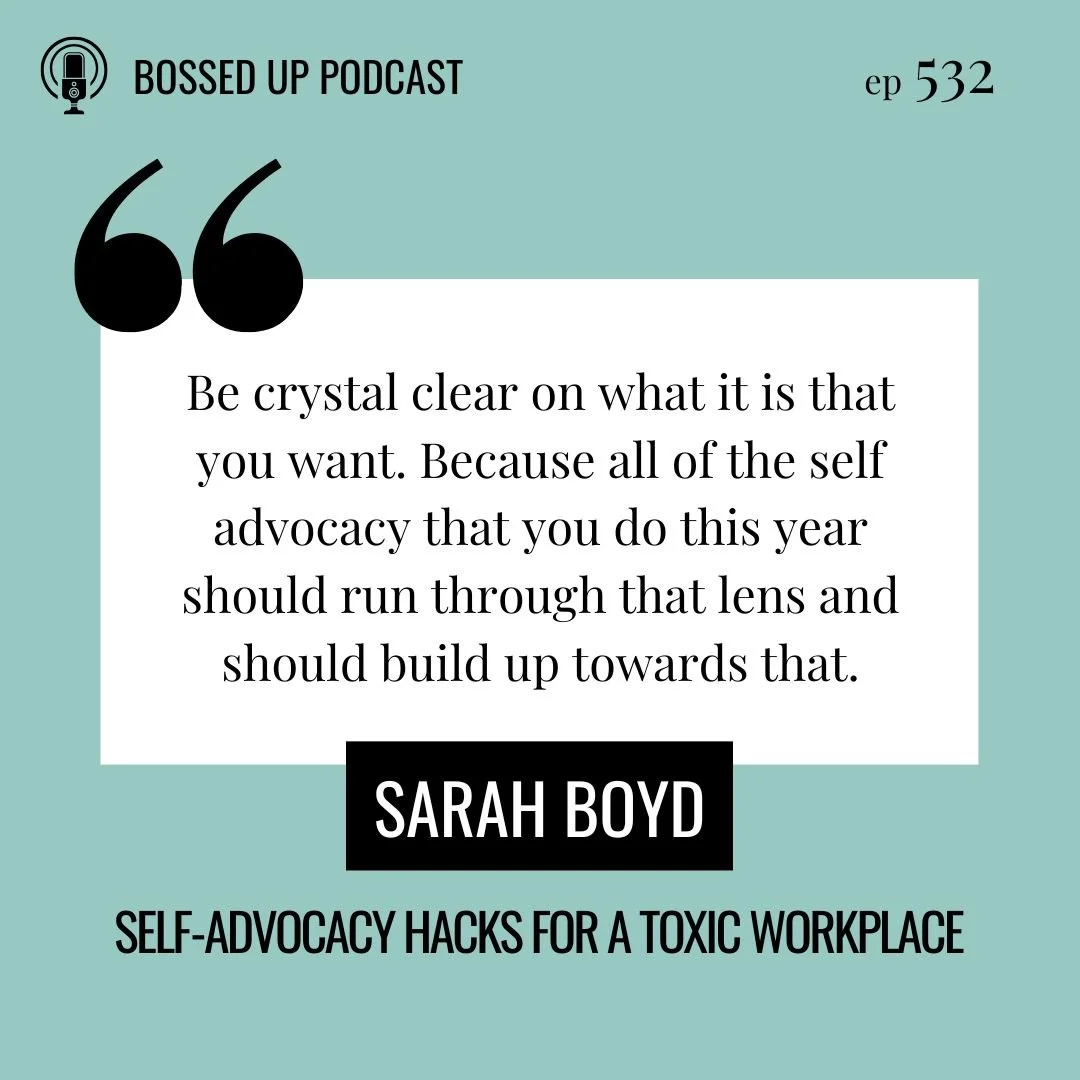
Before I let Sarah go, I asked her for an action item and a caution for all the women going into 2026 with all this economic unrest and disaster looming overhead. Her number-one recommendation is to get crystal clear on what you want.
What does the endgame, what does winning, look like for you? Then, as you tackle these self-advocacy approaches, make sure they all get filtered through that lens. As Oprah says, “Successful people get to where they want to go because they know where they want to go.”
And don’t fall into the trap of isolating yourself. When things get uncertain—when AI starts coming for us or return-to-office mandates make us question everything—sometimes we close ourselves off to the communities and support systems there to help us. Don’t do that. Community helps us find the clarity we’re striving for.
If you’re a Black woman feeling the lack of that community or wanting to build up your career strategy, check out The Formation and the Disrupt program. Sarah’s next cohort kicks off in February!
As we dive headfirst into January’s uncertainty and excitement, I want to know what advice you’re going to take from Sarah into your new career year. Drop me a line directly or get connected in our Courage Community on Facebook or our group on LinkedIn to share how you plan to be your own best advocate in 2026.
Related links from today’s episode:
Get unstuck by clarifying your goals
and understanding your audience:

-
[INTRO MUSIC IN]
EMILIE: Hey and welcome to the Bossed Up podcast, episode 532. I'm your host, Emilie Aries, the Founder and CEO of Bossed Up. And today I am so excited to kick off the new year with a fabulous conversation all about how to advocate for yourself even in a hostile environment.
[INTRO MUSIC ENDS]
Now, a hostile environment here could look like a toxic workplace where you're stuck and you're job-hugging as we've talked about here before. Or it could look like the treacherous nature of the current job market, or perhaps both. Not the rosiest picture that we are entering the New Year on, but it's real.
So let's get real with someone who knows exactly what she's talking about and gives a lot of great advice for how you can still be the boss of your career despite these less than ideal conditions. Sarah Boyd is joining me. She's the Founder and CEO of The Formation, a community based app that serves up real talk, real resources and real community for Black women navigating the realities of corporate America. As a certified talent development leader, Sarah has worked with C-suite executives and senior leaders, coaching, mentoring and building impactful programs to help both individuals and teams successful succeed.
After working in enterprise, startup and social impact spaces, Sarah launched The Formation community to fill a glaring resource gap she saw in each of these environments. Today, she brings her experience to creating resources for strategic disruption, actionable tools and strategies Black working women, and frankly anyone who's listening, can use to advocate for themselves in the workplace and safeguard the investments they've made in their careers. Sarah, welcome to the Bossed Up podcast.
SARAH: Thank you so much for having me.
EMILIE: Thanks for being here and for popping into my inbox just about a year ago now to tell me all about the journey you've been on since joining the Bossed Up community. Why don't we start there? Tell me about the Formation and how you came to found it.
SARAH: The story of how the Formation came to be, to me, is always easiest and best told kind of through the lens of my own journey. Even though what it is and who it serves is about far more than me alone. Like so many other women, women of color, Black women especially, as I was progressing in my career, I was having these experiences that really made me question whether or not it was going to be possible for me to have a career. I was having, you know, these experiences that quite honestly brought me to my knees sometimes and led me to really seek out different resources and strategies and tools and insights and frameworks that I could use to overcome some of the things that I was experiencing.
And what I often found was sometimes there would be tools out there, but I'd have to, you know, hop on a plane and travel somewhere to go participate in some type of in person conference or convening or there would be other tools that spoke about women's workplace experiences, but completely did not acknowledge, completely failed to acknowledge what Black women were experiencing how race and gender created and lended itself to my experience versus gender alone.
And so after years and years of searching and having a talent development background and having an organizational development background, I just kind of one day said, you know what? I can do this. We are the ones we've been looking for. There's so much collective wisdom in our community, so much historical foresight that we can tap into. I'm going to do my diligence, research what's working for people, and use that research and the lived experiences and insights I have to put solutions together for those who are seeking them as I have been.
And so the Formation, I always say it's a space for real talk, real resources and real tight knit community for Black working women. It's a community based app. And within that app you find really just a collective of Black women who are done playing the game the way we've been taught to play it, and are highly interested in those tools and insights and resources and strategies that allow us to navigate these inequitable workspaces without burning ourselves out or, you know, sacrificing ourselves in the process.
EMILIE: And it sounds like to disrupt them for the better.
SARAH: Absolutely.
EMILIE: Yeah, I love that. So let's talk a little bit about the backdrop upon which all of this is taking place. We've been emailing back and forth for close to a year now about the variety of challenges that Black women face in the workplace and that we can extrapolate from many women across the racial spectrum experience. And we were kind of struck by the most recent Women In The Workplace Report from Lean In and McKinsey. What have you found from that report or other research you've done to be some of the challenges or the, the, the dangers that women and Black women in particular face in the modern workplace?
SARAH: You're going to get me all fired up with this report, [LAUGHTER] but I will try and keep it brief and say that ironically, what that report does and what it continues to do is it continues to paint the exact picture of what we're navigating. It continues to paint this picture of organizations that are pulling back, intentionally, knowingly, willingly, pulling back inclusive policies and practices that would help women, women of color, Black women. It paints this picture of organizations where, you know, Black women specifically are the least supported in their careers, the most scrutinized, and often really lack the safety nets that others have.
And in response to that data, what the report shows, does, highlights, that organizations also do, is we look at that data, we see the consequences of that data, and then it gets framed as an individual problem. It gets framed as a lack of ambition,...
EMILIE: Yeah.
SARAH: …framed as, you know, managers needing to step up more and support, sponsors needing support, more people. And so I think that's the biggest thing I've found is, you know, we're overworked, we're undervalued, we're hyper scrutinized. And then the solutions that continually get propped up is, people just saying, oh, well, you need to have more ambition, you need to have more confidence, you need to find a mentor, you need to find a sponsor.
EMILIE: Yeah.
SARAH: Organizations need to be more accountable.
EMILIE: Right? Yeah. What particularly shocked me about this latest report is that these are among the companies who voluntarily share their data with Lean In, right? These are among the companies that voluntarily participate in the Women In The Workplace study each year. And among those companies, 2 in 10 have pulled back on DEI. And so you can imagine the broader picture across companies who don't take the time out of their schedules to take part in this study.
So, it is a bleak picture. In fact, I think it's underreporting how bleak a picture it really is. And you're right, like even us, we in some ways peddle individual solutions because systemic solutions are really hard to come by, right? They are challenging. But I do want to keep that frame in mind as we continue, which is like, okay, as I always say, how can we play the cards we've been dealt while we change the game? So what does collective action look like? What does individual survivalism look like? Because for many Black women, as you say, you've got to protect your paycheck.
And so, I think a lot of us are going into 2026 with that undercurrent of fear and scarcity and this economy being weird as h***l and AI coming for all of us, and World War 3 on the horizon, knocking on all the wood. You're like, what the h*** is going on already? It's like, January 5th, as we are recording this, and have we already entered a new world order? It's a scary time.
So for folks, like, feeling that anxiety and looking in their workplace, like, what do you advise they begin to do? How should we be thinking about the potential hazards in our career path and what we can do about them.
SARAH: The first thing that I want to highlight that you mentioned, which is so important, is what we do and some of the individual actions that I recommend is not a substitute for collective action. Ultimately, what I hope we all do when midterms roll around is that we go out and we vote, right? When we're seeing that over 600,000 Black women have been pushed out of the workforce in less than 12 months. If you want my vote during midterms, I need to hear and I need to see what you're doing to resolve that.
EMILIE: Yes.
SARAH: Because it matters. That's an issue. That's not a Black woman's issue. That's not an issue that impacts the Black community. That's an issue about that really centers how we've built these organizations and the safeguards that we as employees do not have when things change.
So ultimately, that's what we do, right. We go out, we mobilize, we unionize, we vote individually. If you're stepping into 2026, kind of seeing just all this s***, that is unnerving, nerve wracking. Individually, there's so many things that I always recommend doing. But the number one thing that I recommend all women, especially Black women, start doing in the workplace is finding ways to self advocate for yourself strategically. We're acknowledging the cards that we have been dealt. We are recognizing that we are existing in inequitable workplaces. And the number one thing that I typically recommend that women do, especially if they want to advance, if they want to protect their paycheck, is to keep their receipts and speak to them in the moments that are meaningful to them.
EMILIE: Yeah. Say more about what it looks like to keep your receipts.
SARAH: Document everything. Everything.
EMILIE: Yeah.
SARAH: And I know the second I say that, a lot of times people say, okay, cool Sarah, I'm already working twice as hard, so now what? This becomes my second full time job that I get to do. But there are quite a few apps that make that documentation more streamlined and easy. There's one called Wrk Receipts that I always like to shout out. There's another one called Hively that is more centered on helping people document and get ready for things like EEOC claims.
But when I say document everything, I think many of us are taught to document issues that arise, discrimination that arises, injustices that arise. Proactively document the good. Proactively document your wins. There's actually a couple different categories of work that I often recommend that we document proactively when it comes to those wins. It's foundational stretch and strategic work. And the way people are responding to that. That way if something does arise where people start trying to paint you as a problem, where they start trying, say, you know, we've kind of got these performance issues. You're not quite a culture fit, things aren't working out that you have a load of documentation that paints a very different story. And I have seen that play out very beneficially in our favor continually.
EMILIE: So tell me more about foundational stretch and strategic. How should we think about those categories?
SARAH: So when it comes to documenting proactively, your foundational stretch and strategic work. Foundational work, first off, let me say all of that work is about making the invisible visible. Making all of this invisible labor that you're doing, these often invisible ways that people react positively to your work, making those visible.
And so foundational work is about that type of work that we often take for granted. It's the one on ones we have with team members. It's the emails that we're responding to, it's the reports that we're compiling. Maybe you're a support team member. It's all the tickets that you go through. It's just all that stuff that takes up like 80% of your day, but that we forget that we've done because it's just so foundational to what we do.
EMILIE: Totally. I've heard so many women in our community say, but that doesn't really matter because that's just my job. That's just, that's just me doing my job. And I'm like, compare yourself to someone who's doing your job as poorly as it can be done. Like find that gap, like highlight that gap for yourself. And don't forget to count, you know, what you are doing well, even if it is just doing your job, you want to be able to communicate it.
SARAH: No. 100%. And I think to, A, never forget that there's someone who's half-a***** what you're doing. 100%.
EMILIE: Yes, yes.
SARAH: But B, to give a very real example of where, you know, just doing my job and documenting that I'm doing it has really helps people out. I know a woman in my community who documented the foundational work that she did. She had an incredibly problematic leader, someone who would tear her down verbally, someone who was not clear in her expectations, and someone who at every turn would find an opportunity to really scrutinize the work that she had done.
And so I told her, hey, start documenting the foundational work that you're doing. Start documenting the hours of meetings that you're having with her that she's pulling you into. Start documenting, you know, what she's asking of you and then how you're doing it to meet what she has laid out verbally and in writing for you to do. Document all of it. Document that you got something from 0 to 100% done. Document all of that.
EMILIE: Yeah.
SARAH: And sure enough, she got pulled into HR one day and HR starts having this conversation and kind of saying, you know, this just isn't quite working out. We're hearing about all these performance issues. And she goes, that's so odd because I have all of this documentation that shows that she asked this and I did this. She said that we needed to pivot, so I pivoted. When I pivoted, she gave me praise about X, Y and Z.
And so it just paints a very different picture of the way she's responding and telling you about my foundational work versus what I have charted out here. And wouldn't you know, she's still in this job to the same day rather than being terminated, rather than being let go. And on top of that, HR did absolutely realize that there was a problem with someone's performance as a result of that meeting,...
EMILIE: Yeah.
SARAH: …but it was not hers.
EMILIE: I love that. Because your HR VP, you know, to defend them because they get a bad rap, right, for so many reasons as being bureaucratic and overly process oriented. But they are, they have a process for a reason. And when they hear a complaint from a manager, they are investigating that complaint. And sometimes if you bring the proper receipts, that investigation will reveal a problem with the manager instead. So, and, and for. As it should, right? If a manager is being unclear and petty and divisive and, and perhaps even biased in, in how they're responding to people's performances. So I love that illustration. Let's unpack the stretch and strategic categories too.
SARAH: Yeah. So that's your foundational work. Strategic work is that work that's still your job. You know, it's still your job to do, but it's those strategic assignments or those initiatives or those projects that you get voluntold to do, that you get assigned to do, because those projects strategically move the department or the organization forward.
EMILIE: Yeah.
SARAH: Right? And so even though it's your job to do, it's important to document how you've contributed to that work because it's strategic in how it moves the company forward. And so what you want to do in your documentation with that is to say things like, okay, cool, I helped get this project from 0 to 100%. And as a result, we saw, you know, an increase in revenue, we saw an increase in efficiency, we saw a reduction in turnover, whatever the impact is. Because everything you have ever accomplished, you have accomplished. Give yourself credit for it all. Make sure to be documenting that because we don't want others to take that for granted either.
EMILIE: Totally. And I can imagine strategic also being relational work, the sort of like, influencing work. Maybe I'm in charge of this process and this project, but how am I socializing this project throughout the company? How am I looking forward to your point? Like, moving things forward speaks to that visionary leadership skill set, which is different than managing your day to day, right? And so I love that call out to not discount those forward facing strategic goals that you're pursuing that hopefully help unlock the rest of your work, right?
SARAH: Absolutely. Because it's not just about documenting what has been done.
EMILIE: Right.
SARAH: It's about documenting the impact…
EMILIE: Impact, yes.
SARAH: …that work has and also how the approach that you take, the soft skills that you bring to the table, allow you to contribute to that impact and have that impact. And I think that the relational work that we do to build cohesion on teams, to get buy in and agreement to make sure that people just have the foundational knowledge that they need to understand what's expected of them, how they can help contribute, that also typically becomes invisible when we're not speaking to the way that it helps move the needle.
And when it's invisible, it gets taken for granted. But if you're walking into spaces and you're saying, I have a 60 minute standup with the entire, you know, marketing team, and in that meeting, I make sure that people have clarity, I make sure that people have buy in, I make sure that people really know walking out of that meeting, what's needed to move these projects forward. And as a result, we've seen, you know, less copywriting mistakes, which lends itself to our credibility online. We've seen, you know, more engagement because people know how to execute on X, Y and Z marketing strategies. There's a beautiful way of drawing those parallels and drawing that line between that relational work and what it does. But if we don't do that, then it gets taken for granted.
EMILIE: Absolutely. I love that. So last but not least, stretch, stretch work.
SARAH: So stretch work is, you know, foundational and strategic work. It's the stuff that's your job to do. Stretch work is kind of what you raise your hand to do, even though it's not technically your job. And I think the thing that sticks out to me, the most about that stretch work and why we want to document it, our approach to it, and the impact it has isn't just that it's, you know, something you're volunteering to do, but because that stretch work should strategically align with the goals that you have. And so when you're speaking to how you've approached that stretch work, when you're speaking to the impact that it has, don't just document that it got done or that you volunteered for it.
Also document the impact it had and speak to it in a way that aligns with where you're trying to go. If you're trying to promote into leadership, if you're trying to get a pay increase, then be speaking to that stretch work in a way that makes it explicitly clear I know how to do this. I have a unique approach that I'm applying to this, and you would be well served to give me what it is that I'm advocating for, because if not, you're just not going to continue seeing these types of results in this type of impact.
EMILIE: Yeah, I love that category because to me, the stretch work is how you fill a gap that you're navigating, right? So if I am in this role as a junior project manager and I want to become a senior project manager, I want to get really clear on what's the gap there, what do I need to do to fill that gap, and how can I use stretch assignments in addition to other professional development pursuits to fill that gap and show that I'm ready and qualified for this leap? And so being really thoughtful about tying your stretch work and communicating your stretch work as it relates to your career goals is such a key point, I love that.
SARAH: You asked me earlier what some of the most interesting findings in my research have been when it comes to women in the workplace and Black women in the workplace. And there's one that really sticks out as we're talking about stretch work. And what I know to be true is, we as women are really good at solving problems. We're really good at identifying those gaps and then plugging ourselves in as the solution.
What is just so seared in my brain from this research report, I will send it to you in case you want to link it in the show notes.
EMILIE: Yeah.
SARAH: It's this research that shows as women, when we do that stretch work and when we solve those gaps and solve that problem when we're high performers, we actually become more likely to receive what's called as non actionable performance feedback on it, which is ridiculous, right? Cause really think about this, Emilie. When we outperform, we're more likely to get shade. When we outshine, we're more likely to get shade essentially is what shows.
EMILIE: Non-actionable performance feedback. What, what does that actually mean? That sounds like corporate jargon. [LAUGHTER]
SARAH: I guarantee you've heard it in action before. Because non actionable performance feedback is that type of feedback where it is less based on your work and it is more based on your personality. And the way people are perceiving you.
EMILIE: Oh. Like that was harsh or you're not being a team player. Those subjective, ugh, that's awful.
SARAH: Exactly. And so, from this report, it sounds that white women seven times more likely than men to get this non actionable performance feedback. Black women nine times as likely as white men to receive it. But it increases when you are a high performer.
EMILIE: Huh.
SARAH: Because people see you performing, performing, performing.
EMILIE: And, and they have something to say, don't they? Yeah, they have more to say if you're doing more, they have more to say. It's like, every action creates an equal and opposite reaction. Oh man.
SARAH: Yes. And so with this stretch work, that's why I say it's so important not just to document it, not just to, you know, volunteer strategically for that stretch work that you know is going to move you towards your end game and help you advocate for what you want, but then finding ways to articulate that impact. Because realistically speaking, we know that it's not just about documenting it. It's not just about doing it. It's also about speaking to what has been done and what that means for what you are trying to advocate for and getting really strategic about that.
EMILIE: I mean, it sounds like you're saying to control your narrative because there's a counter narrative out there. Like if you don't control that narrative, the peanut gallery will fill in the gap, right?
SARAH: Yeah.
EMILIE: Yeah. Interesting. So, okay. I love the practicality of this, right? It takes the brag book concept to a whole other level, which is like really thinking through your receipts, your documentation, which I know is labor intensive. But as I said to a friend of mine recently, just the other week, the end of the year, she was like, oh, I just have to do my performance review. But that shouldn't take much time at all. I said what? I said that should be what you take the most time on of anything this year. She's like, going for a promotion, going for a raise. I'm like, don't discredit yourself. Like, don't, don't sell yourself short. Try less in other arenas, but not that one right? So do that work. Even if you don't think it's going to yield anything, you want to know that you left it all in the field. But how exactly should we be leveraging these receipts? How should women listening think about, okay, I've done my due diligence, I have my documentation, now what?
SARAH: A, don't approach that documentation and collecting that documentation through the lens of something additional to do. One of the things that we really focus on in my program that I have is finding workflows so that as you go, it's just a part of what you're doing, so that when you get to the point where you go, okay, now what am I going to do with this? You have agency and you have so many options. And I think ultimately one thing to always be aware of is there's a difference between fighting and winning. And I think that we have to really keep a winning mindset versus a fighting mindset.
And the reason I say that is, I think it's really easy to do that work of compiling these receipts and then being like guns a blazing at every turn. I'm walking into every single room telling every single person how awesome I am. And if that works for you, great. But also, that can be really exhausting considering the reality of the workplaces that we're navigating.
EMILIE: Probably exhausting for everyone.
SARAH: Yeah, right?
EMILIE: Yeah.
SARAH: Like chasing everyone down at the water floor. Listen to me, no.
EMILIE: Yeah.
SARAH: And so I think the very first thing to do with these receipts is to really look at them. Look at what winning means to you versus what you're just feeling like you're fighting day in and day out and then looking at okay, cool, do I even care to be discussing these things in a performance review? If I'm sitting in a toxic environment, am I better poised to take these receipts and find ways to speak about them on LinkedIn and, you know, promoting the impact I'm having, the approach that leads me there.
EMILIE: Totally, like both what are my goals, but also who is my audience…
SARAH: Yeah.
EMILIE: …is what I'm hearing, which is like the foundation of strategic communication is like, okay, is this the, uh, right audience for this message or not?
SARAH: Right. I mean, the word toxic just keeps coming to me because I know that so many are sitting and camping out in these environments that are toxic, that are detrimental. And when you talk about audience and strategic communication, if you know that the person that you're trying to communicate to is not capable of hearing you, and why are you going and beating yourself against a wall, right?
Maybe you're just taking that documentation and plugging it into an app like Wrk Receipts because there's some type of legal route that you need to take because of what you're facing and you're going to save your energy instead of trying to take all of that beautiful work that you've done and waste it on ears that just won't hear it.
EMILIE: Yeah. And also I can hear this like dual front emerging which is like I'm going to document this to protect my paycheck, right. If I need it. And I'm going to use this documentation to persuasively communicate externally to create more opportunity for myself. So it is defense and offense in a little, little bit of a way, right? So it's interesting because when I think about the nature of toxic workplaces and how common being frustrated and feeling stuck at work is, I also contrast that with the reality of the job market today, right?
SARAH: Yes.
EMILIE: Which is brutal. A member of our community just posted today saying, look, I'm just being transparent here. I have been job searching for two years and here's how many applications I put forth in 2025, here's how few of them got back to me. And just the nature of the impersonal, brutal, highly competitive and bot filled journey that is the job search these days. It's no wonder people feel stuck between a rock and a hard place, right?
I just actually am rereleasing soon a new version of my LinkedIn Learning course about how to get unstuck. And it has a lot to do with that. Like if you're looking to get unstuck internally or externally, like how do you navigate that? And this is such a really, it just resonates so much because we're seeing this especially for Black women. That hostility is very existential, isn't it?
SARAH: Well, and what you're saying resonates so much too because I think that if you're determined to look at what we're saying through a certain lens, it can sound defeatist, right?
EMILIE: Sure.
SARAH: I would love to live in a world where we have equality in the workplace where this type of work and this type of labor is not needed. But the reality is, if you can be stuck between that rock and a hard place and still find a sense of peace and a sense of agency. And I think that that is one of the things that is most important because as unideal as it is, I would much rather in this economy have that paycheck, have that agency and have the confidence that I'm going to be able to have my own back even in an inequitable work environment.
EMILIE: Yeah, totally, totally.
SARAH: For sure.
EMILIE: I mean, that's sort of self advocacy in a nutshell, right? Like, you need to protect yourself. You need to do what's in your own best interest, and no one else can advocate for you. Like, you have to be your own best advocate, which is unfair. And the reality.
SARAH: Yes.
EMILIE: All right, final words of wisdom. How do you think women who are just starting the new year, who are getting clear on what it is that they want in their careers in the year ahead? What should we be sure to do and not do in 2026?
SARAH: This is the framework that I teach in Disrupt, so I'll break this down really quickly. I think, number one, be crystal clear on what it is that you want. What is your end game? What does winning look like to you? What does success look like to you? Be crystal clear on that. Because all of the self advocacy that you do this year should run through that lens.
EMILIE: Yes.
SARAH: And should build up towards that. So I'd say that's the first thing is be crystal clear instead of just kind of, you know, wandering in. In this valley.
EMILIE: Yes.
SARAH: Of confusion. Clarity over confusion. Always.
EMILIE: Okay, I have to insert an Oprah Winfrey quote perhaps.
SARAH: Please.
EMILIE: She, I'm sure, has many quotes to her name, but one that always stood out to me, that she's credited with is quote, “successful people get to where they want to go because they know where they want to go”.
SARAH: Yes.
EMILIE: And that one has always rocked me because I don't really know. I'm like such a multi. Passionate, multi-hyphenate, multi, like, not focused individual. As much as I get s*** done, I like to move in seven directions at once. And I'm always like, oh, there you go. Oprah says I'm going to be a failure. So there it is, no. [LAUGHTER]
SARAH: Now maybe those seven directions are leading you to something that you want, which is just the ability to be creative, right?
EMILIE: You know what Brad and I have been calling it lately is optionality. I like a little diversification, especially nowadays. I'm going for some optionality, baby. I don't even know if that's a real word. [LAUGHTER] But that is what we've been talking about lately…
SARAH: I like it.
EMILIE: …as we talk about our home and our lives and our goals. It's like we want the option, that agency that you were alluding to earlier to hit the eject button whenever we feel like it, right?
SARAH: Uh, well. Oh, my God, I need an eject button for this. No, it's so true. Options matter. Agency matters. And I think that when you have clarity about what it is that you actually want out of your life, then it helps you have more clarity about the things that you want to advocate for in your career.
EMILIE: Yes. Oh, my god. Amen. I'm subscribing right now to the church of Sarah. I love it. All right, what should we avoid? What are the common pitfalls, challenges you see, or anything? You just don't want for our listeners this year .
SARAH: Moving in isolation. People who've been listening to you, people who are already a part of your community, kind of intuitively know this, which is that when that ground we're standing on starts to get shaky, when, you know, AI gets thrown our way and different, you know, return to office, policies get thrown our way when, when the ground starts to shift. Community is what helps you find your footing and keeps you stable. And so that is the number one. The second thing I would say to do after being really clear about what it is that you're advocating for, is moving community towards that.
EMILIE: Yes.
SARAH: Because it never ceases to surprise me how many people are trying to figure things out but are doing it in isolation.
EMILIE: Yeah. So real, so, so real. I feel like I've had to relearn that lesson throughout my career. And so it's such a good reminder. And there, I mean, no wonder we're friends. Okay, Sarah, first of all, because, like, hello, we are so aligned on so many fronts. I'm obsessed with this. And I'm so glad we finally got you on the podcast to sort of explore all this common ground and hear your unique takes and processes and words of wisdom. Tell us more about Disrupt and where our listeners can get involved with The Formation.
SARAH: Yeah. So Disrupt is a six week career strategy and self advocacy program I created. People ask me like, is it leadership development? No. Is it, is it upskilling? No. It is literally career strategy, self advocacy. It's getting clearer about what it is that you are advocating for and why, what it is that you want in life, and then figuring out how to move towards that, even when you're kind of stuck between that rock and that hard place as a Black woman.
And so, if people are interested in learning more about that program, we do have a cohort that'll be kicking off in February. I created it specifically to be flexible for people who are like, oh, it sounds so great, but I cannot be sitting on, you know, hour long calls for six weeks. So it's got some self paced components to it that people can move through. And then it also has weekly Cohort Connects, where we kind of gather as a group and talk about how to implement these strategies in people's actual careers. So, if people are curious about learning more about that, they can go to the Formations website WeAreYourFormation.com yeah.
EMILIE: I will drop that link in today's show notes and I'm so appreciative of you being here. This was such a delight and a long overdue conversation. But I really appreciate the words of wisdom you shared with our listeners today.
SARAH: Thank you for having me. And thank you for all of the work that you've done through this podcast for the past decade. [LAUGHTER] Okay. Those are your receipts right there. You've helped so many. And thank you for always bringing a systems lens to this podcast as well.
EMILIE: For more links to all the resources, and reports, and data that Sarah and I talked about here today, head to bossedup.org/episode532. That's bossedup.org/episode532. There you'll also find a blog post summarizing Sarah's key points and a fully written out transcript if that's your thing.
And now I want to hear from you. What are you making of this conversation? What advice can you take with you into the new year? And how are you going to be your own best advocate moving forward?
[OUTRO MUSIC IN]
As always, let's keep the conversation going in the Bossed Up Courage Community on Facebook or in the Bossed Up Group on LinkedIn. And until next time, let's keep bossin’ in pursuit of our purpose, and together let's lift as we climb.
[OUTRO MUSIC ENDS]