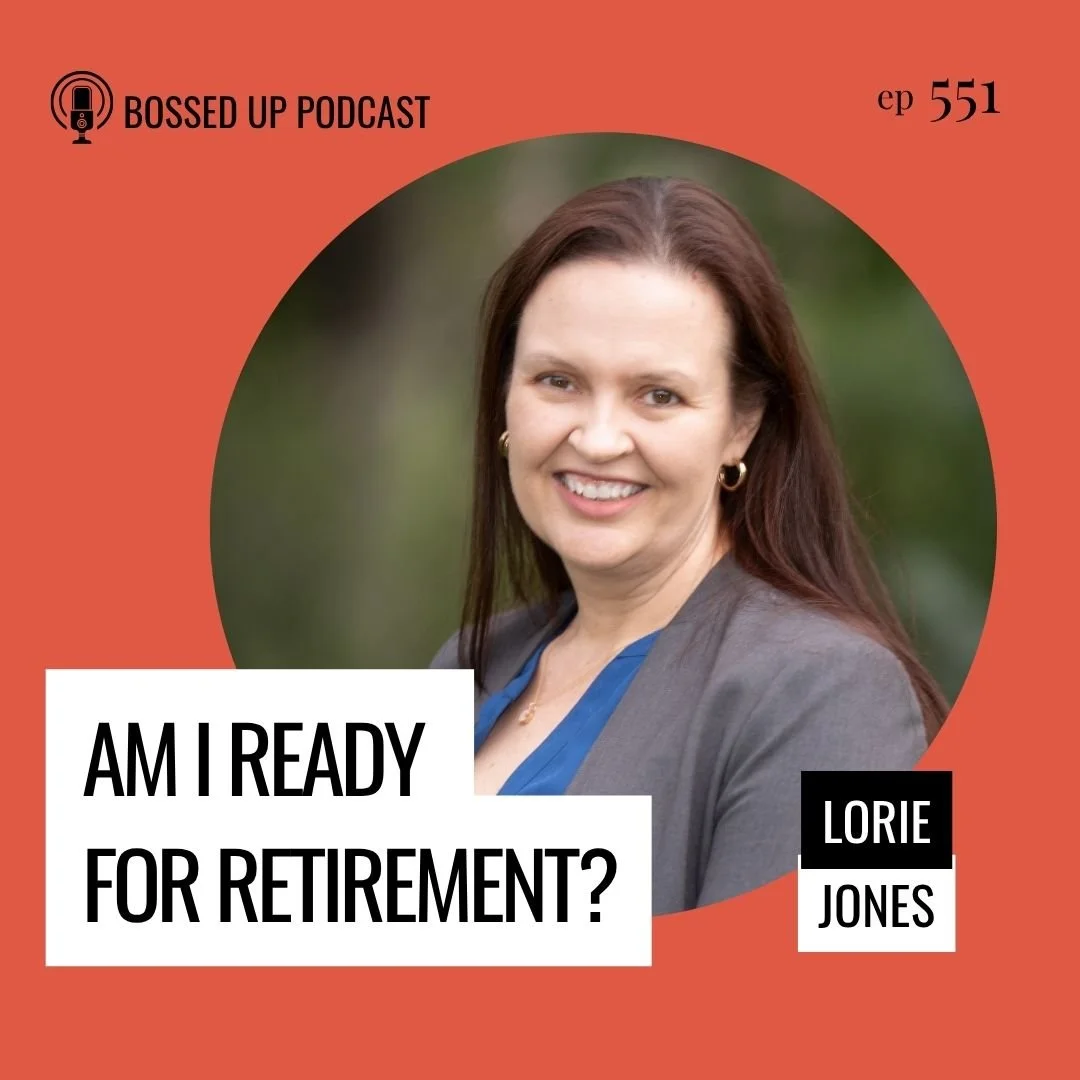
Episode 551 | Host: Emilie Aries | Guest: Lorie Jones
How do you know if you’re on the right financial track for retirement?
Even if retirement is still a decade or more away, at the midpoint of your career, it’s a good thing to be thinking about But in this current economic climate, financial futures feel more uncertain than ever. How do we go about ensuring we can retire when we hope to?
Lorie Jones is a financial advisor and retirement and estate-planning expert and the owner of Fearless Financial Advisors (and host of the Fearless Females podcast!). Lorie takes a practical and compassionate approach to helping high-income and entrepreneurial women sort out their money questions and build financial confidence. Her career in the finance world began after 10 years at home raising four children, so she brings both extensive education and first-hand experience to the unique situation facing many professional women.
The current reality of spending and saving
Even though we all know retirement is something we’ll need to ponder someday, it can be hard to make it a top priority when more glaring concerns, like the cost of groceries and childcare or looming elder care, clearly take precedence. However, Lorie clarifies that this reality is one huge reason women especially should be thinking about their financial futures and not leaving the investing and forecasting up to their spouses.
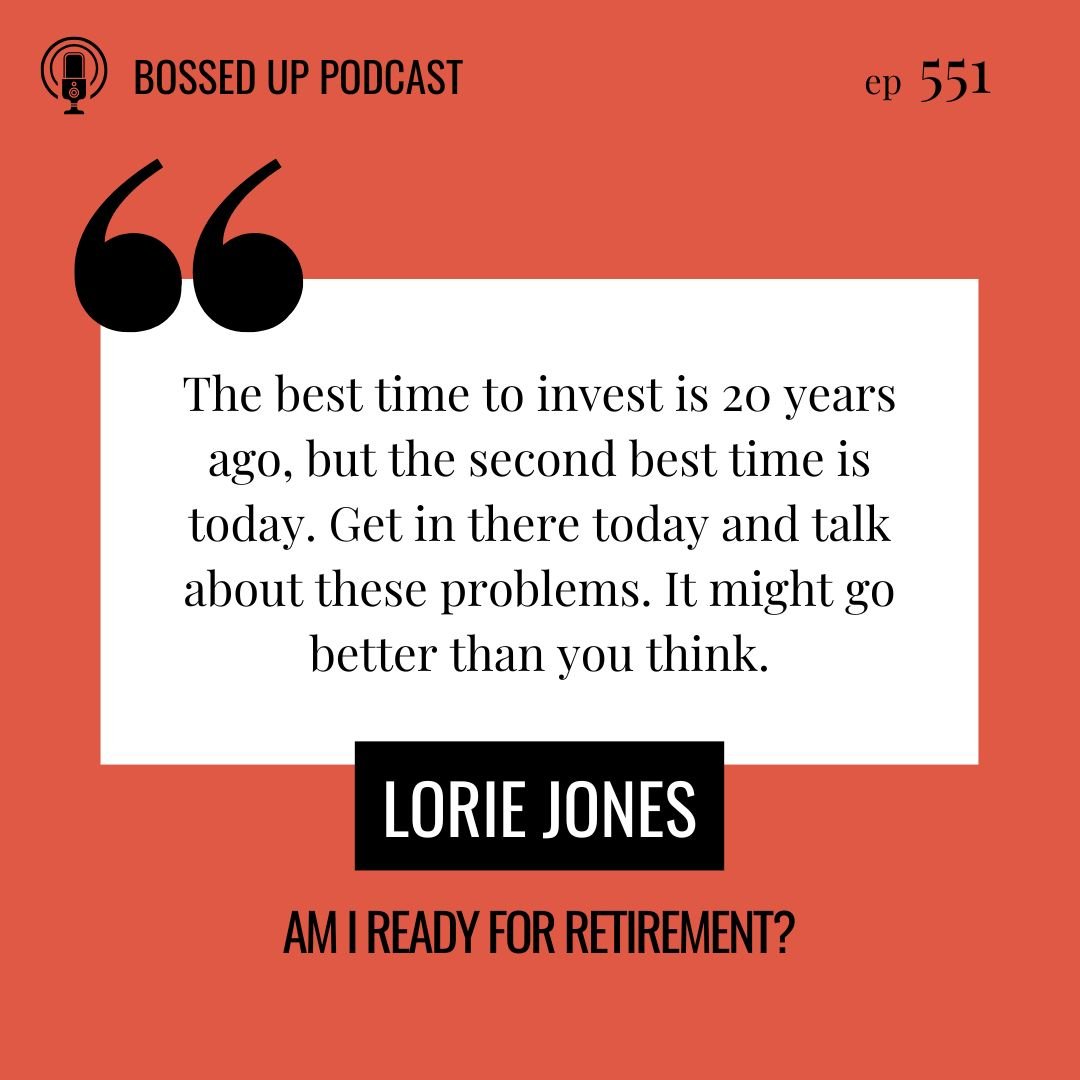
The good news, she says, is that the vast majority of women who come to her for financial advice are in a better position than they think. Often, a few tweaks will set them up for the kind of retirement they want. Sometimes, they even discover they’re primed to take that next step earlier than expected. The trick, Lorie says, is to confront that fear of getting bad news and get yourself to an advisor. As the adage goes, the best time to invest was 20 years ago, but the second-best time is right now.
AI is just another piece of the same puzzle
Women face countless biases, both at work and outside the office. From navigating the ambition penalty to bearing the burden of caregiving for children and aging parents to earning less on average, we’re not strangers to unexpected career interruptions. When I asked Lorie her take on the future of AI and all it implies for women’s jobs (which I talk about in Episode 540, The Double Disadvantage: AI, Women, and the Future of Work, and many other episodes), she’s of the perspective that AI is simply one more factor that could suddenly shift our career and financial futures. In other words, you already have lots of reasons to prepare for the unexpected, whether it looks like resigning to care for a sick parent or getting replaced by a bot.
Start early and stay the course
Lorie cites a satisfying research discovery: women are better at investing than men. We tend to take an appropriate amount of risk and avoid putting all our eggs in one basket, as I discuss in Episode 538, Rebalance Your Career Portfolio. Considering it was only about 50 years ago that women were permitted to carry their own credit, and that financial advice has long been treated as a one-size-fits-all solution (aka: designed specifically for men), we got ourselves up to speed admirably fast.
All these factors, not least among them the centuries-long reality of women’s work being largely unpaid and unaccounted for in the GDP, guide Lorie’s focus on women in her practice. We face unique challenges and start out at a systemic disadvantage, so approaching investing and advising in a way that tailors her message to women’s lived experiences is key. And if the idea of studying stocks and bonds freaks you out, Lorie reiterates: We’re smart; we can figure this out!
Whether you’re in a blind panic after running your pension numbers against reality, you sense a pending layoff, or you’re pretty sure you’ve made a good start and just want confirmation and some guidance, Lorie’s overarching piece of advice is to speak with someone you trust. There are great tools out there today that help financial planners paint a very clear picture of what’s possible for your future, equipping you with the knowledge you need to go forward with confidence.
Where’s your head at when it comes to retirement? I want to hear about your financial fearlessness and what you’ve learned along the way. As always, you can connect with our wonderful cohort of professionals in the Courage Community on Facebook or our group on LinkedIn.
Related links
Episode 386, How to Boost Your Energy With the Power of Nutrition
Episode 512, Your Emotions Around Money Matter More Than You Think
Episode 540, The Double Disadvantage: AI, Women, and the Future of Work
TAKE ACTION on true gender equality
for yourself and women everywhere:

-
[CONFIDENT RHYTHMIC DRIVING THEME MUSIC WITH DRUMS STARTS]
EMILIE: Hey and welcome to the Bossed Up podcast, episode 551. I'm your host, Emilie Aries, the Founder and CEO of Bossed Up. And today I want to talk about retirement.
[MUSIC FADES AND ENDS]
Something that we often don't think about when we are so busy running around tackling the to do list of the day. But this is something that is looming for so many of us, some of us more so than others. And in this age of AI uncertainty and economic shockwaves just rippling through entire industries, facing threat of automation or AI replacement, how should we be thinking about getting our financial lives together?
Joining me to break all this down is Lorie Jones, a certified financial planner and owner of Fearless Financial Advisors, a Colorado based firm dedicated to helping women navigate life's biggest financial transitions with clarity and confidence. She specializes in working with high income women, entrepreneurs, and those experiencing divorce or widowhood by bringing a practical, compassionate approach to financial planning. With more than 13 years of experience in financial services, Lorie's background includes meaningful work in retirement planning, including her time at Empower Retirement, which deepened her commitment to participant education and long term financial well being.
Lorie's also the creator and host of the Fearless Females podcast where she amplifies the voices of women leaders and fosters conversations around empowerment, leadership and financial confidence. Lorie and her husband David live in Colorado and enjoy a busy family life with five grown children and two granddogs, which you'll hear more about in our conversation. So without further ado, welcome Lorie to the Bossed Up podcast.
LORIE: Well, thank you so much for having me. I appreciate it. I was looking forward to this.
EMILIE: I know I'm, I'm delighted always to meet a woman podcaster and professional consultant advisor through a friend, which we did here in Denver. Shout out to Patricia, who brought us together. And Patricia was on the podcast too. I'll link to her episode on nutrition. And today I'm really interested in thinking about the health and wellness of our retirement accounts. [LAUGHTER] It is a crazy year. It is a crazy time and a lot of my listeners are either mid career or starting to think about the last act of their careers. And so I'm so delighted and excited to have you here. First, tell me a little bit about your background and how you came to be a financial advisor.
LORIE: Yeah, thanks for asking. So I actually, I had five kids and I spent the first 10 years of their lives at home just trying to keep them alive. You know, as you're trying to get those kids into the world and grown up, it's like a full time duty just to keep them alive and breathing.
EMILIE: Yes, absolutely.
LORIE: And my younger kids, my two little girls went to school, kindergarten and first grade, about the same point that my boys turned into preteens. And I don't know if I'm sure your listeners have experience with preteen boys. They start eating you out of house and home. Like there is no amount of food that you can put in their bodies to keep them full, right? [LAUGHTER]
EMILIE: And with the price of groceries today, I thought my toddlers were gonna bankrupt me just by their berry habit. I'm like, looking into buying berry bushes so I don't need to spend a fortune at the grocery store.
[LAUGHTER]
LORIE: Financial planning for food. I know, exactly. So as my kids started eating me out of house and home, I'm like, well, somebody had better get a second job because there's a full time just trying to keep them full. And I went out looking, I was just honestly looking for a job. I wasn't looking for a career. I was just looking for somewhere to spend eight hours a day and put some food in their bellies.
And I got hired as a secretary at a small financial services firm in South Denver. And I, it was like angel choirs were singing. I had found my calling. I didn't even know financial advisor was a thing that you could do. I had been raised in a household where boys did some jobs and girls did the other jobs, right? And the girls jobs did not involve planning for finances, making, you know, making the money, telling the money how to earn in investments.
And so it was, it was starting from the ground up. But I just loved everything about the industry. I loved the idea that you could help make a plan that would, would help people realize their dreams. It was just. Yeah, it was so exciting for me. And so I started at that small firm. I started getting my licenses, I got my insurance licenses, my trading licenses. Then I got my MBA and my CFP and started working on my CFA. Yeah, like, I was looking for the alphabet behind my name.
I figured like, then people would know I knew what I was doing. And at the same time, I kind of worked in the industry. I learned all the pieces, all there was to learn about financial planning and holistic financial planning. We delve into tax planning, we delve into estate planning. And I just wanted to have a really good depth of knowledge, as far as that. I came up on the operations side of things. So I worked a lot of times in making things happen. And so it was several years, probably five or seven years before I realized that the financial services industry is predominantly men. It's about 80% men and uh, 20% women. And so it took me a while to realize that I had clients of my own. I was doing financial planning for them. I was doing the job I needed to call myself financial planner instead of an operations person. So, so that was, it was a little bit of a learning curve for me to like, understand that who I was and claim that title.
EMILIE: Well, what I love so much about this story is that you help people, and women in particular, find that empowerment through plan, having a plan around your finances and your journey to getting there was going from like full time caregiver with five kids you're trying to juggle to earning money yourself, like, to making that calculation that look, it's time for me to make a financial plan myself, to then getting your MBA and all these certifications and helping others to do the same.
So, you know, for women in particular, you've kind of lived that journey of being financially dependent, right? And being an uncompensated caregiver, which is how our entire capitalist society has always run is on the backs of women's free labor, right? To earning your own money, you know, investing and helping others to grow that nest egg and find true empowerment and optionality there, is that right?
LORIE: Yeah. And I think that there's something to be said for the fact that learning how to take control of your financial future, learning that you shouldn't ever cede those finances, and that finance, those financial decisions to somebody else, even if you are, you know, a stay at home mom and the, and the one that's giving your free labor, uh, like you should never be out of that financial discussion. It's such an important part of your future. So, yeah, don't give up the driver's seat.
EMILIE: And someone who loves you, who cares for you financially, should not feel threatened by you being involved in the financial planning of your household.
LORIE: No. And that's not love. In fact, I have, I have clients where the guy is the primarily, you know, the man is the financial driver and his wife, a lot of times she just isn't interested in finance and he actually wants her to be. And so he'll bring, he'll bring the, you know, the couple come to me because he's like, maybe you can make it interesting enough. I'm like, I think finance should be fun. I think it should be fun and interesting. I think it should be understandable. We are not dumb dumbs, ladies. We are so smart. We can get this. It's not hard. It's easy.
EMILIE: Absolutely. And I have an episode, I did maybe a year or two ago now, that is so important for women listening to go check out. It's with a woman who specializes in financial, what is it called? Forensic accounting in the case of divorce. And she's just like one big cautionary tale, you know what I mean? For. For folks to listen, even if you have a wonderful partnership, like, never to underscore what you're saying, Lorie like, never cede awareness, never cede responsibility for your financial future.
And so for women who are like, yes, I am bought in, I'm locked in. Let's make money work for me this year, where do we begin? Like, how do you even know if you have retirement savings that are on track? It's such a big thing to wrap your hands around. Where can we start when it comes to raising our awareness of retirement?
LORIE: Yeah. I think that's such a good question. And I'll find that a lot of times, like women, this is always niggling at the back of their mind, like, you know, we are so busy. We just, we are so busy in our daily lives. We've got kids, we've got business, we've got soccer practice. We're raising the next president of the United States. We are busy. We just don't have time. But in the back of our mind, there's always this little piece that says, gosh, you should be doing more with your retirement. Gosh, you should understand investing a little bit better. Gosh, you should be doing a little bit better at this. And that's that piece that it's always. It's kind of. It's niggling, and it's making us feel a little bad about ourselves.
EMILIE: Anxious. Yeah, for sure. You're like, I don't know what. I don't know, but I should know something that I don't know. And that's just going to keep me up at night. And I feel like we're trying to make our, our income stretch at the grocery store. And that feels like a prudent, you know, use of our effort and time and energy, but at the cost of the long term view, right? That short term, can I make rent next month looms so large for so many people that, um, it's like I can't even think about 30 years down the road or 10 or 15 years down the road, and then that s*** catches up with you.
LORIE: Yeah. And so it's this constant cycle of, gosh, I should be doing something, but I don't have time or I'm scared or it makes me feel uncomfortable, then I have to like, get naked financially, that's, that's a hard thing to do, right? And so I think that, that the very first suggestion I make is, my company is Fearless Financial Advisors. Be just a little bit fearless. Like set the appointment, like come in and talk to a financial advisor and just say, hey, this is what I've been doing. It's shocking to me how a lot of times women will feel and men too obviously, but I work a lot with women, how they will feel like they're doing such a poor job. And they come in and I'm like, I have seen the gamut. Like I've seen hundreds, and hundreds, and hundreds of different financial situations. And I’m like, you're not, you're not bad, you're not doing bad. We tweak a few things. We can, you know, we can get you there. And they're all, they're always like so scared.
And as they, as they walk out they're like, oh, oh. It's just seeing that plan, knowing that. And you know, I've got the really cool financial, geeky financial programs that let you put all the numbers into them and then show you like this is what your trajectory could look like. And then you start thinking, you start thinking about what, what if, like, well, I didn't even know I was that good, you know? I had, I had one, one woman who came to me and she had a spreadsheet. She loved the spreadsheet and I'm a big spreadsheet girl, so I was all on board with this. But I put her information in her spreadsheet into my financial planning program and she, she took her retirement age down from, she was hoping she could retire by 55. And she's like, I could retire at 50. And I'm like, yes you could.
EMILIE: Isn't ah, that interesting? I wonder, do you find that people are in like two camps? There's like the overly anxious but actually kind of ahead of schedule people and like, who think they're behind schedule but are like really focused on it and therefore are more ahead of schedule than they think. And then there's the people whose heads are buried in the sand who have no plan. Like, do you find that polarization in the population?
LORIE: Yeah, I find that they, we, we each take a little bit, there are people all along the trajectory and we take a little bit from each of those things. I think each situation is just so totally unique to who you are and where you are. But I would say that, that in general people are often more prepared than they think they are. There's very few times that I come up with someone who is, just has no options. And, you know, like they've, they left it too long and they're just completely unprepared. And in that case we're talking about like, well, what kind of a Walmart greeting job could you get through retirement? Or something like that?
But that so rarely, it rarely happens. And I find that the times that it does is when those people have, have just, they just haven't taken that first fearless step. They haven't gone and taken a look at it. They've just continued to bury their head in the sand. So that is, that is my biggest, if you want to know if you're on track, you know, get the courage up and come chat with someone who can, who can give you like, this isn't taught in school. I mean, you know, they don't have like a retirement ready course, they don't have an investing course, they don't have any of these things. And so talk to somebody who has those tools and they can help even direct you in the right place.
EMILIE: Totally. Ideally during your income earning years, right? Like before it's totally too late. Because truly only in America do we see people in their 70s and 80s behind cashier, you know, in cashier roles and greeting at Walmart because like what a dystopian nightmare is it that we can, any one of us could be bankrupted by a healthcare nightmare, right? Like any one of us could become penniless overnight in our, in our system, unfortunately.
And yet doing what you can do as early on as possible to get yourself set up conservatively. You know what I mean? Is like it, it helps us sleep at night in case the what ifs are good and in case the what ifs are not so good. So having someone who can project the future with you, who can punch some numbers into a calculator and show you the plan, show you the path forward is so empowering because information is power when it comes to your money. Totally.
LORIE: And they just, they leave the, they leave the office and they're like, a lot of times they're like oh, oh I'm better than yes, and sometimes they're like oh, it, it was kind of what I feared. But we've looked at it and we've got a plan going forward. We've got a 10 year plan, we've got a five year plan, you know, like, you know, we've got a way to look forward.
EMILIE: I love that. It's funny, I'm just sort of relating so hard to what you're saying because I grew up in a household where we never went without, but I was one of four kids and things were like, I called it, like, financially magical. Like, some weeks it was like, we have no money, spend nothing. And then other weeks it's like summer camp. Sure. And I was like, wait, what's happening here? And it's because my parents love them to death. And man, were they wonderful. Have they been wonderful parents. But financial planning was not, planning in general was not their thing.
And I remember when I started Bossed Up and started working with financial advisors to serve our community here at Bossed Up, I absorbed enough information and then ultimately worked with a financial advisor myself. And that I said, okay, we need to get mom and dad to a financial planning office, stat. And just in the past decade, seeing them go from like their entire lives in their mid-60s of never having a professional give them any feedback to actually feeling like, okay, yeah, my mom's working till 70, which is not ideal. In 12 hour shifts as a nurse, like, that's not great. But she has the ability to sleep at night because she now knows what her retirement looks like. And that's, that is a not ideal situation, but it's a much better situation than trying to white knuckle it on your own, quite frankly.
LORIE: Yeah. I just love the idea that there is someone there that can help walk you through these, these steps that you can take to put yourself on a better future. And I love, I love that I get the opportunity to be that person that, it just makes me so happy.
EMILIE: Yeah, and it's such a sacred role, honestly. And like providing that level of clarity and comfort, ideally for folks. I want to contrast that with the anxiety rippling through our workforce at the moment, which we've been talking a lot about on this podcast. AI, right? There's been a bit of a panic I've seen really hit white collar America in particular.
Just a couple months ago, there was that viral LinkedIn piece that said, like, you know, AI is coming for white collar jobs and people freaked out, understandably. So I've been talking a lot about how women in particular are facing a double disadvantage when it comes to the AI economy. Our jobs are more exposed to automation via AI agents, and the kinds of jobs that will be created with the economy of the future are more likely to go to men.
So for women in particular, how should we be thinking about this looming threat to our income earning ability and potentially for entire sectors to be wiped out if we're sort of scooted out to retirement way earlier than we'd been planning on? I'm just wondering what your thoughts are on that.
LORIE: Yeah, that's so interesting. And yeah, I've seen those pieces where they're like, oh no. In fact the market went down one day based on those pieces coming out and saying, you know, 20% of the workforce.
EMILIE: I think AI is the only thing propping up our market right now too.
LORIE: Yeah. Yeah.
EMILIE: It's like Wall Street can't make up its mind. Is this a gold mine or a catastrophe?
LORIE: Yeah like, should we be worried? Should we not be? I think that the advantage of working with women is specifically the fact that women actually face, it's not just the AI challenge, we face caregiver responsibilities that ah, could take us out of the workforce early. We, we're the ones that have the kids. A lot of times we, we face huge stretches in our career where we are out of the workforce or partially in the workforce. And so as women specifically, we actually have to plan for that.
So we are already planning for, you know, the possibility of early retirement because we're, we're fulfilling our caretaking responsibilities which are primarily on women, you know, rather than men. We take care of, a lot of times our parents and his parents, you know? A lot of times we take care of the kids and stuff like that. So I think that the way that I think of that piece is that AI doesn't present any different challenge than we're already facing. And we already need to plan for our careers to be shorter and more interrupted so that when we are fully employed, we need to be doubling what we're, we're saving because there are, there are possibilities, very real possibilities for us that our working lives are, are going to be different than a man's.
And that doesn't even address the fact that we make less than men, you know? So, so we already have to save a higher portion of our income. So I think that AI, although a challenge, is not a challenge that we don't already face, you know, And I also think that as women, some of the things that I, I do a podcast called Fearless Females and I talk to successful professional women in all different industries to kind of get their, their what they did well and their tips and tricks and that sort of thing. And I find that women are often thinking about how do I change my skill set? How do I grow. How do I. Those sorts of things are things that we're already concerned about because. Because we have to be twice as, you know, twice as credentialed twice as so. So these are already things that. This isn't an AI thing. This is a we've dealt with this.
EMILIE: Yeah, I'm kind of hearing this idea that women have had to be so resilient in the face of systemic bias in so many regards when it comes to finances, that the most successful women I'm hearing are conservative, right? Are sort of like over saving to account for under earning potentially our entire careers or having more high likelihood of interruption. But that scrappiness is a benefit.
And you know what, you know what comes up for me there, Lorie is that women are the people that every company is marketing to. So there's this like, dichotomy of what I'm hearing is like the value of frugality is more important for women, right? The value of like saving more than you even think you need to has a major impact on women's long term happiness and financial health. Especially because we live longer than men on average, right?
LORIE: Yeah, we live longer. We've got interrupted career paths. We make less. Like, women are unique. I think that something that isn't emphasized enough, especially in financial services. Like, you know, you know, when you do you, you hear about those studies on women's health where they just test man or you know, women's seat belts and they test them on men. You know, like, I think the same thing happens in financial services. Like, we're like a one size fits all sort of industry and women have very unique challenges, I think that, I think that we need to stop treating them the same.
EMILIE: Totally. Women are not smaller men.
LORIE: No. Yeah, exactly.
EMILIE: Yeah, I think that's so true. And I'm sort of frustrated by how much pressure there is on women to consume. Like, women are the number one consumers of consumer products. And so I think about like, who's getting pressure to buy the nicest purses, to be judged by the fanciest shoes, to get our nails done, to get our hair done, to get our, you know, to put makeup on. Like, these are expenses that women incur at a higher rate than men. And yet there's some like, inherent tension. I'm not saying don't buy the makeup because there's also beauty privilege. You know, pretty privilege is real too.
And so it's like what I'm hearing is that in a world that wants women to martyr themselves and provide our labor for free and be caretakers at the cost of our careers and earning potential. And by the way, buy more, spend more of our hard earned dollars. It is a radical act to pay yourself first by saving your money for your retirement, right?
LORIE: Yeah. Yeah, I think that that is a really valid point and really important to think about. I actually, it brings up, I was reading a study not too long ago that just talked about how women are actually better at investing than men are. And it pointed out that women have, they do the things that, you know, as a financial planner, they tell you to do, which is invest broadly. Don't put all your eggs in one basket, so to speak. So you're not overalllocated. You do need to take some amount of risk, but an appropriate amount of risk rather than, you know, betting it all on Tesla or going to the moon on, you know, something like that.
Women are more thoughtful about investing and over the long run, over the course of a lifetime, they take appropriate risks and appropriate allocations and they actually end up with bigger retirement savings. And we save more. We have to. We've been told we have to. So we actually save more than men. So it's so interesting that the narrative for so long, women have only been allowed to own credit in their own name for something like 51 years, something like that. Like, we literally could not even join this whole financial services realm of things until 50 years ago. And we're getting up to speed very quickly, taking the reins, understanding. And then when we're successful, we do different things with our money than men do. A lot of times in social programs, we're helping kids grow, we're helping nonprofits benefiting society. So I'm a big fan.
EMILIE: Don't let anyone tell you that women are not good with money. Okay? Is what I'm hearing. Because even if it's all foreign to you, get started because you're going to be good at this. It'll take some learning, it'll take some effort, but getting in is the first, most important step. What would you say to the woman who's nearing retirement, who's been ushered out the door, who's like, oh my gosh, I'm 55, this was not in my plan. Am I really going to be a job seeker at 55? Like, I have a lot of women come through our job search programs who are very anxious about the very real threat of ageism, and sexism intersecting and negatively impacting their odds of landing a good paying job. So what would you tell someone who's staring down the barrel of an early retirement she wasn't planning for.
LORIE: So I would go back and tell, I mean like ideally you ask me what the best time to start investing today or the best time to start investing is 20 years ago, right? And the second best time is today, right? So, I would go back and tell her, like, make that plan early. Start earlier than you think you need to. Because you know, as we talked about, women have um, interrupted earning cycles. Double, you know, like do more with the time that you are fully employed to take advantage and be over prepared a little bit in this retirement area.
So if they, you know, if you're staring down, I don't think it's just women either. Like you don't have that longevity like the pensions. You used to work for a company for, you know, your entire career and then you'd retire and you'd have this wonderful pension and, and you could live, and it was wonderful and it was all planned and that isn't the way that our lives go anymore. So you've got to plan for the unexpected. You've got to actually plan the what if scenarios. Hey, I'm planning on retiring at 65, but I'm going to take, I'm going to make sure I can retire at 55 if I need to. And kind of make sure that you are talking to a professional to again, it's shocking.
I just spoke with a woman yesterday and we were talking about retirement and she was saying she was closer to 60 and her and her husband had saved very little for retirement. And she said, Lorie I just looked at my Social Security. She's like, and I don't have enough to retire on Social Security. She's like, I'm panicking, what do I do? And we kind of looked through and I'm like, you know, if we supercharge these next, you know, five or 10 years and you know, you live in this range of spending, I'm like, you actually could be just fine. And so with that idea of the best time to invest is 20 years ago, but the second best time is today, like get in there today and talk about these, these problems. It might go better than you think.
EMILIE: I love that. So even if you are in a blind panic, like bring someone in to help you make sense of the situation and don't make any assumptions until you have a plan in place, I think that's really sound advice. Where can our listeners keep up with you and learn more about all that you have to offer. Lorie this has been so helpful. Thank you.
LORIE: Oh, well, good. I'm so excited. I love talking about this and and I tell you all the time, I'm like, you probably have a harder time shutting me up [LAUGHTER] than getting so you can come to my website, which is FearlessFinancialAdvisors.com. I've got the the blog on there. I've got the podcast on there. I working on a video series kind of targeting younger adults on the fearless first like, those first time that you buy a mortgage, file your taxes, join a retirement plan. Like all those kind of getting you started with the idea that financial education should start really young and prepare you for the future. You can also find me on LinkedIn, Lorie Jones and my email is all over the place.
EMILIE: Awesome. I'll make sure to link to all those great resources. Lorie thank you so much for being here.
LORIE: Thanks. I appreciate it.
EMILIE: For links to everything Lorie and I just spoke about, head to bossedup.org/episode551. That's bossedup.org slash episode 551. There you'll find an entire written out transcript of our conversation, as well as a blog post highlighting Lorie's key points. And make sure you check out the show notes for today's episode because I've linked to other related podcast episodes I've done in the past, featuring some other incredible guests and certified financial planners who can bring additional insight to this topic too.
[CONFIDENT RHYTHMIC DRIVING THEME MUSIC WITH DRUMS STARTS]
As always, I want to hear from you. Let's keep the conversation going as always in the Bossed Up Courage Community on Facebook and in the Bossed Up Group on LinkedIn. And until next time, let's keep bossin’ in pursuit of our purpose. And together let's lift as we climb.
[MUSIC FADES AND ENDS]