Episode 538 | Author: Emilie Aries
How can you rebalance your career portfolio to diversify your income, protect your energy, and future-proof your work in an unstable job market?
When someone hears the list of projects I have going on, they tend to think I’m nuts. On any given day, you’ll find me focused on my corporate job, my Bossed Up business, advocacy work, our real estate side hustle, and parenting two littles. Fair enough, I realize it all listed out at once does, in fact, sound a bit crazy.
But here’s the thing: I think it’s far riskier to invest all your time, energy, and identity into a single job.
We’re living in an age where AI feels like it’s threatening everything. Just look at the recent article by Matt Schumer, citing the looming (and already occurring) job losses due to AI! For that reason, and many other features of our modern job market, “investing” in a single area is a risky venture!
Back when loyalty between employers and employees was mutual, that kind of focus might have made sense. But today, people across generations are navigating never-before-seen career upheaval. That’s why I believe diversifying your career portfolio isn’t a distraction—it’s a strategy.
And yes—this conversation was prompted by my own newest side hustle, which I’m finally ready to share 👀
Imagine two pie charts
When I’m talking about career diversification, I like to think like a financial planner. If a client asked me to put their entire life savings into one single investment, I’d tell them to reconsider immediately.
Now imagine your career as two pie charts:
Income Pie: If all your income comes from one source, you’re vulnerable.
Energy Pie: If all your effort, creativity, and skill are poured into one role, you may be over-investing your gifts in a system that doesn’t fully serve you.
Career resilience comes from balancing both of these portfolios.
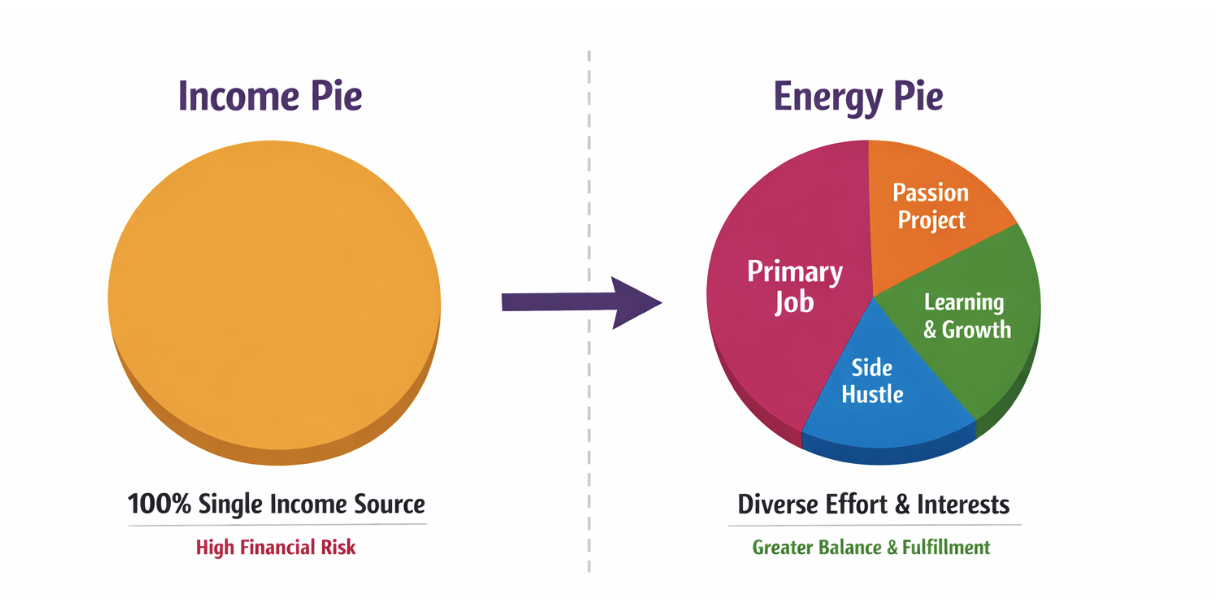
Career pie chart created with the help of AI.
It’s not about quitting your day job
This is definitely not my way of telling you to quit your day job, or quiet quit your day job, or even start sneakily running another gig off the side of your desk. Rather, it’s about figuring out where you can redirect resources to some other streams—like what we talked about in Episode 536, Strategic Detachment: A Trend for Surviving and Thriving.
If you redirected even 10% of your effort from your primary job toward something else - learning, experimenting, creating - your performance likely wouldn’t suffer. But your sense of possibility might expand dramatically.
I’m also not suggesting you have to monetize your hobbies. If you already know that trying to make bank from your passion for watercolor painting would ruin the experience for you, that’s fine! What I want to do is give you permission to lean into your interests, to open up more possibilities to enjoy your job and your life.
Three tips for diversifying your career portfolio
So, to my announcement: I’m starting a pop-up porch bakery!
I love baking, and I’m so excited to pop up on the weekends in my neighborhood in Denver, offering fresh-baked focaccia, muffins, scones, and cookies. Planning and preparing for this has been an amazing experience that’s reconnected me with my love of baking, my mom and sister—who are also big bakers—and my community. I’m loving the diversification this is bringing to my energy and potentially (we’ll see) to my income. More than anything, I’m loving how it’s already bringing my neighborhood closer together.
So with this fresh pursuit in mind, here are three things to consider as you’re pondering a career addition or energy adjustment.
Pursue what you’re already interested in.
I’ve been an avid hobby baker my whole life, and that pretty much sums up tip number one. Don’t pick a side hustle just because you heard it’s a good way to make extra money. You’re going to be thinking about this topic a lot as you plan, nevermind when you execute, so make sure it’s something you’re already interested in.
2. Run some low-stakes experiments
When I decided to sell my baked goods, I didn’t run out and buy a bakery. When you’re getting started, reach out to family and friends to get feedback, and launch some low-cost and accessible evaluations. But don’t forget to explore the monetization aspect in a real way. As Eric Ries writes in The Lean Startup, no early business experiment is truly an experiment until actual value is produced.
3. Don’t be afraid to go off-brand
I spoke with an agent from a reputable agency years ago about my “brand.” She asked me to share things about myself, and when I mentioned baking, she immediately kiboshed associating such a traditionally domestic, feminine hobby with my feminist, political-organizing persona. (Actually, it’s something of a radical act to uplift a traditional practice while also fighting for women’s rights and equality, but okay.)
If you’re running with the first tip, don’t worry about how your new venture “fits” with your brand, your lane, your persona. Worry about how it feels to you. What resonates with and invigorates you? Whether or not it “makes sense” with your official title doesn’t matter.
The Real Constraint: Time
Don’t think I’m overlooking the fact that a side hustle takes time and energy, and those resources are in the red for the vast majority of us.
Think about what you do when you collapse at the end of a long day. If it’s doomscrolling on your phone or watching trashy TV -and hey, no shade if it is -then redirecting those hours into something that brings you joy could be just as relaxing and way more satisfying.
Think like a freelancer, even if you’ve always had a corporate job. Ask yourself:
How can I reduce risk?
Where can I grow and learn?
How can I diversify both income and attention?
What would rebalancing your career look like for you?
Pop into our Courage Community on Facebook or join us in our group on LinkedIn to inspire and be inspired by the big ideas of other women pursuing their passions.
Related Links From Today’s Episode:
Episode 536, Strategic Detachment: A Trend for Surviving and Thriving
My NEW LinkedIn Learning Course: Get Unstuck: Make a Plan to Move Your Career Forward
Make a plan to move your career forward
with my NEW Get Unstuck LinkedIn course:

-
[CONFIDENT RHYTHMIC DRIVING THEME MUSIC STARTS]
EMILIE: Hey and welcome to the Bossed Up podcast, episode 538. I'm your host Emilie Aries, the Founder and CEO of Bossed Up and today's podcast is a timely one.
[MUSIC FADES AND ENDS]
In fact, I'm recording this introduction closer to the release date. It's Thursday night here before the Tuesday episode release because I wanted to update the introduction to explain the importance and the timely relevance of this whole conversation around building your portfolio career, which I think is more important now than ever.
Today's episode is all about diversifying your revenue streams as an individual or as a household in the age of uncertainty that has been particularly ushered in by AI disruption. And I wanted to re-record this introduction because if you like, millions of us happen to see the article that went viral, like mega viral last week on LinkedIn by Matt Schumer. It's called Something Big Is Happening. It sent shockwaves through white collar worker America because it makes the case that the new, newly released AI chatbots that are out there through both Anthropic with their Claude and ChatGPT, they are so much more sophisticated than you might have known or than you might think if you were using ChatGPT a year ago and were like kind of not that impressed with it.
To the point where Matt Schumer and frankly many economists and other technologists in the AI space are predicting mass replacement of white collar workers with AI in the next 12 to 18 months. That's pretty alarmist. And there's a wide spectrum, I should say, of philosophers out there, economists and philosophers and technologists, some of whom are far to the side of optimism. AI is going to be the assistance and the freedom that we all have always wanted, versus AI is going to create mass unemployment and have no available jobs. It's going to trigger a recession like we've never seen before.
Like there's a broad swath of perspectives out there. But this, this particular article, if you haven't read it, I would highly recommend checking it out. I'll drop the link in today's show notes, it really resonated with a lot of folks who felt like so many people, and particularly so many women who've got the degrees, maybe who have grad degrees, right? Who've worked really hard to get to where they are today. If you are in professional services, everything from accounting to legal to consulting, those jobs are going away and going away soon.
And these are folks who haven't had to think like entrepreneurs for the majority of their career. And so today's conversation is part of what I'm really feeling called to do here now, which is to really lean into this AI conversation as it pertains to the future of work and the future of our workforce. Because the kinds of podcasts like the one I've created weeks ago now for you, that you'll hear in a moment, I think are more relevant than ever. Because we need to be strategic and we need to be creative in terms of shoring up our financial resilience for what is coming next.
And the disruption, to be clear, has already started. Just look to the layoffs that the tech industry have faced over the past year. There is good reason to believe that is just the beginning. And I'm not trying to scare anybody, but I'm feeling a little scared. Like, I think the nature of that article Matt Schumer wrote really resonates and feels true because it is so daunting and relatable in that he likens it to being one of the early researchers understanding the scope of COVID19 back in like February or March of 2020, and just how so many people are not grasping the full scale of what's coming.
So, as you can probably tell, I'm not an AI optimist, but I'm also not a fatalist. I think there's opportunity here. I think there's a heads up that you can heed right now and start to get real busy figuring out how we sustain ourselves and how we navigate whatever pivots might be necessary moving forward. In fact, I've been working with LinkedIn Learning recently. I just released a new course with them this week. It's actually a re release, a total reimagining of a course that I first created with them back in 2019. It's called How To Get Unstuck And Propel Your Career Forward. Except this time, when we created it, we infused AI tools at every step of the way. So if AI is coming for our careers, we might as well leverage AI to try to navigate the new normal of career pivoting and career transformation.
And so that's a topic that I'm excited to share in that course. Check out my post on LinkedIn about it, because you can access the whole course for free via the link that I shared a week prior. So, like a week ago, if you're listening to this, on Tuesday, I posted last Tuesday, the last Tuesday in February about this. But that's kind of indicative of the conversations I want to host a lot more of here, which is what does this AI revolution mean for us? Particularly for women in the workplace, because let me tell you, the gender differences are stark in terms of how this AI disruption is going to disproportionately negatively impact women and folks of color.
And then what we can do about it. What are the predictions around the jobs of the future, the economy of the future, and how can we best prepare ourselves for it? So buckle up. A lot more of those conversations are coming our way because let me tell you, the things I've always cared about. Women, workplace equity, workers rights. They are more relevant than ever in this new era that we're entering. So prepare for change, because change is a coming, and I'm excited for us to navigate it together.
Okay. Wow. That ended up being a lot longer than I meant it to be. But there's a lot going on here behind the scenes, and I just wanted to pull back the curtain for a moment. Okay, without further ado, let me cut to the episode I originally prepared for you all about pursuing a portfolio career.
[CONFIDENT RHYTHMIC DRIVING THEME MUSIC STARTS]
When people I talk to hear about all the different things that I've got going on, like raising two kids, working a corporate job, juggling Bossed Up, podcasting and speaking, and all the work we do here,
[MUSIC FADES AND ENDS]
real estate development with my husband, and all my work as an advocate, and then I share that I'm starting a new side hustle that I think I'm finally ready to tell you about. They look at me like I'm crazy. You might be listening to this, thinking that I sound crazy. And I get it, [LAUGHTER] I really do. But you know what I think is crazier? Putting all your eggs in one career basket. Now more than ever with all the volatility in the marketplace, it feels like a risky proposition to overinvest in any one part of your career. That's why I've never felt more sure that diversification across your career and ideally across your entire household's income streams is a really smart thing. In fact, I think it's a modern imperative in today's world.
I don't think it should necessarily be this way. I like, look back on the days of the company man era, where employer and employee loyalty was high, where your company would send you home with a turkey for your family for Thanksgiving, and where you spent 30, 40 years at the same company over the course of your entire career. I look back on those days with nostalgia and longing, quite frankly, what a luxury it must have been to be able to rely on a company and to rely on your employer in that way. That's not the reality anymore. That's not the market that we're living through, that we're facing.
And so more and more millennials, Gen Zers, Gen Xers, and really folks across the age spectrum who are navigating constant upheaval and career change. The concept of a portfolio career is something I want to talk about today as a really smart thing to consider for any one of us. Whether you're looking for a career change or not, whether you are happily employed or discontentedly holding on and hugging onto your current day job because the job market feels so untenable. I get it. You know, we talk a lot about that here at Bossed Up, and we've got tons of free resources for job seekers. But I think every one of us should have our eye on what else is out there, not only as it relates to another employer, but really thinking about how you might explore other alternatives to increase your diversification.
So what am I even talking about here? What is a portfolio career? Let's start there. It's about thinking of your entire career. Kind of like a pie chart, right? Where I’m in fact envision two pie charts. One pie chart is all about where my income comes from. If your entire pie chart, 100% of your pie chart, 100% of your income comes from one source, that's a very risky proposition. That's an all eggs in one basket situation. No financial advisor would ever allow you to have a retirement portfolio or investments that look 100% all in on crypto. That could be a bad idea. 100% all in on government bonds could be a really bad idea. You want to have diversification, and the same is true for your income streams.
At the same time, that's not all I'm talking about. When I think of a portfolio career, I think of the pie chart next to my income pie chart in terms of output. Not just what's coming in, in terms of income, but what am I putting out in the world in terms my attention, my effort, my gifts, my skills. Because if 100% of your attention is going to one source, I would argue that you are over investing in your gifts, your talents, your attention in one place.
I recently had a challenging conversation with my darling Brad the Boo. And I said, look, I know you love your place of work. I know you are proud of the company you've built, of the team you lead, of all that you do. But you have a lot of other things going on, right? You've got some real estate endeavors that you're squeezing in around the margins on nights and weekends. He's designing a ADU build for us right now, an auxiliary dwelling unit, which is like a little house we're building from scratch in our backyard right now. And he's been working on that for years, but barely, right? Slowly, because he doesn't give himself the time of day to work on that.
And I really kind of pushed back and said, look, yes, you've got parenting going on just like I do. Yes, you've got other hobbies and friends and fun time, but you have other, like, work streams, you have other passions you're pursuing, other growth opportunities you're exploring that warrant more of your attention. And right now you're over invested in your day job from an attention standpoint.
And in fact, I challenged him and said, look, let's make an assumption here and say that you're giving 95% of your time and attention, your skills, your effort, your energy to your current employer. I would venture to guess that if you gave 85% instead of 95%, the impact on your company would be negligible. But if you gave 10% more of your time, energy and attention to the ADU project, the side hustle you're working on, the other passion projects and areas of your life that are, by the way, like, those are not nonprofit endeavors, right? Those are also fueling income streams down the road. If you gave 10% more time than you're currently giving that, the impact on that project would be enormous.
And I think that really got through to him because I'm not saying to anyone, if you love your job, you should bail on it just to take on some other hobbies and side hustles. No, you can still give the vast majority of your time, energy and attention to your main stream of revenue, your primary job. But think of what you could do with 5 or 10% more time devoted to something else. The ROI there could be enormous.
And so that's why I think we need to practice what I talk about in the episode from a couple weeks ago on strategic detachment. Where am I adding value and where can I pull back? Because frankly, I'm just over involving myself on things that don't really require my skills and experience and don't where I won't really have a huge impact to create a portfolio career for yourself, to create opportunity to explore other revenue streams. And like I said at the very top, like, there are other aspects of my portfolio that are not revenue generating, like the advocacy work that I do or the parenting work that I do, which is a lot. That's not a for-profit endeavor, but it still requires my attention and my energy and my skills and my gifts.
And so I just, I want us to think more holistically about diversifying those two pie charts, both of what's going out, your attention, your effort, and what's coming in. Because having a portfolio career in your household can be a really helpful way to hedge your bets in a volatile world full of change, full of upheaval, where technology is changing things so rapidly, entire career paths are going to be wiped out as they continue to evolve and change in this landscape. And so you want to diversify your risk.
If your primary income stream goes away tomorrow, you want to have something else, bringing in some revenue, some income. And so having a portfolio career or portfolio approach to your career can help diversify your risk, but it can also just be more fun. [LAUGHTER] We talk about multi-passionate or multi-hyphenate careers as though there's some rare thing. But all people have more than one interest, right? So what would it look like to free yourself to spend some more time on the things that matter to you? To, like, give yourself an excuse to lean into your passions, your hobbies, your interests, and maybe even explore if there's a pathway to profit off of them, whether it's educating others, or monetizing your hobbies by entering the business realm of whatever it is that you're into.
If that does not appeal to you, if you're like, Emilie, please don't ruin my hobby by making me a professional at it. I hear that. I totally get that. As I was recently telling some of my college besties about this new endeavor, this new side hustle, I'll disclose in a minute, my best friend from college was like, that is so Emilie for you to try to like, monetize your side hustle, your side passion. I was like, well, that's part of the fun, right? For me it's not just the thing, it's the business aspect of it that is fun. So if that feels fun to you, go for it, right? Like, give yourself permission to try. I think it's more fun to have multiple avenues you're pursuing at once. I think it can open up opportunities for feeling more purpose driven in your career, especially if your day job is, like, dull, is bumming you out, is not aligned with what you're passionate about.
And finally, the other big benefit of having a portfolio career is that it puts learning and growth into your own hands. You're not waiting on the HR team's approval of your professional development funds. You're pursuing learning and growth through trying and experimentation. So I want to give you a couple of examples of how to start diversifying your career and kind of pursuing this portfolio approach.
The first is to follow your interests. So for me, this looks like leaning into the world of baking. I am excited and a little like, nervous about sharing this new endeavor that I've been working on behind the scenes very quietly. But I'm starting a porch bakery, one of those like pop up porch bakeries that you might see on Instagram on occasion. I'm not a sourdough girly, so I'm not going that realm, at least not yet. But I've been fine tuning my focaccia recipe. I've got some awesome muffins, cookies, cakes, you know, sweet breads, things like that. And I'll be popping up Saturday mornings in my cute little neighborhood on a park in Denver. And I'm really excited about it. It's going to be like a way to start the weekend off in a neighborly, friendly community building endeavor that's like really lighting up the community organizer in me and also reconnecting me with the baker in me.
In fact, my very first business in high school was making custom cakes for like my teachers and friends. And it was so fun. And so I'm really delighted to be reconnecting with something that's been a part of me for a long time. I mean, my mom, my sister are prolific bakers, far superior to me. And so it's like reconnecting me with them, kind of creating an exciting new vision for my neighborhood. Like there's so many aspects to this endeavor that lights me up. So following your interests first and foremost is key here because it's going to be something you got to think about a lot. You got to want to think about a lot. You don't want to have to drag yourself to a new endeavor. Just you don't want to become interested in something like vending machines. Because you've heard vending machine management can be a good side hustle. Like start with what you're already interested in and you're better off from my vantage point.
And then take some low stakes experiments, try some things out, entering the real estate market to become a house flipper. Not a low stakes experiment. That's a very high stakes, high cost, high risk, potentially high reward endeavor. Let's not start there. Let's start somewhere a little closer to home. Something a little more manageable, a little more attainable, a little more low cost. Like start with what is accessible to you and experiment. Try things out. Don't just try things out on your own, try things out in community. Because if you're looking for something that could truly be a side hustle, you need someone who's willing to pay for it. And so experiment with your target audience, with your prospective future customers.
The Lean Startup by Eric Reis taught me a long time ago now when I was just starting, Bossed Up, that no early business experiment is truly an experiment until money is exchanged, right? Until actual value has been produced. And so keep that in mind. Like, you don't want to just be baking your baked goods. You want to be baking your baked goods and having your neighbors test them, try them, weigh in with how much they might pay for them, and then eventually pre-order them and sell them to your neighbors or whomever you're targeting.
Don't be afraid to go off brand. If you're an accountant, you do not have to stay in that lane when it comes to diversifying your career. I know someone who has a financial blog online who's been producing content around personal finance and who experimented with having a farm stand with fresh chicken eggs that she sells, you know, in the last year. You do not need to stay in your lane when it comes to diversifying your career portfolio. In fact, I encourage you to not stay in your lane.
What was really interesting to me about this porch bakery was I felt for many years like I couldn't talk about my love of baking because it was somehow off brand when it comes to Bossed Up and feminism overall, which is such bulls***. But I actually years ago was talking with an agent at a major agency and she gave me some advice. Personal branding. Three words that kind of describe who you are and what you're all about. So what you should be sharing online about you. And we were kind of exploring my life and what I had going on at the time. And I said, well, obviously feminism, girl power, you know, advocacy, leadership, all that was a given.
And then I said, well, I like to play the drums. And she was like, great, super aligned. I love to bake. And she was like, no. [LAUGHTER] She was like, you cannot. That cannot be part of your brand trifecta. Which was so offensive at the time and I didn't really recognize it for the patriarchal nonsense that it was. But even if you look online nowadays, like the baker accounts that I follow, they're all like, very much coded with traditional femininity in a way that I find just so fascinating. In fact, it kind of tickles me a little bit, like wading into my baker identity is actually kind of a radical act as a feminist and a community organizer who wants to bring my neighborhood together through baked goods, right?
So this is not about me being barefoot and pregnant in the kitchen, right? [LAUGHTER] This is about me being a business owner and me pursuing a business. Just like these trad wives who are influencing millions of people on social media are in fact running businesses, but cosplaying traditional housewife along the way. So it's been a really interesting time and I'm curious to hear your feedback and thoughts. I think that's part of the reason I was a little sheepish about expanding my brand identity in this way, because it did feel like I was explicitly told by a branding expert that being a baker is antithetical to being a feminist. Yikes.
Becca, the creator behind The Sweet Feminist on Instagram would disagree, right? She's been making cakes with reproductive rights messages behind them for years on Instagram. And I adore her. So I just think it's like, it's a very interesting time to be expanding beyond the confines the social constructs that people will put other people into.
So I encourage you to give yourself permission to think beyond your swim lane, what you're already doing. Because an attorney can have a side hustle as a professional organizer. And that's cool. That's fine. That's okay, right? A stay at home mom can have a side hustle in the form of a part time consulting business. And that's okay. The idea here is multiple hats is a good thing. Like multiple revenue streams, multiple buckets that get your limited time, attention, energy, and gifts that you have to share with the world can be a good thing.
Making the space for this is the number one challenge. I can hear it already. You're like, Emilie, what the f*** are you talking about? I am so overwhelmed by the world. I was just having a conversation with my girlfriend about this. She was like, by the time I get home from my corporate job, nine to five, pick my kids up from aftercare after school, get dinner on the table and get them into bed by 8 o'clock, I cannot get off the couch. And I said, me too. What do you do on the couch? And she admitted, I'm watching trashy TV, and no shame for that, I think that's great. Like, does it make you feel better? She was like, not really. It's garbage. But at least I'm not just scrolling on my phone.
And I'm like, yeah, that's what I do when I hit the couch. I doom scroll. And she's like, I know I've been doom scrolling for hours, for way more hours a day recently than previously. It's giving me anxiety. I just feel so overwhelmed by the world, I don't even know what to worry about. I'm like, girl, same first of all, and let me just paint a picture of an alternative for you. If there's something that fuels you, that lights you up, that makes you feel good, particularly there's this great Jewish proverb that kind of goes like, if you work with your mind, you should rest with your hands. And if you work with your hands, you should rest with your mind.
So if you're a construction worker who's using, who's doing physically taxing work all day, then rest for you should look like picking up a book or chilling, like in some intellectually inspiring way, listening to a podcast, right? That kind of mind based rest. But for me, who's at a desk all day, who's leading meetings all day, who's thinking about ideas all day, resting with my hands is a far superior alternative than resting on the couch scrolling through Instagram reels, right? Like, and I said this to her, I said, I just feel so much better after bedtime if I can just pull myself off the couch, get some focaccia bread proofing, or mix up some muffin batter for baking the next morning, like, I genuinely feel better and sleep better if I can just resist the temptation to give all of my attention to big tech in the evenings.
And she said, you're totally right. And I don't know if I'm totally right. This is not true for everyone. You got to know yourself. But if there's a way where those interlapping circles, those Venn diagrams, like, I'm thinking of, like an ikigai chart, where the things that excite you, the passions you have, can it potentially overlap with some revenue, some income that you're adding to diversify your income streams? That's something worth looking into, that's something worth experimenting with.
And so I want to encourage you to think like a freelancer, even if you're not. What clients can you pick up? What side hustles can you experiment with? How can you shape your career into more of a portfolio that is well balanced in order to mitigate risk, increase learning and growth, and diversify your income streams as you diversify, what gets your attention.
If this resonates with you, I'd love to hear what this looks like in your life. I don't want to be a part of, like, hustle culture in saying we should always be productive creatures. I'm also, just to be clear, kicking my feet up and reading fiction. And I'm also watching great movies and having dinner dates whenever I can squeeze those in. Like, I'm also enjoying rest and taking rest when I need it, including very regularly binging on social media. [LAUGHTER] Like, not that I'm proud of that it shouldn't always be productive, but I would challenge you to divest some of your attention if you're giving 100% of it to one source and see where that little 5 to 10% of your attention could go in a way that would yield an actual return on that investment for you.
For links to all the things I've been talking about and a blog post synthesizing today's key points, or a fully written out transcript if that's your thing. Head to bossedup.org/episode538 for more that's bossedup.org/episode538 and I want to hear how you are rebalancing your career
[CONFIDENT RHYTHMIC DRIVING THEME MUSIC FADES IN]
or if this is something you're thinking about. Let me know how it's going. Let's keep the conversation going as always in the Bossed Up Courage Community over on Facebook or in the Bossed Up Group on LinkedIn. And until next time, let's keep bossin’ in pursuit of our purpose, and together let's lift as we climb.
[MUSIC FADES AND ENDS]


Michelle didn’t let her non-traditional background stand in her way.