Your Value Proposition is the Biggest Asset of Your Job Search
Episode 544 | Author: Emilie Aries
Summarize your expertise and impact to really stand out from all the other applications.
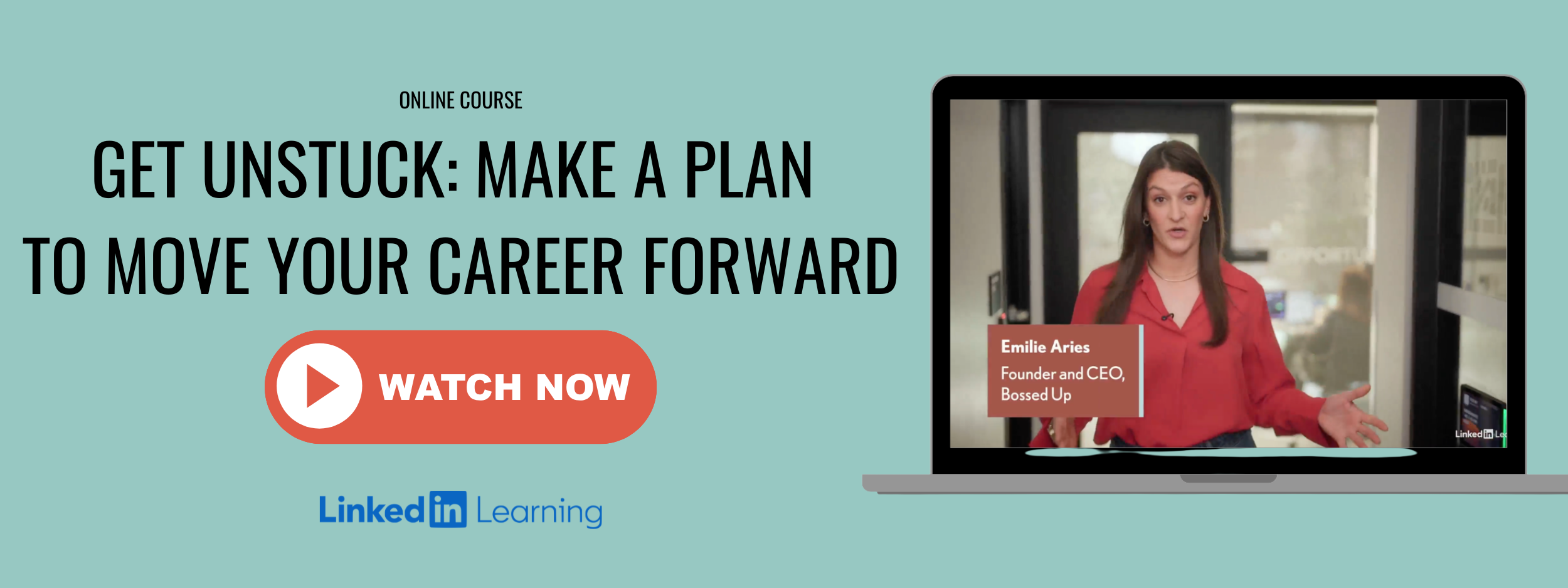
If you can’t explain how your skills and experience make you perfect for a position, why would anyone hire you? Whether you’re looking to rise in the ranks at your current organization, work somewhere else, or go in an entirely new direction, selling yourself with clarity and confidence is essential. In this episode, I dive into what Sam DeMase talks about towards the end of our discussion in Episode 543, Why Your Resume Isn’t Working (and What to Try Instead), and what I outline in Get Unstuck: Make a Plan to Move Your Career Forward, my newest LinkedIn Learning course: how to create a persuasive and compelling value proposition.
Step 1: Take inventory
Thousands of people have your degree; hundreds have your job title. But only you have the combination of skill and experience that makes you uniquely suited to the position you’re applying for or the promotion you’re seeking. The first step to creating a powerful value proposition is to identify exactly what distinguishes you from the rest.
Start with your current or most recent job. Write down everything you do, every problem you solve, and the impact each solution has on the organization. Then, repeat this step for every job you’ve had, all the way back to your education. Your final value proposition won’t include every item on this list, but it will help you highlight the skills most relevant and transferable to your future goals.
Step 2: Get external validation
Not references and recommendations, though those are great, too. I’m talking about collecting data that will firm up what you know from your inventory and give you the language to explain it concisely and convincingly.
Workstyle assessments are a great place to start. Try Gallup’s CliftonStrengths, Myers-Briggs, or the Enneagram. You can also delve into aptitude tests, like the free one offered by the U.S. Department of Labor.
Step 3: Focus on what’s essential
You’ve already highlighted the most relevant skills and examples. To narrow it down further, think about the decision-makers best positioned to propel your career forward. These are the stakeholders you need to reach with your value proposition. Which experiences will speak most strongly to those people or organizations?
If you’re a part of HIRED, Bossed Up’s job search accelerator, you’ve heard me talk about power mapping. It’s a concept for helping you figure out who has more or less power in your work environment, to better navigate the politics and identify those key stakeholders. Learn more about building your own power map in the Get Unstuck course. Bottom line: you’re going to want to keep your audience in mind in order to be as persuasive as possible.
Step 4: “Hire” an AI career coach
In Episode 540, The Double Disadvantage, I talk about why women are resisting AI and large language models like ChatGPT. Despite the many good reasons for this reticence, AI tools can provide a serious competitive edge. Leverage these tools by dumping all your results from steps 1–3 into your LLM of choice and giving it a prompt like this:
“You’re my expert career coach. Help me draft a 3-5 sentence statement that communicates my unique value in terms that would resonate with my target audience.”
Just remember: by default, what you put into an AI program is not private. Generalize or leave out anything you don’t want publicly available. Once you have your output, don’t copy and paste it to your resume; this is just the initial draft of your value proposition. Now, it’s up to you to make it sound human and, more importantly, to make it sound like you. Reading it out loud is a great way to get the wording and cadence just right.
Step 5: Enlist your community
Humility often gets in the way of us really shining a light on all our expertise and potential. There’s a good chance your new value proposition pulls a few punches in terms of how much you’ve accomplished and just how impressive you are. So, ask someone you trust to give it a read. Get an honest gut-check from a friend, mentor, or colleague, someone who sees the best in you and will make sure you’re giving yourself the credit you deserve.
If no one comes to mind, turn to your wider career collective! Over on the Facebook Courage Community and our LinkedIn group, we’re always happy to give feedback and help you talk yourself up!
Value proposition final tips
Your value proposition needs to be concise, but it definitely doesn’t need to be one sentence or 30 brief words. Here are a few more things to keep in mind as you write it:
Be specific. You aren’t just “great with people”; you “spend five years leading a high-performing team of marketing professionals in revenue-generating projects.”
Highlight the impact of every example. Don’t just cite the skill; explain exactly how that skill benefited the company. Use concrete numbers if you can.
If you’re making a career pivot, don’t shy away from it. Use those transferable skills you identified in step one to show how your past accomplishments make you perfectly suited to this new direction.
It’s an iterative process, like all great writing! It might take draft after draft, but at the end of the day, trust that only you and your inner wisdom know the best way to communicate your value.
Once you’ve got your value proposition all shined up, it should require only minor tweaks to fit into all the aspects of your job search or promotion pitch. Make it the summary statement of your resume. Use it to form the backbone of your cover letter’s opening paragraph. And, in your interview, let it anchor your answer to that daunting question: “Tell me about yourself,” to keep you focused on what’s uniquely valuable about you.
Related Links From Today’s Episode:
Episode 543, Why Your Resume Isn’t Working (and What to Try Instead)
Episode 540, The Double Disadvantage: AI, Women, and the Future of Work
Episode 522, Know Your Aptitudes to Direct Your Career with Confidence
LinkedIn Learning, Get Unstuck: Make a Plan to Move Your Career Forward
Discover how AI tools can help you GET UNSTUCK at work:
-
[CONFIDENT RHYTHMIC DRIVING THEME MUSIC WITH DRUMS STARTS]
EMILIE: Hey, and welcome to the Bossed Up podcast, episode 544. I'm your host, Emilie Aries, the Founder and CEO of Bossed Up. And today I want to pick up on a topic that came up at the very tail end of an interview I did recently with Sam DeMase, which was all about navigating the job market in 2026.
[MUSIC FADES AND ENDS]
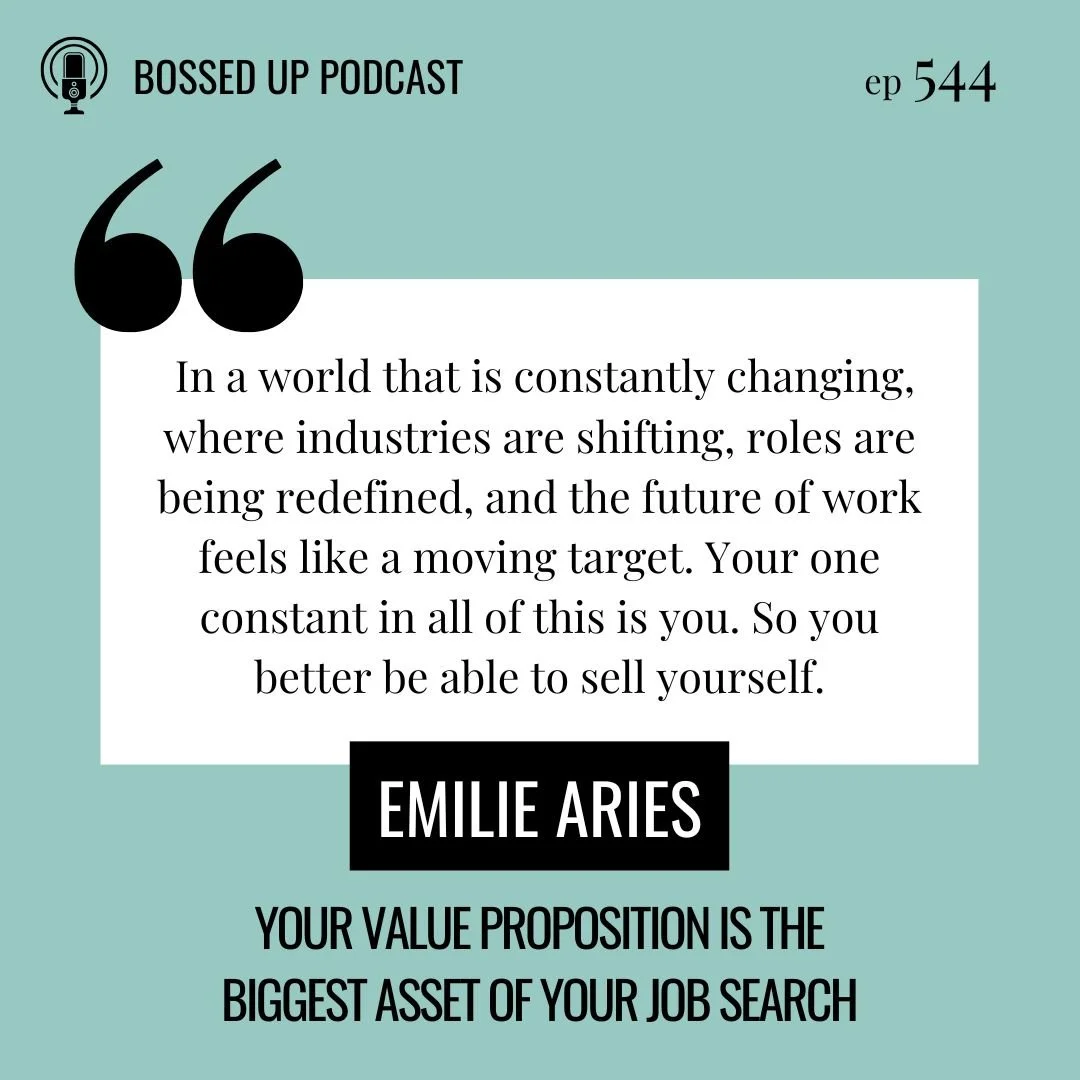
And during our conversation, Sam talked about understanding your value proposition. And it reminded me of one of my videos in my recently launched LinkedIn Learning course, Get Unstuck: Make A Plan To Move Your Career Forward, in which I deep dive into how to write your unique value proposition. And I want to bring this lesson to the podcast because I think it's one of the most powerful exercises you can do with when you're feeling stuck and honestly, even when you're not, even when you're just thinking about what could be next for your career, or wanting to really get articulate around what your next act might be. Because here's the thing. In a world that is constantly changing, where industries are shifting, roles are being redefined, and the future of work feels like a moving target. Your one constant in all of this is you. So you better be able to sell yourself. You better be able to know thyself intimately and be able to communicate what it is that you have to offer and the value that you bring to those around you, to the organizations, to the people you serve, right? And to the companies that you want to get hired by.
So what do I mean by your unique value proposition? I mean what you, and only you, have to offer. Look, even if there are hundreds or thousands of people out there with your same degree, your same title, even your same area of expertise, the fact of the matter is only you have your perspectives and unique blend of strengths. So whether you're looking to advance in your current organization or considering opportunities elsewhere, being able to concisely communicate that value can boost your confidence and your persuasion as you figure out what's next.
This is the kind of thing you want to be able to communicate wherever and whenever you're talking about your career, whether it's in the about me section of your LinkedIn profile, in your resume, in your cover letters, or even just in everyday networking conversations or interviews, you want to be able to quickly get across who you are, what you have to offer, and what your impact is. So how do you actually build your unique value proposition? Let's walk through it together.
Step one is to take inventory. Starting with the job you currently have, map out all the unique skills that you bring to the role, the problems that you solve, and the impact that you have. Then repeat that process for every role you've ever had, all the way back to your education, if that's relevant. I know that sounds like a lot, but look, we're not trying to write a memoir here. You're just brainstorming. So bullet point this, get it out of your head and onto the page, and then highlight the skills and experiences that you feel are most relevant for the kind of work you hope to be focused on in this next phase of your career. That's the raw material you're starting from your past, skills that are transferable and relevant when it comes to your future career goals.
Step two is to get some external validation and no I'm not talking about that kind of approval seeking behavior. I mean, get some data on yourself. Work style assessments like Gallup's Clifton Strengths, Myers Briggs, or the Enneagram can help you put language around the strengths that might feel hard to articulate on your own. If you want go a step further. Aptitude tests can give you an even clearer sense of your capabilities and competencies too. The US Department of Labor actually has a free skills matcher tool at CareerOneStop.org. That's a great place to start. These tools aren't going to tell you who you are, but they can help you communicate what you already know about yourself with more precision and confidence and give you a new vernacular for use when talking about what you have to offer.
Step three is where it all weaves together. You're going to want to focus your value proposition on what matters most, what is most essential, both for you and for the key stakeholders who you're trying to reach with this message. If you've listened in on earlier podcast episodes for a while, or if you happen to have watched my LinkedIn Learning course on getting unstuck and moving your career forward, you may have already heard me talk about power mapping your workplace or your power map as it relates to your career and networking and influencing strategy overall. It's really just a way to identify the key people and decision makers who are career forward. So keep those key stakeholders, those key people, in mind when you're thinking about how to essentially drill down your value proposition into its most essential parts.
AI can be a really helpful thought partner on all of this. You can take all the reflection you've done up until this point, your skills inventory your assessment results, what you know about your target audience, and drop them into an AI chatbot. With a prompt like this, “You're my expert career coach. Help me draft a three to five sentence statement that communicates my unique value in terms that would resonate with my target audience”. And then, of course, describe your target audience and give additional context around your unique strengths. You can even upload supporting documents like your resume or assessment results. But you're just going to want to be mindful about privacy because whatever you upload is not private by default, so avoid sharing anything sensitive unless you're using a platform with data protections in place.
And then finally, do not forget this step, because this is important. Once you've got an initial draft back from AI or whatever chatbot you're using to write your first draft, your next job is to add a human touch. AI is just the starting point, not the final answer. So you want to be mindful and careful about exaggerations and even full on hallucinations that chatbots are known to make on occasion. You want this to be grounded in reality, right? And to be true to who you actually are. You want it to sound like you. So practice speaking your value proposition out loud and edit it until it sounds like you.
Now, this brings me to my final step, which is one I think we undervalue, and that is to enlist your community. Ask a friend, a mentor, a trusted colleague to give you a gut check on what you've come up with. Does it ring true to them? Does it align with how they experience you? Because if you tend to be your own harshest critic, which, let's be honest, most of us are getting an outside perspective from, someone who really sees the best in you, can make all the difference. It can help you get out of your own way, especially because selling yourself can be downright uncomfortable.
Now, if you're looking for a community of women who are great at this kind of thing, you know, join us in the Bossed Up Courage Community on Facebook and in the Bossed Up Group on LinkedIn, because we're really good at that kind of thing. We are happy to be your hype women and give you feedback on this kind of thing as you navigate a career transition.
Now, before I wrap this episode, I want to leave you with a few concrete examples, because this all sounds well and good, theoretically, but when you put pen to paper, it gets pretty tricky quickly. I said earlier that I want this to be concise. I want you to be able to quickly communicate your value. But that doesn't mean any one of us can do this in like a quippy single sentence, necessarily. So let's look at some examples and share how specificity can actually be really helpful. Okay?
So let's say you are a Project Manager with 8 years of experience in healthcare tech and you're looking to move into a director level operations role. Your value proposition might sound something like this, “I'm an operations leader with 8 years of experience driving complex healthcare technology implementations from pilot to scale. I specialize in bringing cross functional teams into alignment on high stakes projects, which has helped me deliver over $15 million in completed initiatives on time and under budget. I bring a rare blend of deep technical fluency and people first leadership. Which means I don't just keep projects on track, I keep teams engaged and bought in along the way”.
Do you hear how specific those three sentences are? They're not like the shortest, quippiest sentences, but they're specific and relatively concise. You're not just saying these broad sweeping generalities like look, I'm a good leader, I'm a hard worker, I'm a team player. You're talking here about the industry, the scale, right? You're adding numbers and specificity whenever possible. You're talking about your superpowers, and most importantly, you're talking about impact.
Now let's look at a different example. Let's say you're a marketing professional pivoting from corporate brand management into the nonprofit space. Your value proposition might sound something like this, “I've spent six years building brand strategies for consumer products that drove measurable audience growth, and now I'm channeling that skill set toward missions I care about. I bring a data driven approach to storytelling that helps organizations punch above their weight. And my experience managing six figure campaign budgets means I know how to maximize impact with limited resources, something I know matters in the nonprofit world”.
You'll notice how that one directly addresses the career pivot and effectively translates their past experience to their future audience, their future environment that they're aiming for. It's not apologizing for the transition or shying away from it, or pretending like that isn't going to be a big pivot. But it frames the corporate experience as an asset in a new context.
Now, once you've got your unique value proposition drafted, you can adapt it for different settings. On a resume, it becomes your summary statement at the top in two to three sentences, and you're tailoring it to that specific role. In a cover letter it's maybe the backbone of your opening paragraph, sharing why you're writing and why you're the right fit for the role. And in an interview, when someone says, tell me about yourself, your value proposition becomes your anchor, the sort of point you return to throughout the course of the interview. You're not reciting your resume chronologically, you're leading with what makes you uniquely valuable for the role that you're applying for. The core stays the same, but the framing flexes depending on the audience and depending on the context.
So here's what I want to leave you with today. This can be a bit of a process. This can be an iterative process. And frankly, all great writing is process writing. That's what we're talking about here. Like, you know, you've got to put this through the wringer to polish it over time, right? To make a diamond out of this, you really gotta, to work it a little bit. And you can absolutely have AI's help in writing something like this with you or brainstorming on this with you. But don't look to AI, or even any external like source, even a friend or mentor for the one right answer. Because how you communicate all that you have to offer the world is ultimately up to you.
Don't lose sight of the importance of listening to your own inner wisdom, because all of these tools and frameworks and examples and assessments, they're just starting points. The expert on you is you. Now, if you want to go deeper into all of this with me on how to build your power map, brainstorm your career vision and navigate a career transition step by step, check out my LinkedIn Learning course, Get Unstuck: Make A Plan To Move Your Career Forward. I'll drop the link in today's show notes.
[CONFIDENT RHYTHMIC DRIVING THEME MUSIC WITH DRUMS STARTS]
And you can get a fully written out transcript or summarizing blog post of today's key points at bossedup.org/episode544 that's bossedup.org slash episode 544. Until next time, let's keep bossin’ in pursuit of our purpose and together let's lift as we climb.
[MUSIC FADES AND ENDS]