The Women’s Ambition “Gap” is a Myth
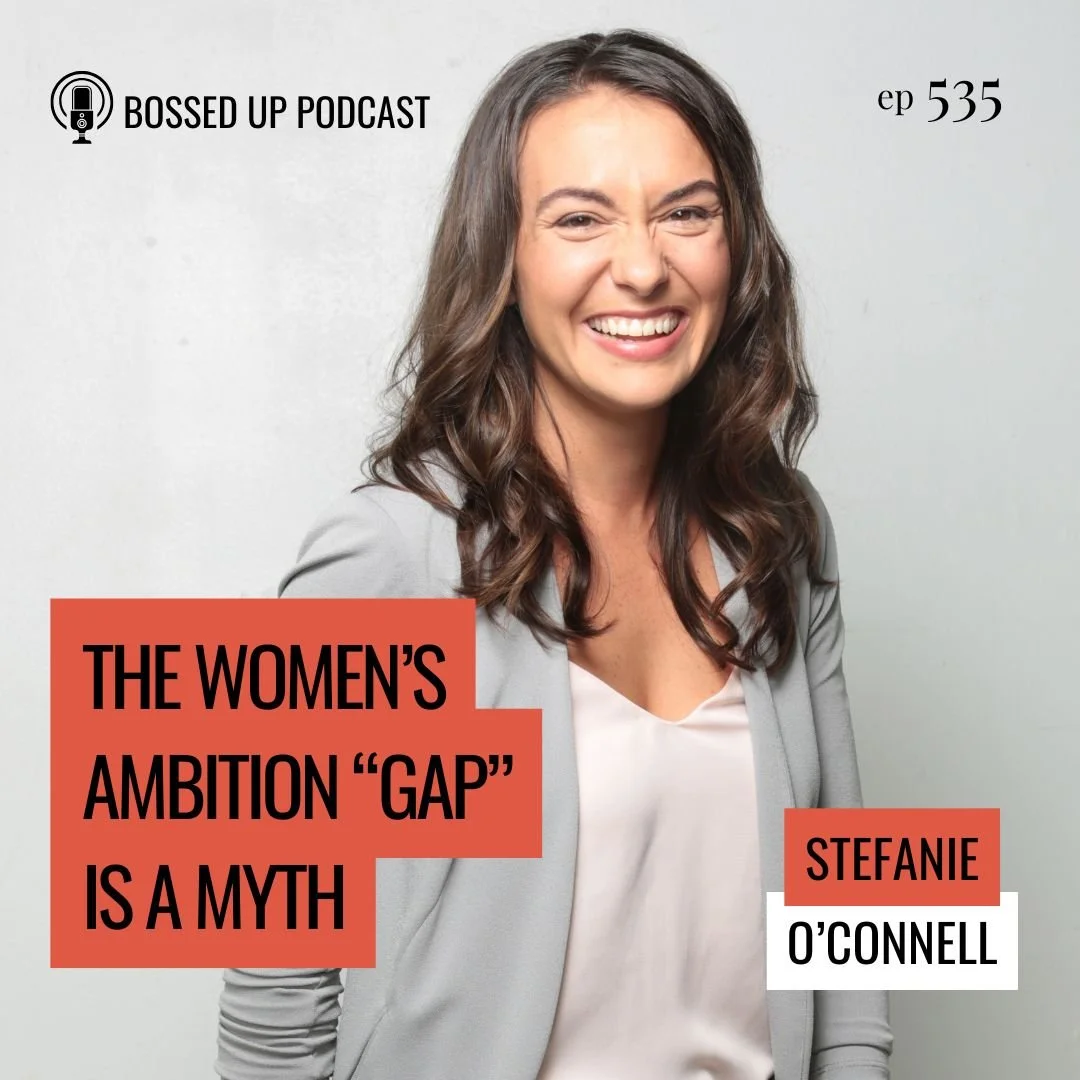
Episode 535 | Host: Emilie Aries | Guest: Satefanie O’Connell
Inequality in the workforce isn’t your personal failing. It’s the fault of broken systems.
As women, we often hear the rhetoric that if we want it enough, if we work hard enough and upskill enough, we’ll succeed. From little girls who can “be whatever we want to be” to full-grown “girl bosses,” the world is our equal-opportunity oyster.
The problem with this way of thinking has never been as clear as it is in Stefanie O’Connell’s forthcoming book, The Ambition Penalty. Stefanie’s research-backed, data-driven new book explores “how corporate culture tells women to step up―and then pushes them down.” This might feel all too real to you, or you might be skeptical. Either way, you’ll want to hear how Stefanie, the creator of the award-winning Too Ambitious newsletter, breaks down the metricsand the myths behind the moment of anti-ambition we find ourselves in.
The inspiration behind the book
There are plenty of ambitious women these days, and Stefanie and I spoke previously about the penalty they face, back in episode 408. If all it takes to “make it” is the same drive and determination for which men are celebrated, why is the pay gap trending in the wrong direction, and why is female representation in leadership frozen in time?
It’s a broken promise—the one that states hustling, confidence, and ambition will save you—because equal effort and ability don’t reap equal rewards. That’s why Stefanie wrote The Ambition Penalty: to bust the myths and expose the true disconnect between what we’ve been told and the lived reality.
Embrace outside-in thinking
I love that Stefanie’s book stops that personal failure playback loop in its tracks. If you’ve ever failed to get a job, or a promotion, or a raise and assumed you must have screwed up your interview or flubbed your negotiation, this book reminds you just how much nonsense that is. Individualizing your experience doesn’t just make you feel like garbage—it’s also the exact opposite of what we need to do to get to the root of the problem.
The whole idea of women’s empowerment has long been sold as the idea that “everything you need to access power comes from inside you.” So when we don’t see lasting results, it’s easy to feel like it’s all your fault. Instead, argues Stefanie, we need to bring the focus outside to those damaging environments, not inside to self-loathing. Only by placing the blame where it belongs can we start to put pressure where it’s really needed.
“Systemic” isn’t just government
Stefanie divides the systems we need to change into three broad categories, and we must address the injustice in each one. First, there’s the interpersonal environment. In The Ambition Penalty, Stefanie focuses a lot on challenging the gender dynamics in heterosexual relationships, but this category includes wider family and platonic relationships as well.
Then, there’s the institutional environment: our workplaces, schools, and community organizations. And finally, there are the political and cultural systems, all levels of government. Campaigning for policy change is vital, but if we only beg for parental leave and don’t put a foot down when our husband fails to shoulder his half of the household chores or the boss asks the only female executive to take notes, we’re missing out on key opportunities for positive change.
Girl Boss culture and the myth of self-optimization
Thanks in large part to the Girl Boss era, we’ve been told that hustling, improving our negotiation skills, and ultimately adopting a more “masculine” approach to business could turn us into high-power entrepreneurs with the same spectacular outcomes as our male counterparts. But as Stefanie points out, this approach perpetuates individualism and that very self-blame she wants us to avoid through outside-in thinking.
As she says, “we’ve self-optimized about as far as we can go.” Research shows that in the past decade, women have become more likely to negotiate their salaries than men. When even shifts like that fail to improve the gender pay gap, it’s clear that it’s not you, it’s them. And ignoring that to focus on self-care and self-improvement lets the system continue functioning while we’re busy scapegoating the individual as the problem.
Male victimhood and the Gen Z discrepancy
We’re hearing a lot these days about a growing masculinity crisis, including male isolation, academic struggle, and depression, but she points out that the people having these conversations cite metrics that fall far short of the whole picture. They mention more men being homeless than women without acknowledging that many more women live in poverty than men. They talk about the “boy education crisis” without clarifying that women have outpaced men in higher education for 40 years—without much to show for it in our careers.
Their solution, it seems, is to double down on patriarchal values like allowing men to be the protectors and providers, but that’s exactly the mindset that got us here. The idea that manhood can only be asserted through dominance is hurting male mental health and female economic outcomes, just like it always has.
And then there’s the perhaps unexpected generational shift we’re seeing among young men. We might imagine Gen Z to be even more enlightened than Millennials. However, surveys show more than half of Gen Z respondents believe equal rights for women have “gone far enough” (that’s a higher headcount than Baby Boomers). Additionally, 60% of Gen Z men believe women’s equality discriminates against men.
Behind this is a widespread misperception about just how bad gender equality still is. All too often, people believe women’s outcomes are better than they are. Our representation in leadership and access to pay are highly overestimated, and stats like “15% of women hold executive positions” are consistently misread as “50%.” All this leads people to doubt that discrimination still exists or that we need to prioritize policies addressing it.
The call for community
Like many of you, I’m a mom of littles I’m determined to raise to be better. I wanted to know how Stefanie views motherhood in light of her research and the hard truth of the fading American Dream. She admits she finds it baffling how fixated social media conversations remain on parental choices that have middling-at-best impacts, like breastfeeding or school choice, and so little on things like how we model power and gender dynamics in front of our kids and how we build community.
Because community is the big part of the solution. If we stay isolated, it’s easy to buy into the narrative that it’s just us: our education, our willpower, or our skillset is lacking, and that’s why we haven’t excelled in our careers. As soon as we talk to other people, we can reframe the problem within the broader system—a system that discriminates against mothers, underpays women, and undervalues childcare.
Of course, the things we do as individuals day by day matter, too. Stefanie encourages us all to think about the shifts we can adopt to challenge the real problem. We still have to survive in this system, so we still have to make compromises. But once we stop calling constraints “choices” (like the “choice” to stay home because childcare is too expensive) and recognize that bias is holding us back, not natural gender differences, we stop passively—and individually—accepting the status quo and can start pushing back, together.
The Ambition Penalty: How Corporate Culture Tells Women to Step Up--And Then Pushes Them Down is a powerful and eye-opening look at what’s wrong with what we’ve been told and how we can start to fix our stunted systems. Stefanie’s book comes out in May, so pre-order it now to reserve your copy!
What are your thoughts on everything Stefanie and I discussed? How are you challenging power dynamics, and how have you had to compromise to keep your sanity? Don’t let isolation and individualism win—join in the conversation with others on our Facebook Courage Community or our group on LinkedIn.
Related links from today’s episode:
TAKE ACTION TOGETHER, and let’s challenge the status quo:

-
[INTRO MUSIC IN]
EMILIE: Hey, and welcome to the Bossed Up podcast, episode 535. I'm your host, Emilie Aries, the Founder and CEO of Bossed Up. I am so delighted to bring on today a friend of mine, an author, a creator, a thought leader, maybe you already know and love seeing Stefanie O'Connell.
[INTRO MUSIC ENDS]
She is going to unpack her new book, The Ambition Penalty: How Corporate Culture Tells Women To Step Up And Then Pushes Them Down. She has been writing about and covering the kinds of topics that I am glued to my phone listening to, whether it's through her podcast or her Substack or her Instagram, which I highly recommend you give a follow right now, too. For years that have got me DMing her, chatting with her. We've been texting about the topics that we're about to unpack for a long time. And frankly, I could have extended this interview by about five hours.
I think of Stefanie as just one of the most prominent voices out there who captures the experience of being a millennial woman accurately and the disillusionment that we have experienced as millennial women who were told that we can be whatever we want to be, only to find out that the world wasn't actually serious when they said that to us as little girls. So let's unpack what the Ambition Penalty is and where that leaves the whole girl boss movement, of which I am very much a part.
But first, a little about Stefanie O'Connell, the author of the Ambition Penalty, which is out this May. And it's an essential guide to dismantling the hidden forces that hold women back, burn them out and make us all pay. In her new book, Stafanie draws on extensive research to expose how popular myths around women's work, money, and ambition, like the myth that women aren't speaking up and asking for more, have locked gender inequality in place. And she reveals how liberating women's ambitions liberates us all. So let's get into it, Stefanie, welcome back to the Bossed Up podcast.
STEFANIE: Thanks for having me.
EMILIE: And congratulations on the soon to launch publication of your book, the Ambition Penalty.
STEFANIE: Thanks so much. It's been a long time coming.
EMILIE: It really has. You and I have been texting about this topic for years now. It feels like, right?
STEFANIE: I mean, literally years.
[LAUGHTER]
EMILIE: And your phenomenal reels and video work and social media presence on Instagram and beyond has been like, some of my favorite stuff to share.
STEFANIE: Well, I appreciate it.
EMILIE: I'm so glad. I mean, you're doing such great work. I know this audience is going to love what you have to share. So why don't you tell us, like, sort of the premise of the ambition penalty. Why did you write this book? Why now? And what does it mean? What is it that you're talking about here?
STEFANIE: I wrote this book because I, like so many of the women I'm surrounded by, am a very textbook millennial who came of age in this era of girl power and this promise that if you just worked hard and went after those things that you really wanted and you were willing to lay claim to those ambitions, then they would be accessible to you in the same ways they are to your male peers. And the reality, for those of us who are my age, I'm turning 40 this year, so I'm entering middle age. I'm a young mother. Like, I'm at what should be my peak earnings years. And the fact is, my outcomes as a millennial woman today, on average, are not much better than they were 20 years ago than when I graduated college.
And I'm not saying my outcomes as me, Stefanie. I'm saying me as like, an archetype of millennial women's outcomes in the United States of America. The pay gap is as bad as it was before we even entered the workforce. Our outcomes are actually getting worse on metrics in terms of representation in the pipeline to leadership. Obviously, women's reproductive rights have been regressing. There's attacks on all kinds of autonomies and freedoms going on right now that are really hurting women. And I think what this book is really getting at is the broken promise that ambition will save you, that if you lean in hard enough, that if you ask enough, that if you just keep hustling as much as your male peers, that you will enjoy access to the same rewards.
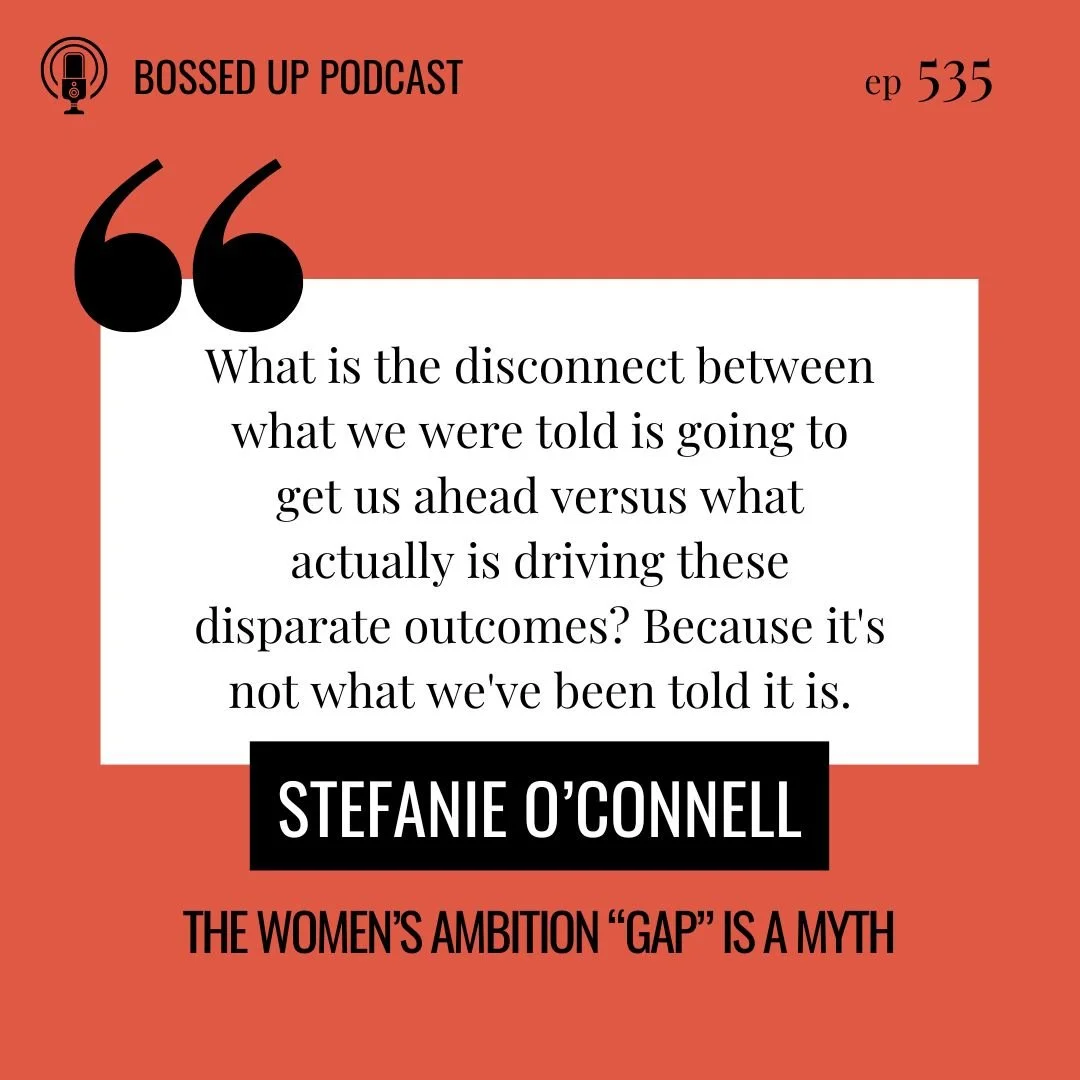
And what I wanted to do with this is not only bust those myths, but also to expose what's actually happening here. Like, what is the disconnect between what we were told is going to get us ahead versus what actually is driving these disparate outcomes? Because it's not what we've been told it is. It's not a quote unquote, lack of ambition or commitment or just because we're parents, because the boys are parents, too, and they're doing just fine.
So a lot of this book is what I would consider myth busting, but it's also an idea of, like, digging into what the myths that, like, women just aren't ambitious enough to get what they want or to have equal access to opportunity. What do they cost us all? And that's what I really wanted to dig into here and then to imagine a new way forward.
EMILIE: Yeah, I mean, I think of so much of what you're talking about as part of this great disillusionment, right? The millennial midlife crisis, or the great millennial career crisis, as some are calling it on social media. But for women in particular, this disillusionment with the promises that were made to us, right? And so many of us are very quick to individualize that narrative and say, you know what? This just wasn't for me. Or, you know what? I just didn't hustle hard enough. I'm burnt out. And this, like, personalization of what you're saying is a very macro level trend.
And what I love so much about what I've read in your book is it makes you feel less crazy. It makes you feel less like a personal failure if you're like, I did everything. I followed the rules, I leaned in, I studied how to negotiate. Like, I asked for more. Just like I was told by Emilie Aries at Bossed Up, or by whoever, right? You know, Sheryl Sandberg, et cetera, all the girl boss enablers. And it didn't work out. And it can leave you feeling like such a personal failure. And your book posits a different, a different theory, right?
STEFANIE: Yeah. And, and that is why I've written this book, because this advice is set up to get you to internalize these outcomes as an individual failure, a personal problem. But what we're talking about here is not a personal problem. It's statistically, I go through the data in detail in the book to really show that, like, this is not a matter of individual choices. It's a matter of a system in which you have different people making the same exact choices, practicing the same exact behaviors, using the same exact language or performance, and they get different outcomes based on their identities. That is not a personal problem. That's a problem with the system, right? If you had the same inputs and you get different outputs differing on identity, then that's not a you issue.
But because we've been indoctrinated into this individualistic belief, and this is a bigger belief than even girl boss culture. This is the American dream culture. This is the myth of meritocracy. And this extends far beyond gender. It's across all metrics of identity, right? It's this idea of who gets rewards is in alignment with whose efforts were the greatest or who was as committed as possible or who deserved it the most. And this book really debunks that. In great detail.
And I think that can feel frustrating, but it's actually quite liberating to realize that, oh my gosh, first of all, it's not just me. It's happening at scale. And it's not a me problem. It's not a personal problem. And so if it's not a personal problem, what I have found in doing a lot of the interviews with people that I spoke to for this book is that it releases people from a lot of the shame, a lot of the isolation. And it starts to get them sharing their experiences and starting to work collectively to challenge some of these systems that are reproducing these unequal outcomes.
And that's really the goal here, from shifting from this, like, internal and individualistic idea of getting ahead, to reconnecting with communities and identifying these as collective problems that require collective solutions and us coming together to share our stories and then work together to reshape these systems.
EMILIE: Yeah, I found so much of what you wrote really inspiring. And actually, I want to read a quick passage here that you make at the beginning of the book. You say, “here's my prediction to the reader who's, like, embarking on this journey. As you examine your long standing ideas of ambition, you will come to see that much of what you have thought of as your individual insecurities or exhaustion or, quote, lack of ambition”, end quote, actually had little to do with you at all and was instead part of a collective experience you have in common with millions of women around the world.
And it does feel like there's something to this book that feels very millennial, very girl boss era, but kind of like a trauma bonding group [LAUGHTER] where we're like, how do we make sense here in therapy of what we just lived through? And you talk about inside-out versus outside-in thinking, which I love in my book. I talk a little bit about cultivating a leadership identity and thinking about what to internalize and what to externalize. So tell me more about how you put this from an inside-out to outside-in empowerment perspective.
STEFANIE: Yeah. So I make the argument in this book that women's empowerment was really sold as this idea that what you need to actually access power, it comes from inside you. And then you express that outward into your interpersonal environment, your institutional environments, and then your cultural and political environments. And the way those environments shift is all coming from, like, what you are doing individually and internally, right?
Like, so if you can just be more confident, the promise is like, the whole institution will change and women will be equally represented in the workplace and in leadership. And in pay and all that. And so the idea is like, okay, obviously we have evidence that this does not work. Now what do we do instead. And so what I propose based on the data is that we take this outside-in approach and recognize that what we're experiencing on an individual level is actually shaped in response to the environment around us, not by some crazy differences within us. Yes, we are all very different as individuals, but as groups of people as large and diverse as women, like women and men really are not different in meaningful ways in terms of, like, what we're talking about here, professional ambition by every metric.
And all these studies, like, it's really very similar. The way we engage in our behaviors is very similar. The things we want and the way we try to get them are very similar. In the workplace, what is different is the response to those behaviors. And so what this outside-in approach does is say, okay, if the problem is the difference in the response the problem is the way the environment is reacting to us differently. What we need to do is bring our focus to those environments instead of into ourselves. So how do we shift those environments? And I identified these three different levels. The interpersonal environment, that's your home, heterosexual relationships are a large focus of this book, and they're a site of great inequality. But also like, your friends and your family dynamics, there's a lot of gender dynamics that are still very, very present, that are reinforced in the interpersonal sphere.
And then you have the institutional environment there, you have the workplace there, you have schools there, you have your community organizations. And then you get the broader political and cultural systems. So, this could be your local government, your state government, federal government. But I think one of the things I wanted to do here is really get clear about what we mean when we talk about things being systemic and letting this be something that's a little bit more tangible than just, hey, we want this legislation. Well, no, it doesn't just have to be like this federal policy of paid leave we're all trying to get, right? It can be something that we're advocating for at every single layer of this empowerment framework. This, you know, from the outside-in, what does this look like, in my interpersonal environment to reshape the way caregiving looks. That's just one example.
EMILIE: Well, yeah, and like, I like the term, a family system that comes from therapy, right?
STEFANIE: Like, that’s perfect, yeah.
EMILIE: Right? Like, how can I influence my family system? How can I change my family tree? And I do see millennial dads totally transform, on average, transforming the role of fatherhood right now, right?
STEFANIE: I think you're more optimistic than I am, but that's probably because I've spent too much time in the den. [LAUGHTER]
EMILIE: Well. No, actually, I'm curious to hear your thoughts. You. Because, I think it is a both and situation, right? Which is like, let's not give my husband too much credit, okay, for being almost an equal partner in sharing the load here, right? Like, I see that. I critique my mom when she's too complimentary. I'm like, he's just parenting. Calm down. [LAUGHTER] Like, not worth praise, but, you know, that's significant progress where there was a complete lack of equality.
STEFANIE: Yes.
EMILIE: And not that we're there yet, but, my God, they're making a lot of progress. Not all of them, but many, many of them. And, like, influencing your family system, to me is like, step one.
STEFANIE: I think we really discount how important that is. One of the takeaways I've come to more recently is to think about this kind of outside-in approach to tackling, let's say, your family system or your workplace system or your, you know, your local government, your broader government is thinking of this as like, a daily practice. What are the ways in which I am operating within these systems in ways that reinforce an unequal status quo, and what are ways I'm doing that challenge that status quo?
EMILIE: Can we give some examples here? Because that is hard to make tangible.
STEFANIE: Yes, totally. So this is very challenging to talk about because, again, we often come back to this framework of, like, oh, it's all about, like, personal choices. But I really argue against that framework. Again, getting out of the individual mindset of, like, feminism is me being able to do what I want. And I'm like, well, no, if what I want is doing something that harms other women, that is not feminist, right? And so, when I say challenging the status quo, I'm like, I'm talking about a system of power that reinforces men's power and privileges at scale, like, you know, money, financially, representation, leadership. And again, this is like, in every single sphere in the home, in our communities, you know, in. In politics, in the workplace, of course.
So what are the things that I am doing in my life, like, as a daily practice that is basically being complicit in that system. And to be fair, like, we are all complicit in that system to an extent, okay? And there are compromises that we are going to have to make because the fact is we are still living within these systems and we have to survive them. And part of surviving them is making those compromises.
One of, one like very simple example I use is like I'm talking to you right now and I'm wearing makeup and that is me like complying with that, a patriarchal beauty standard. So in a way I'm reinforcing that, I'm upholding that. But what I will not do is say me wearing this lipstick is feminist. It's not feminist, right? Like I can be coping through the system, but I don't have to sit here and pretend it's something that it's not and justify it and then be like, okay, now let's all go buy this lipstick and like and say that's feminism.
Because that's kind of like how we fell down that girl boss train in the first place is we wound up with these systems where we were like taking our hyper individualism and saying like this is what it means to be empowered while at the same time we were undercutting support for like the very collective action needed to fundamentally change those systems.
EMILIE: Yeah, I thought of like, you wrote quite a bit about how that girl boss culture we were complicit in, we hoped would at least have a positive influence on some women's lives, right? Particularly we knew like, it wasn't going to lift all boats, right? We're not talking about like the most in need of advocacy and support. We're never going to benefit from lean in message. But maybe some super privileged like already pretty well to do women, myself included, could negotiate for more or could, you know, take something away from it about not taking your foot off the gas pedal until you absolutely had to in order to advance your career, whatever.
But did we acknowledge that that wasn't going to pass, you know, universal childcare? Yeah. Like, that wasn't going to help someone who has three kids and was like not able to work and fully participate in the workforce, right? But what I found most shocking in your book was this is not a neutral act, right? That you have found research that shows people who perpetuate individualism. I just need to learn to negotiate, to ask for more, to you know, be a better self advocate. Which to be clear, I'm a big fan of, right? What took me aback while reading your book was like when presented with that narrative, with that philosophy, those people were significantly like, statistically significantly less likely to take part in collective action.
STEFANIE: Yes. And they were more likely to tolerate gender discrimination, less likely to even perceive it in the first place, more likely to justify it away and then more likely to blame women for the consequences of the discrimination against them. And then, yes, by extension, less likely to partake in collective action, like advocating for pay transparency laws, for example.
EMILIE: So if you believe that it's on me to negotiate my salary for more, I don't get it. In fact, my job offer is rescinded for daring to be so greedy as to ask for more money. Like, was the case for some of the women you interviewed in your book. That if I'm a big proponent of self advocacy in doing so, I might actually not see that as having anything to do with sexism and instead say she really should have learned how to modulate her tone better. This was on her to improve her performance. And then I'm not going to go advocate for equal pay for equal work loss because I'm seeing this as an individual problem. Is that, is that the idea?
STEFANIE: Well, I wouldn't say that. Like, the takeaway here is women shouldn't negotiate, right? Like, what we're saying is that women's individual negotiation is not solving for gender inequality, and gender inequality is not an outcome of women negotiating less or any of these individualistic things. So the idea is, first of all, best practices is a tough word to use because a lot of this book exposes like. Exactly. For who in what context. Like, that stuff matters. So part of this is like, let's reframe our idea of best practices within the environment and hold those environments to account so that they're not rewarding and penalizing people differently, depending on their identity for utilizing the same practices.
But then the second part is, okay, now with all of that stuff that we're, we're still doing, again, not saying, like, don't negotiate your salary. Let us not pretend that the inequality we're still experiencing is because these like, quote unquote individual differences, which aren't even borne out in the data.
EMILIE: Yeah, I remember sitting in a few negotiation trainings that I've given. I think this one that comes to mind was with a group of women in engineering or something like that, women in construction maybe. And I gave a interactive, you know, workshop through their affinity group or through their, like, association on how to negotiate. And I had some women kind of sharing war stories of horrible experiences and the backlash that you write extensively about to them advocating for themselves. And the question that kind of was emerging was, what did I do wrong? And I remember in that moment, like, the whole room was holding its breath, and I said, oh, it's not you.
STEFANIE: That's the takeaway.
EMILIE: I remember being like, whoa, you could do everything I'm describing here and you could like read my entire guide. You could, you know, follow this to a T. It could still blow up in your face and has nothing to do with you. And that was totally not the answer they were expecting. And the relief that you could see wash over some of them as they were sharing this was like, that's what you're describing, right?
STEFANIE: This is exactly the reason for this book. You know, when I say it's not, you people will be like, oh, that's just such a victim thing. And I'm like, first of all, no, it's not. It's a way of creating systems of accountability. Because what we're doing right now is like, we're pretending that like, it is you when it's not. We know statistically it's not. And what it does is it allows the status quo to continue. It allows the systems to continue functioning while we scapegoat this like individualism as the problem when we know it's not.
So again, we're saying we're not going to get rid of everything we know about how best to operate, but we're also not going to pretend that the inequality that still emerges is an individual thing when we see it happening at scale. So one of the things like, I think about is, oh, we have self optimized about as far as we can go.
EMILIE: Yeah.
STEFANIE: And I think millennials are like, a very good case study of this. Like millennial women have self optimized their education, right? They've self optimized like all of their career strategies. They have been leaning in. I cite a study that shows that women have been more likely than men to negotiate their salaries now for over a decade. And where are we? The pay gap has been growing the last two years. So this is like, really just saying, hey, we've reached the limits of the effectiveness of this kind of individual approach. What we really need to do is bring in this accountability to the system.
EMILIE: Yeah. This is why we've been in such close contact over the past few years. Because what you're describing has been my existential crisis that I've had at Bossed Up, particularly at the 10 year mark, 2023. I remember looking at all that data and said, what, the pay gap got bigger? What? The gender leadership gap is frozen in time? What the h*** have we been doing here? Right? Because we have spent a decade, not just you and I, but like collectively this generation of women has, has taken all the notes, right? We have adjusted all that we can possibly adjust for individually.
And it is so like disillusioned is an understatement to say how I feel. And it really caused a bit of a crisis of confidence here where I was like, I cannot pedal the same stuff I've been peddling. Like that's when we at Bossed Up, opened up our TAKE ACTION page, our policy priority list. Like, how do we leverage that same energy that women, now middle aged women have and all women ideally have for self advocacy and turn that into collective advocacy?
STEFANIE: I mean that is the call of action to this book. And what you are doing is in total alignment. I think what we have been sold is this idea of self optimization above all else. Like you can self optimize your way into where you want to go. And right now we're even seeing that same trend transition from the girl boss to like, the opposite of it. The whole like,...
EMILIE: Tradwife?
STEFANIE: …the whole honestly, the tradwife is a version of it. But, even like, things like the soft life, the idea of like, well, I'm just going to like totally opt out. I'm going to be anti-ambitious. But honestly, those movements suffer from the exact same problem. They are self care, not collective care, right? It misdiagnoses the problem. Like the reason you're exposed. Experiencing this disillusionment isn't a you thing. It is part of being in a world in which like, you expressing the same behaviors is really met with not equal rewards and not equal support and being subject to disproportionate constraints and being exhausted in ways that your male counterparts are not.
We talk about women's burnout without acknowledging the fact that men have over 400 extra hours of leisure and every single year relative to women. So the problem isn't that like it's just girl boss culture. Actually, no. It's the sexism and, and like, yeah, hustle culture is a problem, but the fact is like the dudes are doing okay. You know, there is an idea that they're not. But, and there is an argument to be made about like, changing hustle culture. But the way you do that is not by women saying, hey, we're just going to throw our hands up in defeat. No, because that leaves the system in place for all of us, including the people we are often partnered with. And it just robs us of the power we have to actually do anything to change it.
So instead of like self optimization like the girl boss or self care, like, the soft life, tradwife thing, I really want us to always try to think about what is the collective version of this thing. Collective care is parental leave, right? Collective care is a community sharing our resources here, maybe it's a mom group by forum here. It doesn't have to just be me trying to, you know, take enough bubble baths that I don't feel existential dread in the morning.
EMILIE: Yeah, totally. I want to talk about men. [LAUGHTER] I'm going to set that aside for a second. But I think of the soft life or tradwife anti-work trends summed up by like the term “rest is radical”. And I want to be like, is it because not only do they suffer from all the same problems that the girl boss movement did, which is that hyper individualism changes nothing, but it's also so privileged. All the anti-work women I follow on Instagram, many of whom I've invited on this podcast, who've like, bailed on it for unknown reasons. But like I've had them booked. I've had, I've had my one and only no show was from an anti-work influencer who's quite well known and I chased her down like, are you okay? But I guess that's the soft life is just like not taking responsibility for your work and like just not responding to people. But the…
STEFANIE: Oh boy.
EMILIE: …the whole like rest is radical notion is like, I'm pretty sure we don't feel that way for women of color or for someone who's been on welfare. You're not going to be like, oh, rest is radical. She's talking to a corporate work from home like underperformer who's radically opting out of like giving their all in a way that's like don't over function for your corporate overlords. And I'm like, that is such a privileged message that doesn't translate in any real way, in any meaningful way for people who need it most. Just like lean it.
STEFANIE: Yeah, I mean the great irony of the rest as resistance is that there was a black feminist rest as resistance movement, but the entire premise was based in collective community care. And then it became co-opted, most often by white women on the Internet with all this privilege being like, oh no, it's just me like doing my skincare routine. And one of the really things that I've noticed in these like anti-ambition trends, that's like the, the bucket term I use for all of them is they are all gendered. They are all tied up in these very, very patriarchal performances of femininity. There is a distinctly gendered undertone. This is not something that we're having men, like, engage within a meaningful way.
Like, no one's saying, like, the to dudes, like, oh, the problem is really just your ambition and you should give it up. No, they're only saying that to women. And so it's really nefarious. It's a way of promoting a patriarchal ideology under the guise, in some cases, of, like, even progressive ideals, like anti-capitalism. But it's not anti-capitalist in any way when you're really just channeling women's labor into supporting men's paid labor.
EMILIE: Yeah, absolutely. And, like, if I want to self-actualize, right? If I have ambition, broadly, as you define it, which is not just professional ambition, right? If you want to get things done in your life, like, you have goals, you have dreams. Telling women to dream less, to aim lower is not the answer.
STEFANIE: Correct, right.
EMILIE: No one's telling that to men.
STEFANIE: And this is where I kind of loop back around to what I say the girl boss got right, which is a bigger, more expansive vision of what women can and should have access to. I think that is what the girl boss did. Well, her ambition wasn't so much the issue, it was the individualism. And what we have wind up keeping from the girl boss is actually the thing that sucked about her. We kept the individualism, and we have, like, decided that the ambition was the problem when it's actually the reverse.
EMILIE: Yeah. So interesting. And so that's what you're seeing around, like, burnout, opting out, you know, tradwife. Maybe I should dream less. And maybe, like, feminism is really saying that professional success isn't the only kind of success to pursue. So I'm going to not do that. And then I'm going to be financially particularly relevant for you and your background in personal finance stuff, right? Is like, I'm going to be financially vulnerable.
STEFANIE: Yeah. I mean, if the key to having work life balance and more access to free time and leisure was giving up your professional ambition or your public life, whatever it is, men would not have so much more of it. Okay?
EMILIE: Ooh, that's a really interesting point. Let's talk about men. [LAUGHTER] This could be a whole other podcast. But I have been very swayed by the Scott Galloways of the world.
STEFANIE: Girl.
EMILIE: And you and I have talked about this before. I have been very pulled in as, like, a boy mom. It really got to me. And as, you know, someone with brothers who've, like, who kind of, some of them fit into some of those archetypes a little bit that Scott Galloway’s and what's his name, Richard Reeves, have been talking about. You and I were texting about the Richard Reeves interview on Aira or Ezra Klein's podcast, right? So the male victimhood narrative, it has holes in the argument and you and I talked about them, but I'm wondering if there's anything about that argument that you agree with. Let's start there. Like, do you see men's victimhood as having validity in that, in that sort of general idea that boys and men are struggling?
STEFANIE: Oh, 100%. I just don't think the idea that boys and men are uniquely struggling really can hold much water, particularly the boys and men who are centered in the Galloway and Reeves discourse, which is overwhelmingly like, an implication of white, straight, able bodied boys and men. So by every metric, like, these people still have the best relative outcomes on just about like, every metric of financial power representation, you know, power in the home just about everywhere.
And where the outcomes that are often cited are, you see a problem or they're worse, they're really, really, I would say nefariously constructed. So you'll often hear Scott Galloway or Richard Reeves talk about the boy education crisis. Just for context. Women have been outpacing men in higher ed for 40 years. It has done nothing for any of us, obviously. [LAUGHTER]
EMILIE: Other than put us in a lot of student loan debt.
STEFANIE: Yes. So being able to access higher pay, better benefits, better job security with less education is the very definition of privilege. But this is like, almost every data point they share is basically a version of that. It's like, oh, we're going to talk about men's homelessness because that is obscuring the fact that women are much, much more likely to live in poverty, right? So it is hard to, for me to listen to what they have to say, even if they have valid points of that, and basically the point is like, patriarchy is bad for everybody.
But what the other thing that I struggle with, with what they're saying is their solution is actually to double down on what makes patriarchy patriarchy. Scott Galloway's message is, oh, what we really need is to allow men to be protectors and providers. Like, that's not a new script. That's what got us here. This idea of men as protectors and providers is actually like what's harming everyone. The idea that you have to assert your manhood through dominance and that you can't exist in partnership is actually hurting your mental health as much as it's hurting women's economic outcomes. And well being as well, right?
EMILIE: Yeah. There's like an academic crisis that's been going on for quite a long time around men not being able to compete with women academically. And that has had no impact on the workforce outcomes. We haven't seen women gain a lot of power or financial standing because of our educational dominance. And so, like, how can all of these things be true at the same time? Is always what's confounding for me. And it's because it's not as simple as saying all men are all women, right?
STEFANIE: Oh, of course not. No. Actually, gay men have the highest higher education rates relative to everyone. So what I think it really is a deconstruction of is the idea of manhood in and of itself and the idea of like, the construction of that which is typed as masculine as being like, very in opposition to anything that is perceived as feminine. And now higher education is perceived as feminine. And so men are increasingly saying, I don't want to be perceived as feminine. I don't want to engage in that.
And so, in places where there are greater gender egalitarian values, men have better educational outcomes relative to women. It's actually in places with higher gender inequality where their outcomes, you know, can start to slip. Like when it's not cool to study or to be good or interested in education or like, to be like the girls. You don't want to be, like, considered like a girl, then, yeah, I don't want to be involved in this. We've seen this in the workforce with occupational segregation.
We see this in the way women's careers are routinely devalued, right? And this is a bigger issue of like, oh, we just devalue everything that's associated with femininity. And then we're like, well, why don't boys want to be in this same space that girls are known for being good at? And I'm like, yeah, that's not like a problem with what women are doing.
EMILIE: Yeah. Well, what really alarmed me that you were writing about was what's going on with Gen Z men. Because you're like, this idea of passing the buck to the next generation to fix is tempting as a middle aged millennial now,...
STEFANIE: I know, right?
EMILIE: …like, a tale as old as time. And if we look downstream, you know, you cite this 2024 report that says when it comes to giving women equal rights with men, over half of Gen Z and millennial respondents think that things have gone, quote, far enough, which is a higher share than baby boomers. So millennial and Gen Z respondents said that they were actually more likely than older generations to believe men are being asked to do too much to support gender equality. And 60% of Gen Z men believe women's equality discriminates against men.
So there's like, there's a reality and then there's like, a public perception and narrative that's come out of this male victimhood or male men crisis, men and boy crisis conversation that is very detached from reality and very scary.
STEFANIE: It's incredibly scary. People really misperceive how bad gender inequality is. People believe that women's outcomes are much, much better than they are. People often overestimate how many women are represented in corporate leadership, political leadership, any leadership, to be honest. They overestimate women's access to pay, to all kinds of metrics that we cite.
And what that overestimation does is make people less likely to believe that discrimination still exists and that they really need to prioritize policies that address it. And so then you get people saying, like, oh, I don't think we need, like, a system of pay transparency here to make sure that people who are doing the same job get paid the same. No, what's the need for that? Because women are already equal. You hear this all the time. I hear this all the time. Women are already equal. And I'm like, do you know anything? [LAUGHTER]
EMILIE: It's just we've gotten a bad rap, I think, sometimes. Because when I saw the Barbie movie, I had this really weird emotional response to it where I, like, couldn't stop crying for a little while. And it wasn't the joy of seeing women center stage in Hollywood and, like, blockbuster success. It was, oh, no, like, people feel like Barbie is what's happening in the world. Like, people, I think, have perceived, especially those who feel left behind by culture. The culture. It's like, oh, no, they think women are running this world.
STEFANIE: Yeah, it's because, like, when one woman is on a poster or like, when a woman speaks, what is it? Like, 30% of the time they're perceived as dominating the conversation. Like, we are so biased against women, like, all of us men and women, we're so biased against women, we don't even realize the extent of it.
And so when there is like, a, and this is true across so many metrics, of course, this is not just gender. But because of that, we will see something like, you know, maybe what is it? Uh, 15% of women in, in executive positions and think it's closer to 50. We'll perceive 15 as 50. And that is a real problem. And so a lot of this book is very data heavy because I'm like, no, no, no, let's get grounded in where we actually are because these misperceptions are not serving us.
EMILIE: Yeah. You know what I think is an interesting note maybe for us to end on too, is this aspirational future that will never be the present. Because you talked about the future is female, but never today. And I remember, like, the Barbie movie made me feel this way. That slogan, the future is female made me feel a certain type of way when I saw that on shirts. And I don't know what this emotional response was about. It was like mourning a future that I know will never arrive.
And you kind of like, you hit the nail on the head in that part of the book when you talked about the little girl bronze statue on Wall Street. We're all okay with this idea that there's a whole horizon of a future where women get equality. We love this idea of girl power. It's not threatening, like, actual women having power. What is going on there? Like, how do you unpack that for us?
STEFANIE: Yes. So I call this the empowerment cliff, where you are allowed to dream as large as you want as a little girl, and people will generally champion you, support you, think that's lovely. As soon as you go to actually assert that power as an adult woman, you will start to experience backlash. And it is a kind of whiplash that is very, very strange to experience. And I think this is like, a lot of the disillusionment that millennials have been experiencing now at this point for like, 20 years. But it is a very bizarre thing to reckon with.
I will never forget being a teenager and, like, the transition from people asking me what my favorite subjects were in school, where I wanted to go to college, what I wanted to do with my life, to, like, being in my 20s. And the only thing people ever asking me was who I was dating and when I was going to get married. And now, like, when are you going to have a kid? And now when are you going to have another kid? And it's like, oh, wait, like, what happened to the full scope of my humanity? I am not allowed to, like, dream beyond this vision of what a woman is allowed to be under patriarchy anymore, now that I have actually become a woman with the power to put my dreams into practice.
And it is very, very hard to, like, confront that when you've grown up with this idea of infinite possibility. And I think we now, like, have, have traded that dream on, even as people who experienced it to our children. Like, I think we still want to buy into that fantasy. And I'm not saying like, I don't think it can get better. I do think it can get better, but it will not get better unless we are being honest about these dynamics, right? If we continue to trade in on that fantasy, what do we know about misperception? What do we know about the idea that things are better than they are? We know it backfires. We know it triggers resentment from men. We know it undermines support for public policies that actually address these issues. So we have to get real about what is happening. So it's not just about like the potential of power, it's about our realized power.
EMILIE: Okay, so as a mom of a two year old daughter, what does that sound like?
STEFANIE: I mean, my daughter can't speak, so I haven't figured anything out.
EMILIE: You're in trouble when she can really start.
STEFANIE: But you know what I think about a lot is, you know, of course I think about what I model. One of the things that I have found fascinating as a young mom is the extent to which motherhood discourse is so concerned about so many things that in the end are relatively trivial. Like statistically, don't we know they don't make that much of a difference in children's outcomes.
EMILIE: Breastfeeding.
STEFANIE: But then things. Exactly. And then things like, the way you model power dynamics in your home, the way your child sees you engage like, with power outside in the world around you and your community, or how you build community and relationships or don't build community in relationships.
EMILIE: Or like, have an individual identity at all.
STEFANIE: Right. And with whom. Like, I can't believe that more people aren't concerned like based on the data about what is happening in terms of like, gender inequality in the home. I think like, that is, I'm way more worried about that than I am about like, honestly, even cell phone usage. And it's kind of, I know I'm, I am, don't worry. I am worried about cell phone usage.
EMILIE: I'm in the middle of Jonathan Haidt's book right now, so I'm prime.
STEFANIE: I mean I am worried about my cell phone usage, but like, I just, I will say like the extent to which like, you see all these hacks online about like, how to hide your phone. And I'm like, meanwhile I see women out here like every day being like, left to do everything themselves. And like, we're not talking about that in terms of like, what we're modeling for the next generation. For me that's the. That's the five alarm fire.
EMILIE: Yeah, I. It's so funny. Like, I was obsessed when I first started Bossed Up with love and relationships being central to Bossed Up. And then we've really gotten away from that because we became so focused on professional development. And I remember before Aziz Ansari had his little Me Too moment. Whatever you think about it, he wrote an amazing book about love and modern romance with a cognitive scientist. And I thought, that'll be my next book is like, like a feminist partnership. What does that look like? Because, man, that's important. And Brad recently brought that up again. He was like, I thought you were gonna write that.
STEFANIE: I think it's a good one because you're right. I think it's needed.
EMILIE: The minute egalitarian partners in the heterosexual, you know, branch of relationships procreate goes s*** out the window, right? And that is under discussed and like a huge problem for how we pass on or don't pass on real equality, right?
STEFANIE: Yeah, it's called like, the intergenerational transmission of gender ideals. So it's modeling what does it mean to be a good quote, unquote, woman or men, right? And when a child is in a household where a father is engaged, where he's a contributing to household chores, then those children, the boys are more likely to also become equal contributors when they partner someday. And the daughters in those households are more likely to be in relationships where they are supported.
So that stuff really, really matters. And I think we underestimated at our own peril. And I think this comes back to like, what I was getting at earlier about like, okay, we're all kind of navigating these unequal systems, right? Like, you can't make your partner treat you as an equal if you're in that situation. But like, we don't have to say, oh, it just makes sense, you know? That doesn't make sense.
EMILIE: Oh my god. Daycare price situation thing. I'm just like, the daycare equals one person's salary.
STEFANIE: Oh, yes, yes, yes. Yeah, we. Oh, we always compare the cost of daycare to women's salary, right? I never heard a man say that. I'm sure like there. Some guy's gonna be like, yeah, I, uh, I, uh, it was me. I said it. And I'm like, okay, you know what I'm talking about.
EMILIE: Actually, the minute I hear it from any woman, I go, well, how much of your husband's salary is that? Because it's just that one really makes my blood boil because I'm like.
STEFANIE: It does 45 of women in the United States of mothers in the United States are the breadwinners in their household.
EMILIE: So what the f*** are we talking about?
STEFANIE: So what are we talking about? There's so many things wrong with that framing, but that is, for me, the big one. Like, so many times we. We again, are in this delusion that we are in some kind of, like, progressive era or even, like, let's say the delusion is broken. But even five years ago, there was this delusion that we were in this progressive era. But, like, the way we talk about these things is still overwhelmingly gendered for things that are not gendered.
And this is among people who would consider themselves progressive. And I really challenge everyone to get out of that pattern because it is so important to, like, reframe these within a broader system of, like, oh, it's not just, like, me or my personal situation. It's a problem with a system that, like, systematically underpays women, systematically discriminates against all mothers, not just me, systematically refuses to provide meaningful child care, right? And the way we do something about it is by being real about what the roadblocks are and not just being like, oh, well, you know, it just makes sense for me to give up my entire life.
EMILIE: Yeah, I cannot underscore that enough. I feel for us who are in the trenches right now, like, who are navigating.
STEFANIE: I mean, I am too. Like, I'm not. I'm not going to sit here and tell you I don't have to make compromises. Compromises with it. Like, we all have to do it. And I'm not modeling everything I want to model, but I am always thinking about it. And that's where I come back to, like, this is my daily practice of, like, where can I challenge the status quo?
Like, you know, and this comes like the micro feminism trend, right? Like, calling the dads. You know, all my daughter's doctors are women. Like, all of this, these things, you know, these are the kinds of things. I think, again, we can think of it as a daily practice, and we're not always getting it. Like, we are compromising within the system. We all have to survive it. However, like, certainly thinking about how we uphold power or challenge it and then again building community so that we can better do so together.
EMILIE: Totally. Yeah. We talk a lot about that here. And I think about asking my neighbors for an egg or a cup of sugar or something. Like, that's how micro we're talking it’s like,...
STEFANIE: Yes, Amanda Lippman, she just had a book out and she
EMILIE: …I had her on.
STEFANIE: Yes. So she just did this thing last year where she had people over, like, every week.
EMILIE: 52 dinners, she said.
STEFANIE: Yeah, yes. And I thought that was such a great example of, like, building community. I know it just sounds silly, but it really, really, like, this is the stuff that matters. This is how you. You not only, like, first of all, challenge systems of power, but, like, you share stories, you share knowledge, you create resistance and, like, I think, also break out of some of these chronic issues we're having that extend beyond this, like, loneliness epidemic that is obviously not just for men, but for everyone. You know, the kind of feeling that we're disconnected and isolated, like, community is really where it's at.
EMILIE: Totally. Yeah. I think kind of tying back those same two points you just made, it's like when you have more of those conversations about the individual choices that every family's making and every woman's making those compromises, you start to realize they're all constrained by the same systematic failures. And, you know, you start to say, oh, maybe these aren't free choices. Maybe we're not, like, just individually opting out of the workforce. No, maybe we're being squeezed out. Maybe you're being forced out. And it doesn't feel very empowering to say it that way, but, like, when those choices are as constrained as they are, they gotta be called out for being that way.
STEFANIE: Yes. I mean, the only way these systems can continue to do, to recreate themselves is, you know, reframing outcomes of bias as outcomes of gender differences. So we reframe our constraints as choices and the outcomes of bias and discrimination as evidence of, like, naturally different preferences or behaviors or if they're being, like, very explicitly sexist, then skills.
But that's not what's happening. It's that women aren't being supported or rewarded in the same ways that men are. It's not that women aren't as ambitious, or as committed, or as dedicated, or as interested in advancing. So I think to bring it full circle here. Yeah. That is so important because being in community contextualizes your individual experience within, you know, the broader experience of what is happening to all women. And that really helps you identify it as. Oh, it's not a me issue. It's part of this broader collective sense, systemic issue. And a collective problem requires a collective solution.
EMILIE: I could talk with you about this for about, I don't know, 10 more hours.
STEFANIE: I know we could go on for. We'll just read the whole book right now.
EMILIE: Yeah, let's do it. [LAUGHTER] So for those who are listening who are dying to get their hands on your very well researched, beautifully written and also filled with very real world stories. So like, kind of illustrated through not only data but really compelling narratives. Where should they go to follow you and get their hands on your book?
STEFANIE: The book is called The Ambition Penalty: How Corporate Culture Tells Women To Step Up And Then Pushes Them Down. It can be ordered now. It comes out in May, but pre-ordering is very important. So if anyone can buy the book wherever you get your books and it'll ship to you as soon as it's out and then on Instagram or whatever social media you use. I am Stefanie O’Connell. Stefanie with an F. And I'm on Substack at Too Ambitious.
EMILIE: Love it. I'll drop all those links in today's show notes. Thank you so much for all the important work you do and I'm so excited.
STEFANIE: This was such a great chat. Thank you.
EMILIE: Thank you. For more links to everything that Stefanie and I were just talking about, head to bossedup.org/episode535 that's bossedup.org/episode535. There you will also find a written out blog post summarizing our key points from today along with a full transcript if that's your thing.
[OUTRO MUSIC IN]
And now I want to hear from you. What do you make of what we discussed here today? Head to the Bossed Up Courage Community on Facebook or the Bossed Up Group on LinkedIn and let's keep the conversation going. And as always, let's keep bossin’ in pursuit of our purpose. And together let's lift as we climb.
[OUTRO MUSIC ENDS]